%201.svg)

The InterspectAI Blog

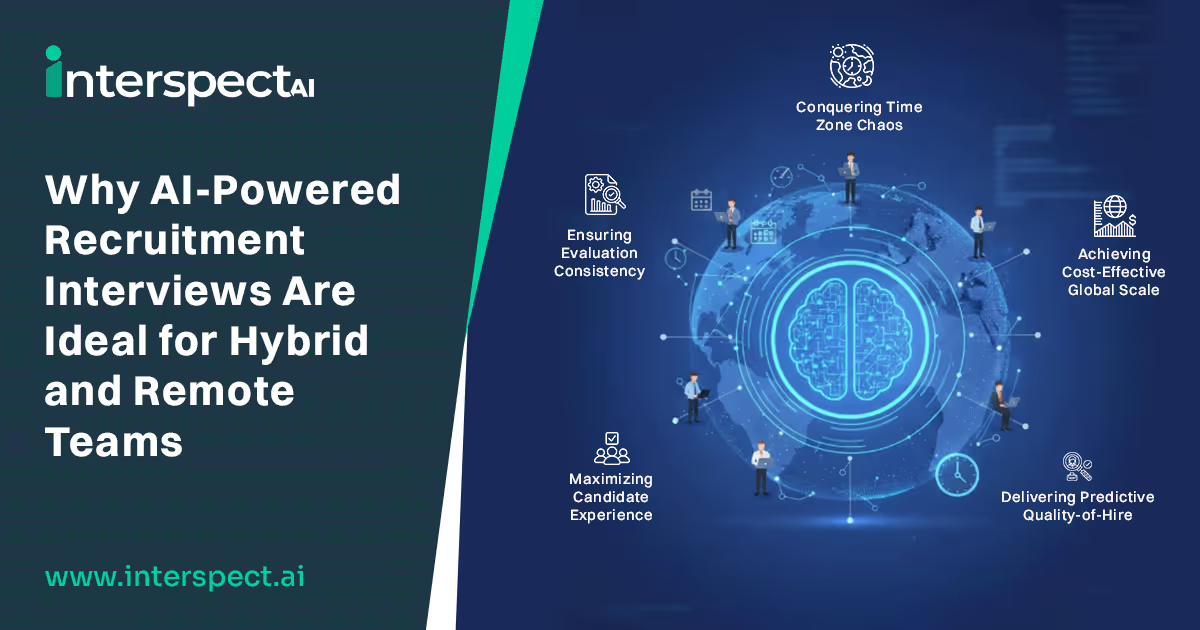
The modern shift to remote and hybrid work demands a new approach to talent acquisition. Traditional methods struggle with time zones, scheduling conflicts, and maintaining consistent evaluation standards across decentralized teams. AI-Powered Recruitment Interviews are the answer, providing the standardization, scalability, and objective data collection needed to hire high-quality talent anywhere in the world.
5 Ways AI Interviews Drive Remote Hiring Success
1. Conquering Time Zone Chaos (Boosting Time-to-Hire)
In traditional remote hiring, scheduling involves complex, manual coordination across continents, a bottleneck that significantly increases the Time-to-Hire (TTH). Automated candidate interviews solve this by offering true 24/7 access. This means a candidate in Tokyo can complete their screening at 2 AM their time, and the recruiter in London can review the objectively scored data during their standard workday. This asynchronous efficiency eliminates the delay caused by logistical friction, allowing hiring managers to move qualified candidates forward instantly and to secure global talent faster.
2. Ensuring Evaluation Consistency (Fostering Fairness)
Decentralized teams often struggle to maintain interview standards, where variations in interviewers' questions or biases can lead to unfair or inconsistent hiring decisions, harming the Bias Reduction Index. AI Candidate Evaluation Tools guarantee uniformity. Every candidate, regardless of their location or the time they interview, is subjected to the same standardized questions and scored against the same rubric. This removes the variable of human inconsistency, ensuring a consistently fair process that focuses purely on objective, job-relevant competencies like Role Alignment.
3. Maximizing Candidate Experience (Boosting CSAT)
For candidates, a drawn-out, fragmented remote hiring process is frustrating and can severely lower the Candidate Satisfaction Score (CSAT). AI-Powered Recruitment Interviews provide a seamless, reliable, and fast experience. The ability to complete the first screening immediately is a major convenience benefit. Furthermore, many AI systems provide candidates with personalized, actionable feedback (like a Skills Breakdown), which turns the interview into a valuable growth opportunity, fostering a positive view of the company even for those who are not hired.
4. Delivering Predictive Quality-of-Hire (QoH)
Traditional remote interviews can struggle to assess soft skills and behavioral fit accurately. AI transcends this by providing deep, objective behavioral analysis. By assessing communication patterns and consistency, AI makes data-driven predictions about a candidate's future performance and cultural fit, directly increasing your Quality-of-Hire (QoH). Metrics like the Overall Candidate Fit and Authenticity Score quantify fit with far greater precision than subjective human judgment, ensuring the remote hire is set up for long-term success in a distributed team environment.
5. Achieving Cost-Effective Global Scale (Lowering CPH)
Scaling a global remote recruiting effort using human recruiters is expensive due to increased labor hours for coordination and screening. By automating the most time-intensive tasks like screening, scheduling, and basic evaluation, AI-Powered Recruitment Interviews reduce the number of recruiter hours required per hire. This automation functions as a scalable infrastructure, enabling companies to expand their talent search globally without proportionally increasing their internal recruitment team size, resulting in a dramatic reduction in Cost-per-Hire (CPH).
SpectraHire: Quantifying Fit for Follow-Ups
To master candidate follow-up, recruiters need specific, granular data to make communication meaningful. SpectraHire is an agentic AI platform that provides this exact level of quantification, helping recruiters move beyond subjective impressions to objective, measurable metrics:
- Overall Candidate Fit: Provides a holistic score, evaluating an applicant's strengths, gaps, and next suggested steps. This ensures follow-up is relevant, whether the candidate is being advanced or pipelined.
- Role Alignment Score: Precisely checks how a candidate’s experience directly matches the Job Description requirements (critical for automated decision-making).
- Authenticity Score: Evaluates the genuineness in responses through the use of personal examples, ensuring honest candidate insight.
- Communication Skills/Confidence: Assesses clarity of explanations, including pacing, which are core indicators of effectiveness.
- Technical Proficiency: Assesses competency in technical interview rounds.
By leveraging these quantified insights, recruiters are armed with a much higher signal-to-noise ratio, ensuring automated follow-up is personalized and accurate, and that only the most qualified candidates move forward.
Conclusion
The "black hole" of recruitment is a choice, not a necessity. By deploying AI Agents to manage the entire spectrum of candidate follow-up—from instant acknowledgment to personalized feedback and future nurturing—companies demonstrate respect for every applicant. Recruiters leverage data provided by platforms like SpectraHire to quantify complex metrics such as Overall Candidate Fit and Authenticity Score. This investment proves that modern AI Candidate Evaluation Tools are not just an efficiency play; they are a strategic move to secure the highest quality talent faster, fairer, and cheaper than ever before, ensuring that even rejected applicants become advocates for the company.
Start hiring smarter. Request a SpectraHire demo today.
FAQs
How does AI for recruitment interviews ensure a fairer process?
AI ensures fairness by applying a standardized scoring rubric to every candidate, eliminating human unconscious biases. It focuses purely on objective metrics like Role Alignment to provide a transparent assessment based on required competencies.
Is Quality-of-Hire (QoH) measured solely by the AI tool?
No. AI improves the predictive aspect of QoH by analyzing communication and behavioral fit, providing metrics like the Overall Candidate Fit score, which strongly correlates with post-hire success. QoH is an organizational metric measured after the hire.
What is the main difference between an AI screening interview and an automated candidate interview?
AI screening is focused on early funnel filtering (e.g., basic qualification questions). An automated interview can be a more comprehensive assessment, including scenario-based questions to measure Technical Proficiency or providing a full Skills Breakdown report.
Can small and medium-sized businesses (SMBs) afford to use these AI recruitment tools?
Yes. The efficiency gains in Time-to-Hire and Cost-per-Hire often result in a rapid ROI, making the investment worthwhile for SMBs. Scalable AI for recruitment interview solutions is available for businesses of all sizes.


The modern shift to remote and hybrid work demands a new approach to talent acquisition. Traditional methods struggle with time zones, scheduling conflicts, and maintaining consistent evaluation standards across decentralized teams. AI-Powered Recruitment Interviews are the answer, providing the standardization, scalability, and objective data collection needed to hire high-quality talent anywhere in the world.
5 Ways AI Interviews Drive Remote Hiring Success
1. Conquering Time Zone Chaos (Boosting Time-to-Hire)
In traditional remote hiring, scheduling involves complex, manual coordination across continents, a bottleneck that significantly increases the Time-to-Hire (TTH). Automated candidate interviews solve this by offering true 24/7 access. This means a candidate in Tokyo can complete their screening at 2 AM their time, and the recruiter in London can review the objectively scored data during their standard workday. This asynchronous efficiency eliminates the delay caused by logistical friction, allowing hiring managers to move qualified candidates forward instantly and to secure global talent faster.
2. Ensuring Evaluation Consistency (Fostering Fairness)
Decentralized teams often struggle to maintain interview standards, where variations in interviewers' questions or biases can lead to unfair or inconsistent hiring decisions, harming the Bias Reduction Index. AI Candidate Evaluation Tools guarantee uniformity. Every candidate, regardless of their location or the time they interview, is subjected to the same standardized questions and scored against the same rubric. This removes the variable of human inconsistency, ensuring a consistently fair process that focuses purely on objective, job-relevant competencies like Role Alignment.
3. Maximizing Candidate Experience (Boosting CSAT)
For candidates, a drawn-out, fragmented remote hiring process is frustrating and can severely lower the Candidate Satisfaction Score (CSAT). AI-Powered Recruitment Interviews provide a seamless, reliable, and fast experience. The ability to complete the first screening immediately is a major convenience benefit. Furthermore, many AI systems provide candidates with personalized, actionable feedback (like a Skills Breakdown), which turns the interview into a valuable growth opportunity, fostering a positive view of the company even for those who are not hired.
4. Delivering Predictive Quality-of-Hire (QoH)
Traditional remote interviews can struggle to assess soft skills and behavioral fit accurately. AI transcends this by providing deep, objective behavioral analysis. By assessing communication patterns and consistency, AI makes data-driven predictions about a candidate's future performance and cultural fit, directly increasing your Quality-of-Hire (QoH). Metrics like the Overall Candidate Fit and Authenticity Score quantify fit with far greater precision than subjective human judgment, ensuring the remote hire is set up for long-term success in a distributed team environment.
5. Achieving Cost-Effective Global Scale (Lowering CPH)
Scaling a global remote recruiting effort using human recruiters is expensive due to increased labor hours for coordination and screening. By automating the most time-intensive tasks like screening, scheduling, and basic evaluation, AI-Powered Recruitment Interviews reduce the number of recruiter hours required per hire. This automation functions as a scalable infrastructure, enabling companies to expand their talent search globally without proportionally increasing their internal recruitment team size, resulting in a dramatic reduction in Cost-per-Hire (CPH).
SpectraHire: Quantifying Fit for Follow-Ups
To master candidate follow-up, recruiters need specific, granular data to make communication meaningful. SpectraHire is an agentic AI platform that provides this exact level of quantification, helping recruiters move beyond subjective impressions to objective, measurable metrics:
- Overall Candidate Fit: Provides a holistic score, evaluating an applicant's strengths, gaps, and next suggested steps. This ensures follow-up is relevant, whether the candidate is being advanced or pipelined.
- Role Alignment Score: Precisely checks how a candidate’s experience directly matches the Job Description requirements (critical for automated decision-making).
- Authenticity Score: Evaluates the genuineness in responses through the use of personal examples, ensuring honest candidate insight.
- Communication Skills/Confidence: Assesses clarity of explanations, including pacing, which are core indicators of effectiveness.
- Technical Proficiency: Assesses competency in technical interview rounds.
By leveraging these quantified insights, recruiters are armed with a much higher signal-to-noise ratio, ensuring automated follow-up is personalized and accurate, and that only the most qualified candidates move forward.
Conclusion
The "black hole" of recruitment is a choice, not a necessity. By deploying AI Agents to manage the entire spectrum of candidate follow-up—from instant acknowledgment to personalized feedback and future nurturing—companies demonstrate respect for every applicant. Recruiters leverage data provided by platforms like SpectraHire to quantify complex metrics such as Overall Candidate Fit and Authenticity Score. This investment proves that modern AI Candidate Evaluation Tools are not just an efficiency play; they are a strategic move to secure the highest quality talent faster, fairer, and cheaper than ever before, ensuring that even rejected applicants become advocates for the company.
Start hiring smarter. Request a SpectraHire demo today.
FAQs
How does AI for recruitment interviews ensure a fairer process?
AI ensures fairness by applying a standardized scoring rubric to every candidate, eliminating human unconscious biases. It focuses purely on objective metrics like Role Alignment to provide a transparent assessment based on required competencies.
Is Quality-of-Hire (QoH) measured solely by the AI tool?
No. AI improves the predictive aspect of QoH by analyzing communication and behavioral fit, providing metrics like the Overall Candidate Fit score, which strongly correlates with post-hire success. QoH is an organizational metric measured after the hire.
What is the main difference between an AI screening interview and an automated candidate interview?
AI screening is focused on early funnel filtering (e.g., basic qualification questions). An automated interview can be a more comprehensive assessment, including scenario-based questions to measure Technical Proficiency or providing a full Skills Breakdown report.
Can small and medium-sized businesses (SMBs) afford to use these AI recruitment tools?
Yes. The efficiency gains in Time-to-Hire and Cost-per-Hire often result in a rapid ROI, making the investment worthwhile for SMBs. Scalable AI for recruitment interview solutions is available for businesses of all sizes.

The modern recruitment environment demands that hiring teams move beyond subjective judgments to a data-driven strategy. AI candidate evaluation tools, which handle everything from AI screening interviews to behavioral analysis, now provide the precise data necessary to measure operational efficiency and prove ROI. For recruiters aiming to secure top talent quickly and effectively, mastering these metrics is essential.
Here are the 7 crucial Key Performance Indicators (KPIs) you can track and improve using advanced AI tools.
1. Time-to-Hire (TTH) Reduction
Time-to-Hire is arguably the most immediate and visible benefit of deploying automated candidate interviews. It measures the duration from a job opening’s approval to the final offer acceptance.
How AI Helps:
AI tools eliminate manual screening and scheduling time sinks. By conducting AI screening interviews 24/7, the platform objectively scores candidates and filters top performers faster, leading directly to a lower TTH and securing talent sooner.
2. Quality-of-Hire (QoH)
Quality-of-Hire is the gold standard, measuring the long-term success of a hire through performance reviews, retention rates, and contribution to company goals. It’s a notoriously hard metric to quantify, but AI makes it actionable.
How AI Helps:
AI candidate evaluation models are trained on high-performer data. During interviews, AI assesses both content and behavioral skills, identifying patterns in communication and cultural alignment that lead to more predictive and higher-quality hires.
SpectraHire in Action: Quantifying Candidate Quality
Platforms like SpectraHire utilize agentic AI to provide deep, actionable insights on candidate fit that directly map to Quality-of-Hire. These metrics move beyond basic keyword matching to quantify a candidate’s readiness and sincerity:
- Overall Candidate Fit: Evaluates an applicant's strengths, gaps, and next suggested steps, giving recruiters a holistic score.
- Role Alignment Score: Checks how precisely a candidate’s experience directly matches the Job Description requirements.
- Authenticity Score: Evaluates the genuineness in responses through the mention of personal examples, ensuring honest candidate insight.
- Communication Skills/Confidence: Assesses clarity of explanations, including pacing, which are core indicators of workplace effectiveness.
By leveraging this data, recruiters are armed with a much higher signal-to-noise ratio, ensuring only the most qualified candidates who are genuinely aligned with the role move forward.
Candidate Readiness with SpectraSeek
Candidates use SpectraSeek as their personal AI interview coach to prepare for these high-stakes screenings. By practicing and receiving immediate feedback on their ‘Overall Candidate Fit’ and ‘Communication Skills’, candidates ensure they walk into the interview process ready to highlight their best qualities and achieve the high scores recruiters value.
3. Interview-to-Offer Ratio (Conversion Rate)
This KPI tracks the efficiency of the human interview stage, the percentage of candidates interviewed by a human who eventually receives an offer. A high ratio indicates efficient screening, while a low ratio suggests wasted recruiter time.
How AI Helps:
The precision of AI screening interviews is the key. Because the AI pre-qualifies candidates based on objective criteria and competencies (including technical proficiency and experience areas), the human interview pool is highly vetted, dramatically increasing the downstream conversion rate.
4. Candidate Satisfaction Score (CSAT / NPS)
The Candidate Satisfaction Score, often measured by NPS (Net Promoter Score) is the candidate’s rating of their experience with the application and interview process. A negative experience damages the employer brand.
How AI Helps:
Recruitment tools offer convenience (24/7 interviews) and standardization, removing human bias. This consistent, fair process, along with detailed feedback on Interview Readiness and Skills Breakdown, improves the overall candidate experience and CSAT.
5. First-Year Attrition Rate (Retention)
This tracks the percentage of new hires who leave the company within their first year. High attrition is expensive and disruptive.
How AI Helps:
AI analyzes soft skills, personality, and motivation beyond the resume. By identifying candidates whose behavioral profile is a strong cultural match (reflected in Overall Candidate Fit and Authenticity Score), AI minimizes mismatch hires, leading to better long-term retention.
6. Bias Reduction Index (Fairness)
This is a critical metric measuring the degree of fairness and consistency in candidate assessment across demographic groups.
How AI Helps:
AI for recruitment interviews enforces standardization, applying the same rubric and eliminating the unconscious biases of human screeners. Focusing on objective data like Response Insights and Technical Proficiency scores ensures a fairer, auditable process.
7. Cost-per-Hire (CPH) Savings
The CPH is the total money spent (internal and external costs) to acquire a single successful hire. It’s the ultimate measure of recruitment spending efficiency.
How AI Helps:
By automating screening and scheduling, recruitment tools free up recruiters time for high-value tasks. This reduction in labor hours, combined with improved TTH and conversion rates, translates directly into significant savings, lowering the overall CPH.
Conclusion
The "black hole" of recruitment is a choice, not a necessity. By deploying AI Agents to manage the entire spectrum of candidate follow-up, from instant acknowledgment to personalized feedback and future nurturing, companies demonstrate respect for every applicant. Recruiters leverage data provided by platforms like SpectraHire to quantify complex metrics such as Overall Candidate Fit and Authenticity Score. This investment proves that modern AI Candidate Evaluation Tools are not just an efficiency play; they are a strategic move to secure the highest quality talent faster, fairer, and cheaper than ever before, ensuring that even rejected applicants become advocates for the company.
Start hiring smarter. Request a SpectraHire demo today.
FAQs
How does AI for recruitment interviews ensure a fairer process?
AI ensures fairness by applying a standardized scoring rubric to every candidate, eliminating human unconscious biases. It focuses purely on objective metrics like Role Alignment to provide a transparent assessment based on required competencies.
Is Quality-of-Hire (QoH) measured solely by the AI tool?
No. AI improves the predictive aspect of QoH by analyzing communication and behavioral fit, providing metrics like the Overall Candidate Fit score, which strongly correlates with post-hire success. QoH is an organizational metric measured after the hire.
What is the main difference between an AI screening interview and an automated candidate interview?
AI screening is focused on early funnel filtering (e.g., basic qualification questions). An automated interview can be a more comprehensive assessment, including scenario-based questions to measure Technical Proficiency or providing a full Skills Breakdown report.
Can small and medium-sized businesses (SMBs) afford to use these AI recruitment tools?
Yes. The efficiency gains in Time-to-Hire and Cost-per-Hire often result in a rapid ROI, making the investment worthwhile for SMBs. Scalable AI for recruitment interview solutions are available for businesses of all sizes.
The modern recruitment environment demands that hiring teams move beyond subjective judgments to a data-driven strategy. AI candidate evaluation tools, which handle everything from AI screening interviews to behavioral analysis, now provide the precise data necessary to measure operational efficiency and prove ROI. For recruiters aiming to secure top talent quickly and effectively, mastering these metrics is essential.
Here are the 7 crucial Key Performance Indicators (KPIs) you can track and improve using advanced AI tools.
1. Time-to-Hire (TTH) Reduction
Time-to-Hire is arguably the most immediate and visible benefit of deploying automated candidate interviews. It measures the duration from a job opening’s approval to the final offer acceptance.
How AI Helps:
AI tools eliminate manual screening and scheduling time sinks. By conducting AI screening interviews 24/7, the platform objectively scores candidates and filters top performers faster, leading directly to a lower TTH and securing talent sooner.
2. Quality-of-Hire (QoH)
Quality-of-Hire is the gold standard, measuring the long-term success of a hire through performance reviews, retention rates, and contribution to company goals. It’s a notoriously hard metric to quantify, but AI makes it actionable.
How AI Helps:
AI candidate evaluation models are trained on high-performer data. During interviews, AI assesses both content and behavioral skills, identifying patterns in communication and cultural alignment that lead to more predictive and higher-quality hires.
SpectraHire in Action: Quantifying Candidate Quality
Platforms like SpectraHire utilize agentic AI to provide deep, actionable insights on candidate fit that directly map to Quality-of-Hire. These metrics move beyond basic keyword matching to quantify a candidate’s readiness and sincerity:
- Overall Candidate Fit: Evaluates an applicant's strengths, gaps, and next suggested steps, giving recruiters a holistic score.
- Role Alignment Score: Checks how precisely a candidate’s experience directly matches the Job Description requirements.
- Authenticity Score: Evaluates the genuineness in responses through the mention of personal examples, ensuring honest candidate insight.
- Communication Skills/Confidence: Assesses clarity of explanations, including pacing, which are core indicators of workplace effectiveness.
By leveraging this data, recruiters are armed with a much higher signal-to-noise ratio, ensuring only the most qualified candidates who are genuinely aligned with the role move forward.
Candidate Readiness with SpectraSeek
Candidates use SpectraSeek as their personal AI interview coach to prepare for these high-stakes screenings. By practicing and receiving immediate feedback on their ‘Overall Candidate Fit’ and ‘Communication Skills’, candidates ensure they walk into the interview process ready to highlight their best qualities and achieve the high scores recruiters value.
3. Interview-to-Offer Ratio (Conversion Rate)
This KPI tracks the efficiency of the human interview stage, the percentage of candidates interviewed by a human who eventually receives an offer. A high ratio indicates efficient screening, while a low ratio suggests wasted recruiter time.
How AI Helps:
The precision of AI screening interviews is the key. Because the AI pre-qualifies candidates based on objective criteria and competencies (including technical proficiency and experience areas), the human interview pool is highly vetted, dramatically increasing the downstream conversion rate.
4. Candidate Satisfaction Score (CSAT / NPS)
The Candidate Satisfaction Score, often measured by NPS (Net Promoter Score) is the candidate’s rating of their experience with the application and interview process. A negative experience damages the employer brand.
How AI Helps:
Recruitment tools offer convenience (24/7 interviews) and standardization, removing human bias. This consistent, fair process, along with detailed feedback on Interview Readiness and Skills Breakdown, improves the overall candidate experience and CSAT.
5. First-Year Attrition Rate (Retention)
This tracks the percentage of new hires who leave the company within their first year. High attrition is expensive and disruptive.
How AI Helps:
AI analyzes soft skills, personality, and motivation beyond the resume. By identifying candidates whose behavioral profile is a strong cultural match (reflected in Overall Candidate Fit and Authenticity Score), AI minimizes mismatch hires, leading to better long-term retention.
6. Bias Reduction Index (Fairness)
This is a critical metric measuring the degree of fairness and consistency in candidate assessment across demographic groups.
How AI Helps:
AI for recruitment interviews enforces standardization, applying the same rubric and eliminating the unconscious biases of human screeners. Focusing on objective data like Response Insights and Technical Proficiency scores ensures a fairer, auditable process.
7. Cost-per-Hire (CPH) Savings
The CPH is the total money spent (internal and external costs) to acquire a single successful hire. It’s the ultimate measure of recruitment spending efficiency.
How AI Helps:
By automating screening and scheduling, recruitment tools free up recruiters time for high-value tasks. This reduction in labor hours, combined with improved TTH and conversion rates, translates directly into significant savings, lowering the overall CPH.
Conclusion
The "black hole" of recruitment is a choice, not a necessity. By deploying AI Agents to manage the entire spectrum of candidate follow-up, from instant acknowledgment to personalized feedback and future nurturing, companies demonstrate respect for every applicant. Recruiters leverage data provided by platforms like SpectraHire to quantify complex metrics such as Overall Candidate Fit and Authenticity Score. This investment proves that modern AI Candidate Evaluation Tools are not just an efficiency play; they are a strategic move to secure the highest quality talent faster, fairer, and cheaper than ever before, ensuring that even rejected applicants become advocates for the company.
Start hiring smarter. Request a SpectraHire demo today.
FAQs
How does AI for recruitment interviews ensure a fairer process?
AI ensures fairness by applying a standardized scoring rubric to every candidate, eliminating human unconscious biases. It focuses purely on objective metrics like Role Alignment to provide a transparent assessment based on required competencies.
Is Quality-of-Hire (QoH) measured solely by the AI tool?
No. AI improves the predictive aspect of QoH by analyzing communication and behavioral fit, providing metrics like the Overall Candidate Fit score, which strongly correlates with post-hire success. QoH is an organizational metric measured after the hire.
What is the main difference between an AI screening interview and an automated candidate interview?
AI screening is focused on early funnel filtering (e.g., basic qualification questions). An automated interview can be a more comprehensive assessment, including scenario-based questions to measure Technical Proficiency or providing a full Skills Breakdown report.
Can small and medium-sized businesses (SMBs) afford to use these AI recruitment tools?
Yes. The efficiency gains in Time-to-Hire and Cost-per-Hire often result in a rapid ROI, making the investment worthwhile for SMBs. Scalable AI for recruitment interview solutions are available for businesses of all sizes.

The hiring process is full of tiny moments that make or break candidate experience.
The “Thanks, we got your application!”
The “Here’s your interview link.”
The “We’ll update you by Friday.”
The “Hey, don’t forget the deadline.”
They seem small. But together, they define how candidates feel about your company.
And hiring teams know the truth - humans don’t always have the time to send all those messages. So follow-ups slip. Great candidates wait. And eventually… they fade away. Recruiters lose talent. The brand takes a hit.
That's why more and more teams are implementing AI agents for candidate follow-ups, as they are always-on, never-overwhelmed, process-obsessed helpers that keep every candidate informed, prepared, and reassured.
The 5 core follow-up flows AI agents run (and why each matters)
- Pre-Interview reminders - Short, specific reminders (time, links, device tips). These cut no-shows. They’re small, but they work. AI agents pick the best channel (SMS vs email) based on past candidate behavior.
- Real-time interview monitoring & immediate confirmations - When a candidate finishes an automated video interview, an AI agent can send an instant “thanks - we got it” plus timeline expectations. Immediate feedback reduces candidate anxiety and improves perceived fairness.
- Dynamic follow-up based on performance - If a candidate’s automated video interview flags a missing competency, the AI agent can follow up with a tailored micro-task (e.g., “Can you tell us briefly how you handled X?”). This keeps promising candidates engaged rather than losing them to long delays.
- Automated scheduling and rescheduling - When interviews need to be moved, AI agents coordinate calendars, propose slots, and close the loop - often without human intervention. This reduces back-and-forth and shortens time-to-hire.
- Post-process nurturing & closure - For applicants who aren't hired, AI agents deliver personalized closure messages, suggestions for other roles, or invitations to events. A thoughtful decline message preserves the relationship and future pipelines.
How AI agents make follow-ups feel human (yes, really)
People worry AI will feel robotic. The trick is to blend automation with human design.
- Micro-personalization - Use the candidate’s name, role applied for, and the exact step they completed. A line or two that references their interview question (e.g., “Loved your example about X”) goes a long way.
- Appropriate cadence - AI agents follow timing rules (e.g., immediate confirmation → 48-hour status update → weekly nurture). Too frequent = spam. Too rare = ghosting.
- Fallback to humans - Escalate when candidates ask complex questions or when sentiment analysis detects frustration. Good systems flag these for a recruiter.
- Tone templates - Keeps messages concise, warm, and transparent (“We expect feedback by Thursday, Nov 20”). Short sentences + human phrases outperform long corporate paragraphs.
FAQs
1. Will AI agents replace recruiters?
No. They free recruiters from repetitive tasks so humans can focus on relationship building, hard decisions, and interviewing.
2. Are follow-ups legal to automate?
Generally yes, but comply with consent and privacy laws (e.g., GDPR/CCPA). Keep data retention transparent.
3. How do AI agents handle candidate replies?
They can auto-respond to simple queries (status, next steps) and escalate complex ones to humans. Use intent detection to triage.
The hiring process is full of tiny moments that make or break candidate experience.
The “Thanks, we got your application!”
The “Here’s your interview link.”
The “We’ll update you by Friday.”
The “Hey, don’t forget the deadline.”
They seem small. But together, they define how candidates feel about your company.
And hiring teams know the truth - humans don’t always have the time to send all those messages. So follow-ups slip. Great candidates wait. And eventually… they fade away. Recruiters lose talent. The brand takes a hit.
That's why more and more teams are implementing AI agents for candidate follow-ups, as they are always-on, never-overwhelmed, process-obsessed helpers that keep every candidate informed, prepared, and reassured.
The 5 core follow-up flows AI agents run (and why each matters)
- Pre-Interview reminders - Short, specific reminders (time, links, device tips). These cut no-shows. They’re small, but they work. AI agents pick the best channel (SMS vs email) based on past candidate behavior.
- Real-time interview monitoring & immediate confirmations - When a candidate finishes an automated video interview, an AI agent can send an instant “thanks - we got it” plus timeline expectations. Immediate feedback reduces candidate anxiety and improves perceived fairness.
- Dynamic follow-up based on performance - If a candidate’s automated video interview flags a missing competency, the AI agent can follow up with a tailored micro-task (e.g., “Can you tell us briefly how you handled X?”). This keeps promising candidates engaged rather than losing them to long delays.
- Automated scheduling and rescheduling - When interviews need to be moved, AI agents coordinate calendars, propose slots, and close the loop - often without human intervention. This reduces back-and-forth and shortens time-to-hire.
- Post-process nurturing & closure - For applicants who aren't hired, AI agents deliver personalized closure messages, suggestions for other roles, or invitations to events. A thoughtful decline message preserves the relationship and future pipelines.
How AI agents make follow-ups feel human (yes, really)
People worry AI will feel robotic. The trick is to blend automation with human design.
- Micro-personalization - Use the candidate’s name, role applied for, and the exact step they completed. A line or two that references their interview question (e.g., “Loved your example about X”) goes a long way.
- Appropriate cadence - AI agents follow timing rules (e.g., immediate confirmation → 48-hour status update → weekly nurture). Too frequent = spam. Too rare = ghosting.
- Fallback to humans - Escalate when candidates ask complex questions or when sentiment analysis detects frustration. Good systems flag these for a recruiter.
- Tone templates - Keeps messages concise, warm, and transparent (“We expect feedback by Thursday, Nov 20”). Short sentences + human phrases outperform long corporate paragraphs.
FAQs
1. Will AI agents replace recruiters?
No. They free recruiters from repetitive tasks so humans can focus on relationship building, hard decisions, and interviewing.
2. Are follow-ups legal to automate?
Generally yes, but comply with consent and privacy laws (e.g., GDPR/CCPA). Keep data retention transparent.
3. How do AI agents handle candidate replies?
They can auto-respond to simple queries (status, next steps) and escalate complex ones to humans. Use intent detection to triage.
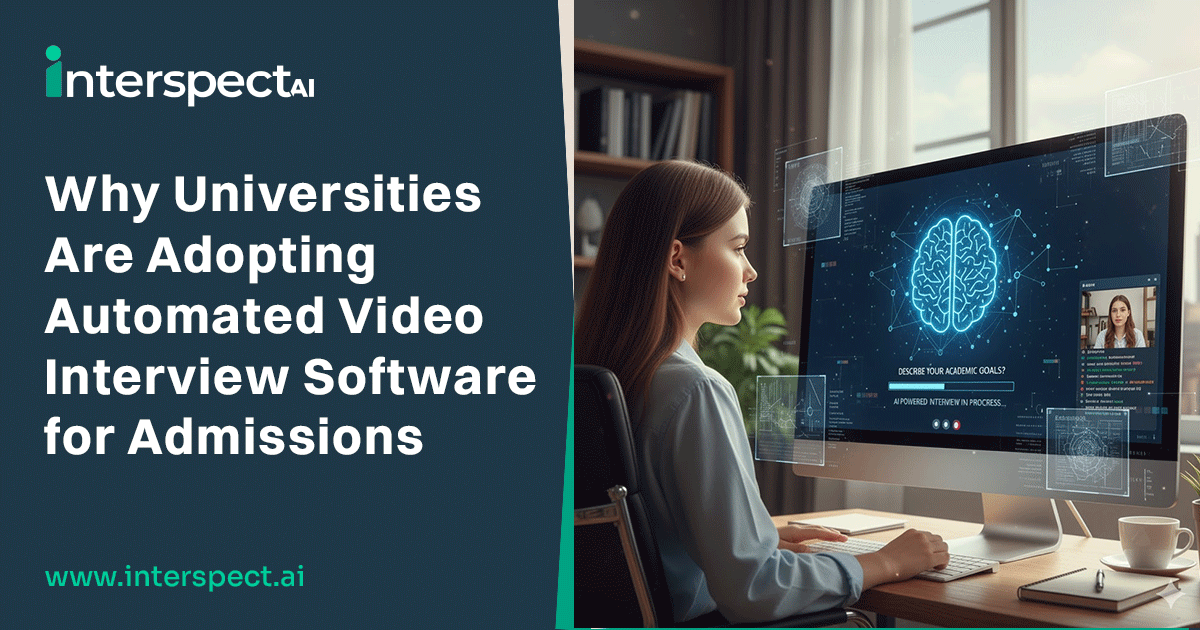
GPAs and essays used to be the whole story when it came to college admissions. Not anymore. Universities now want a clearer, more human look at who a student really is.
That’s why automated video interview software – tools that let students record answers to preset questions on video, analyzed by agentic AI – are gaining traction.
The global video interview software market (across all industries) was roughly $1.5 billion in 2023, with forecasts to reach about $4.9 billion by 2032 (a CAGR of ~12.5%).
That growth is fueled by universities and colleges adopting these digital solutions alongside corporations. North America (especially the U.S.) currently leads the market, reflecting its robust tech infrastructure, but Asia-Pacific (including India) is projected to grow fastest, driven by rapid digitization and expanding educational access.
In short, adopting automated video interviews puts universities in line with a rapidly growing global trend.
These platforms can streamline admissions by screening many applicants quickly, consistently and at scale, and promise to make admissions faster and fairer!
However, administrators still have questions: what exactly is this technology, how does it work, and why should a university consider it? Let’s address those first.
What is automated video interview software?
It’s a digital platform where applicants record video responses to predetermined questions. Unlike a live Zoom interview, there’s no interviewer on the other end. Often, these AI interview prep systems use AI to evaluate answers for communication, confidence and other traits.
How is it different from a live interview?
Candidates complete the video interviews on their own time, responding to questions by themselves. The software captures and timestamps of all answers.
It can also rank or pre-screen applicants using built-in analytics. This asynchronous approach means one interviewer can effectively assess hundreds of candidates’ videos later.
And it doesn’t even mean that the interviewer has to go through each and every video, as the AI will share summaries and auto-rank them.
Why are universities exploring this now?
Admissions offices face huge applicant volumes and tight resources, and asynchronous video interviews help “save time and costs for both universities and the students” compared to thousands of in-person interviews.
The COVID-19 pandemic further accelerated the shift, since in-person campus interviews became logistically challenging. In short, automated video tools let admissions teams screen large applicant pools quickly - a game-changer when every department is already stretched thin.
What are the key benefits of AI-powered automated video interviews for university admissions?
AI-powered video interviews allow admissions teams to connect with applicants remotely. Students can answer admission questions on camera from anywhere, and AI tools can analyze their responses.
This approach goes beyond essays by revealing applicants’ communication skills, confidence and personality in real time.
Speed and Scale
Hundreds of applicants can be screened in parallel, as these tools operate at a massive scale. Admissions officers can quickly filter large pools by reviewing key responses later, instead of scheduling one-on-one interviews with every candidate.
Data-Driven Insights
AI platforms record far more than a thumbs-up/thumbs-down. Advanced algorithms analyze each candidate’s tone, word choice and non-verbal cues to generate detailed scores on communication skills, empathy, and other soft traits.
Universities can use this data to identify top candidates aligned with their values (e.g. leadership or teamwork) and compare applicants objectively. Over time, the system “gets better with time by incorporating machine learning” based on which hires perform well, yielding continually improved decision support.
Consistency and Fairness
Human interviewers naturally vary in what they emphasize and may carry conscious or unconscious biases. Automated interviews use predetermined criteria and blind scoring to eliminate those inconsistencies.
They can be programmed into ignoring demographic factors like race, gender or background, helping ensure each applicant is evaluated on the same metrics.
As a result, universities can promote more equitable admissions.
Enhanced Candidate Experience
For students, recorded interviews are more convenient. Applicants can do them on their own schedule, eliminating travel or time-zone hurdles.
This flexibility lets prospective students showcase themselves at their best - good lighting, a comfortable environment - and can reduce anxiety compared to a one-off live call.
Cost Reduction
Traditional interviews require significant staff time or external recruiting partners. By automating initial screenings, universities reduce the labor costs of admissions interviews.
Fewer panels and fewer campus visits means savings for both the institution and students – a point emphasized by admissions leaders during the pandemic..
These combined benefits explain why university administrators – grappling with record application numbers are eager to try automated video interviewing as a supplement (not a replacement) to their admissions toolkit.
What does implementation look like in practice?
In practice, integrating automated video interviews into admissions typically works like this:
- Question Setup: Admissions staff create a set of questions (e.g. “Why do you want to attend X University?” or problem-solving prompts). The questions are usually timed and cannot be skipped.
- Candidate Response: Applicants login to the system (often via a web link) and record answers on video. They may have a brief prep time before each question and a fixed time to respond.
- AI Analysis & Review: The software automatically scores or flags responses based on defined rubrics. It might score fluency, enthusiasm or specific keywords. These results, along with the recorded clips, are then made available to admissions reviewers. Staff can watch top candidates, compare performance metrics side-by-side, and manually short-list the best fits.
- Follow-up: Selected applicants may then be invited to live interviews or move on in the process. The key is that the automated video stage filters the applicant pool efficiently.
The AI provides standardized scoring and insights, but admission officers still make the final decision. The blend of technology and human judgment can help teams focus their time on the most promising students rather than repetitive screening tasks.
What should universities consider before adopting AI-powered interview agents?
Despite the advantages, administrators should be mindful of potential pitfalls. The main concerns include:
- Algorithmic Bias: If not carefully managed, AI models can inadvertently reflect biases in their training data (for example, favoring certain accents or speech patterns). Experts warn that if historical hiring or admissions data contained biases, the AI might perpetuate them. Responsible vendors now employ audits and bias-detection techniques, and many universities pair AI scoring with human oversight to guard against unfairness.
- Data Privacy and Security: Video interviews capture personal data (video, audio, facial expressions). Universities must ensure any platform complies with privacy laws and securely stores interviews. This means vetting vendors for strong encryption and data protection certifications.
- Accessibility and Equity: Not all students have equal access to quality recording setups or stable internet. Schools need to offer support (like on-campus kiosks or extended deadlines) so that students from all backgrounds can participate on equal footing.
- User Experience: For success, the software must be easy and stable. Clunky platforms or frequent technical glitches would frustrate applicants and staff alike. Many institutions pilot-test new tools on small groups to work out kinks before a full rollout.
In short, automated video interviews are a powerful tool when used thoughtfully. They require clear communication with applicants (“Here’s how it works”), careful platform choice, and ongoing monitoring to ensure fair use.
FAQs
1. Is an automated interview a replacement for an in-person interview?
Generally no. Most universities use automated video interviews as an initial screening or supplement – not to fully replace human interaction. After AI screening, top candidates might still have live interviews (online or on campus). The AI step just helps narrow the field efficiently.
2. How should applicants prepare?
Advise students to find a quiet space, check their camera and microphone, and practice answers to common questions beforehand.
They should speak clearly, keep answers concise, and maintain friendly eye contact (looking at the camera). Since automated systems may analyze nonverbal cues, a confident, natural presentation is helpful.
3. Can AI interviews really assess “soft skills”?
To some extent, yes. AI can evaluate elements like verbal fluency, positive tone, and even facial expressions. Many systems claim to gauge professionalism or empathy.
However, these are still proxies – AI is best used to highlight trends (e.g. “this candidate speaks very clearly and remains composed”) rather than as absolute judgments. Final decisions should consider AI feedback as one piece of the puzzle.
4. What if a student has limited internet or tech skills?
Universities should provide alternatives, such as allowing a live video option or in-person completion, to accommodate those who can’t record at home.
Flexibility is key - the goal is to evaluate talent, not test tech wizardry. Clear instructions and support can help mitigate access issues.
5. Does this reduce applicant diversity?
It can actually increase diversity if done right. For example, by enabling candidates from distant regions or with tight schedules to interview (without travel), universities open doors to more applicants.
Because AI scoring is (ideally) blind to background, it can help focus on merit. But institutions must still ensure bias safeguards to truly see a broader, fairer pool.
GPAs and essays used to be the whole story when it came to college admissions. Not anymore. Universities now want a clearer, more human look at who a student really is.
That’s why automated video interview software – tools that let students record answers to preset questions on video, analyzed by agentic AI – are gaining traction.
The global video interview software market (across all industries) was roughly $1.5 billion in 2023, with forecasts to reach about $4.9 billion by 2032 (a CAGR of ~12.5%).
That growth is fueled by universities and colleges adopting these digital solutions alongside corporations. North America (especially the U.S.) currently leads the market, reflecting its robust tech infrastructure, but Asia-Pacific (including India) is projected to grow fastest, driven by rapid digitization and expanding educational access.
In short, adopting automated video interviews puts universities in line with a rapidly growing global trend.
These platforms can streamline admissions by screening many applicants quickly, consistently and at scale, and promise to make admissions faster and fairer!
However, administrators still have questions: what exactly is this technology, how does it work, and why should a university consider it? Let’s address those first.
What is automated video interview software?
It’s a digital platform where applicants record video responses to predetermined questions. Unlike a live Zoom interview, there’s no interviewer on the other end. Often, these AI interview prep systems use AI to evaluate answers for communication, confidence and other traits.
How is it different from a live interview?
Candidates complete the video interviews on their own time, responding to questions by themselves. The software captures and timestamps of all answers.
It can also rank or pre-screen applicants using built-in analytics. This asynchronous approach means one interviewer can effectively assess hundreds of candidates’ videos later.
And it doesn’t even mean that the interviewer has to go through each and every video, as the AI will share summaries and auto-rank them.
Why are universities exploring this now?
Admissions offices face huge applicant volumes and tight resources, and asynchronous video interviews help “save time and costs for both universities and the students” compared to thousands of in-person interviews.
The COVID-19 pandemic further accelerated the shift, since in-person campus interviews became logistically challenging. In short, automated video tools let admissions teams screen large applicant pools quickly - a game-changer when every department is already stretched thin.
What are the key benefits of AI-powered automated video interviews for university admissions?
AI-powered video interviews allow admissions teams to connect with applicants remotely. Students can answer admission questions on camera from anywhere, and AI tools can analyze their responses.
This approach goes beyond essays by revealing applicants’ communication skills, confidence and personality in real time.
Speed and Scale
Hundreds of applicants can be screened in parallel, as these tools operate at a massive scale. Admissions officers can quickly filter large pools by reviewing key responses later, instead of scheduling one-on-one interviews with every candidate.
Data-Driven Insights
AI platforms record far more than a thumbs-up/thumbs-down. Advanced algorithms analyze each candidate’s tone, word choice and non-verbal cues to generate detailed scores on communication skills, empathy, and other soft traits.
Universities can use this data to identify top candidates aligned with their values (e.g. leadership or teamwork) and compare applicants objectively. Over time, the system “gets better with time by incorporating machine learning” based on which hires perform well, yielding continually improved decision support.
Consistency and Fairness
Human interviewers naturally vary in what they emphasize and may carry conscious or unconscious biases. Automated interviews use predetermined criteria and blind scoring to eliminate those inconsistencies.
They can be programmed into ignoring demographic factors like race, gender or background, helping ensure each applicant is evaluated on the same metrics.
As a result, universities can promote more equitable admissions.
Enhanced Candidate Experience
For students, recorded interviews are more convenient. Applicants can do them on their own schedule, eliminating travel or time-zone hurdles.
This flexibility lets prospective students showcase themselves at their best - good lighting, a comfortable environment - and can reduce anxiety compared to a one-off live call.
Cost Reduction
Traditional interviews require significant staff time or external recruiting partners. By automating initial screenings, universities reduce the labor costs of admissions interviews.
Fewer panels and fewer campus visits means savings for both the institution and students – a point emphasized by admissions leaders during the pandemic..
These combined benefits explain why university administrators – grappling with record application numbers are eager to try automated video interviewing as a supplement (not a replacement) to their admissions toolkit.
What does implementation look like in practice?
In practice, integrating automated video interviews into admissions typically works like this:
- Question Setup: Admissions staff create a set of questions (e.g. “Why do you want to attend X University?” or problem-solving prompts). The questions are usually timed and cannot be skipped.
- Candidate Response: Applicants login to the system (often via a web link) and record answers on video. They may have a brief prep time before each question and a fixed time to respond.
- AI Analysis & Review: The software automatically scores or flags responses based on defined rubrics. It might score fluency, enthusiasm or specific keywords. These results, along with the recorded clips, are then made available to admissions reviewers. Staff can watch top candidates, compare performance metrics side-by-side, and manually short-list the best fits.
- Follow-up: Selected applicants may then be invited to live interviews or move on in the process. The key is that the automated video stage filters the applicant pool efficiently.
The AI provides standardized scoring and insights, but admission officers still make the final decision. The blend of technology and human judgment can help teams focus their time on the most promising students rather than repetitive screening tasks.
What should universities consider before adopting AI-powered interview agents?
Despite the advantages, administrators should be mindful of potential pitfalls. The main concerns include:
- Algorithmic Bias: If not carefully managed, AI models can inadvertently reflect biases in their training data (for example, favoring certain accents or speech patterns). Experts warn that if historical hiring or admissions data contained biases, the AI might perpetuate them. Responsible vendors now employ audits and bias-detection techniques, and many universities pair AI scoring with human oversight to guard against unfairness.
- Data Privacy and Security: Video interviews capture personal data (video, audio, facial expressions). Universities must ensure any platform complies with privacy laws and securely stores interviews. This means vetting vendors for strong encryption and data protection certifications.
- Accessibility and Equity: Not all students have equal access to quality recording setups or stable internet. Schools need to offer support (like on-campus kiosks or extended deadlines) so that students from all backgrounds can participate on equal footing.
- User Experience: For success, the software must be easy and stable. Clunky platforms or frequent technical glitches would frustrate applicants and staff alike. Many institutions pilot-test new tools on small groups to work out kinks before a full rollout.
In short, automated video interviews are a powerful tool when used thoughtfully. They require clear communication with applicants (“Here’s how it works”), careful platform choice, and ongoing monitoring to ensure fair use.
FAQs
1. Is an automated interview a replacement for an in-person interview?
Generally no. Most universities use automated video interviews as an initial screening or supplement – not to fully replace human interaction. After AI screening, top candidates might still have live interviews (online or on campus). The AI step just helps narrow the field efficiently.
2. How should applicants prepare?
Advise students to find a quiet space, check their camera and microphone, and practice answers to common questions beforehand.
They should speak clearly, keep answers concise, and maintain friendly eye contact (looking at the camera). Since automated systems may analyze nonverbal cues, a confident, natural presentation is helpful.
3. Can AI interviews really assess “soft skills”?
To some extent, yes. AI can evaluate elements like verbal fluency, positive tone, and even facial expressions. Many systems claim to gauge professionalism or empathy.
However, these are still proxies – AI is best used to highlight trends (e.g. “this candidate speaks very clearly and remains composed”) rather than as absolute judgments. Final decisions should consider AI feedback as one piece of the puzzle.
4. What if a student has limited internet or tech skills?
Universities should provide alternatives, such as allowing a live video option or in-person completion, to accommodate those who can’t record at home.
Flexibility is key - the goal is to evaluate talent, not test tech wizardry. Clear instructions and support can help mitigate access issues.
5. Does this reduce applicant diversity?
It can actually increase diversity if done right. For example, by enabling candidates from distant regions or with tight schedules to interview (without travel), universities open doors to more applicants.
Because AI scoring is (ideally) blind to background, it can help focus on merit. But institutions must still ensure bias safeguards to truly see a broader, fairer pool.
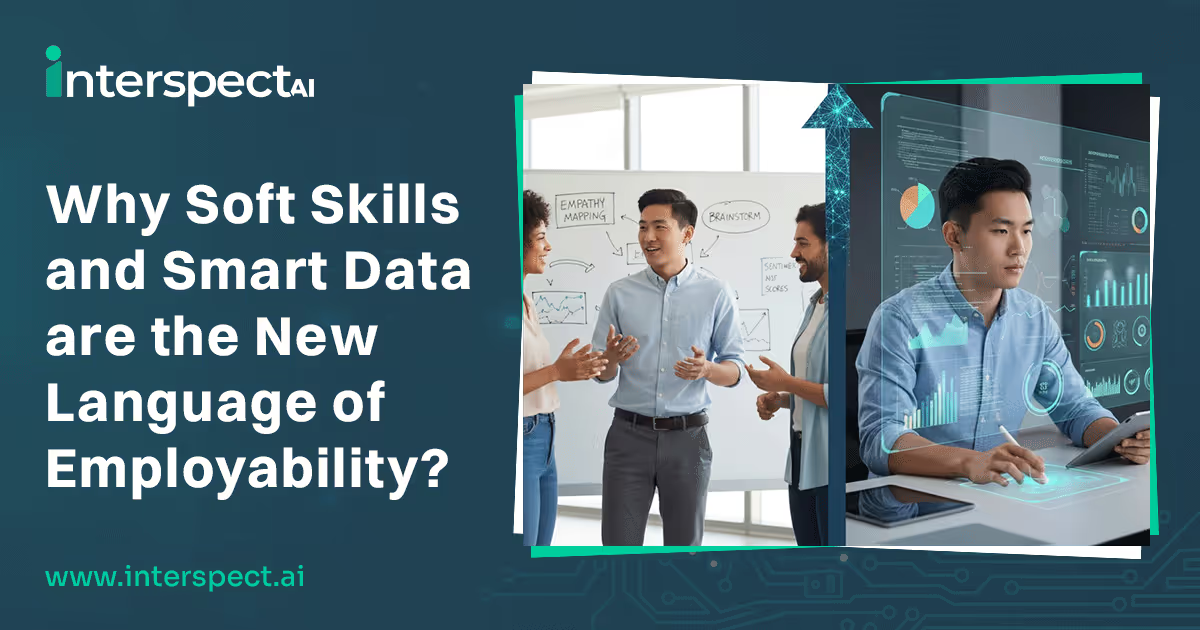
The modern job market demands professionals fluent in two languages: high-value human interaction and objective data. As automation and AI handle routine and technical tasks, the capabilities that remain uniquely human like creativity, emotional intelligence, and critical thinking have become the most strategically important.
This shift creates a Dual Fluency model. Success requires mastery of soft skills in employability paired with the capacity to interpret and leverage complex information, a competency we call Smart Data fluency.
The Soft Skills Stack: The New Mandate for Human Excellence
Soft skills are no longer "nice-to-haves"; they are core drivers of organizational success and failure. Communication and collaboration deficits, for example, are cited by 86% of employees and executives as the main cause of workplace failure. Conversely, teams that communicate effectively can increase productivity by up to 25%.
Employers consistently rank specific soft skills as mandatory for new hires:
The strategic mandate is clear: soft skills mitigate operational risk and generate measurable ROI.
Smart Data Fluency: Quantifying Human Value
Smart Data Fluency is the essential partner to soft skills. It requires professionals to rigorously challenge automated outputs and translate complex findings into actionable business language. This competency is highly valued: job postings mentioning AI have increased by 100% over last year alone, resulting in a substantial 56% wage premium for workers with AI-related skills.
The revolutionary element is that AI-powered coaching can now translate previously subjective soft skills into objective, coachable insights.
AI’s Role in Data-Driven Soft Skill Assessment
Advanced platforms use multimodal analysis to quantify communication and emotional skills in real-time, moving assessment beyond the content of the answer:
SpectraSeek: Bridging the Gap with Quantifiable Insights
SpectraSeek is at the forefront of translating soft skills into smart data. Built on proprietary agentic AI, it functions as an LLM-powered decision engine, delivering verifiable, high-precision behavioral assessments. This objective data allows for targeted skill growth:
- Personalized Feedback: The system provides individualized feedback on vocal tone and coherence. Crucially, this coaching is customized to the user’s specific goals; 96% of users report that the AI responses were tailored to their context, eliminating generic advice.
- Soft Skill Amplification: AI actively helps human communication. 73% of knowledge workers report that generative AI tools help them actively avoid miscommunication at work, systematizing clarity and structure so human advisors can focus on strategic interpretation and emotional buy-in.
- Data-Driven Curriculum: For institutions, aggregated student development analytics identify cohort-wide soft-skill gaps (e.g., low confidence scores). This allows universities to refine curriculum and allocate resources based on the specific, objective competencies that the labor market demands.
The Imperative for Dual Fluency
Employability success is no longer a matter of singular proficiency. It demands Dual Fluency: the soft skills to lead and collaborate, and the Smart Data literacy to interpret and apply the results of the modern workplace. By investing in digital career tools that quantify the human layer of performance, institutions and individuals ensure they are not just knowledgeable, but verifiably ready to create strategic value in the automation economy.
Ready to Master the New Language of Employability?
The future of career readiness requires blending human insight with objective performance data. SpectraSeek is the platform that delivers this necessary analysis, translating soft skills into quantifiable metrics for accelerated mastery. Ready to move beyond subjective training and start measuring true competence? Discover how our agentic AI can transform your student development analytics.
Frequently Asked Questions
Q: Why are soft skills now considered mandatory for employability?
A: Hard skills are increasingly automated, making human skills (emotional intelligence, critical thinking, and communication) the most valuable. Failures in soft skills are major organizational cost drivers, cited by 86% of executives as the cause of workplace failures.
Q: How does AI quantify subjective soft skills like tone?
A: AI-powered coaching uses Real-Time Voice Analysis (RVA) and Natural Language Processing (NLP) to objectively measure vocal pitch, pace, and tone. Sentiment scoring can even assign numerical values (e.g., -3 to +3) to emotional context.
Q: How does SpectraSeek help students achieve Smart Data fluency?
A: SpectraSeek provides objective communication skills analytics on performance. Students learn to refine their output based on data points the AI hiring systems actually score, internalizing the metrics that govern the digital career tools used by employers.
Q: What is the economic advantage of combining soft skills with AI literacy?
A: The mastery of soft skills provides a foundational career advantage, while AI-related skills command a 56% wage premium. Professionals who master this Dual Fluency unlock the highest-value roles in the modern economy.
The modern job market demands professionals fluent in two languages: high-value human interaction and objective data. As automation and AI handle routine and technical tasks, the capabilities that remain uniquely human like creativity, emotional intelligence, and critical thinking have become the most strategically important.
This shift creates a Dual Fluency model. Success requires mastery of soft skills in employability paired with the capacity to interpret and leverage complex information, a competency we call Smart Data fluency.
The Soft Skills Stack: The New Mandate for Human Excellence
Soft skills are no longer "nice-to-haves"; they are core drivers of organizational success and failure. Communication and collaboration deficits, for example, are cited by 86% of employees and executives as the main cause of workplace failure. Conversely, teams that communicate effectively can increase productivity by up to 25%.
Employers consistently rank specific soft skills as mandatory for new hires:
The strategic mandate is clear: soft skills mitigate operational risk and generate measurable ROI.
Smart Data Fluency: Quantifying Human Value
Smart Data Fluency is the essential partner to soft skills. It requires professionals to rigorously challenge automated outputs and translate complex findings into actionable business language. This competency is highly valued: job postings mentioning AI have increased by 100% over last year alone, resulting in a substantial 56% wage premium for workers with AI-related skills.
The revolutionary element is that AI-powered coaching can now translate previously subjective soft skills into objective, coachable insights.
AI’s Role in Data-Driven Soft Skill Assessment
Advanced platforms use multimodal analysis to quantify communication and emotional skills in real-time, moving assessment beyond the content of the answer:
SpectraSeek: Bridging the Gap with Quantifiable Insights
SpectraSeek is at the forefront of translating soft skills into smart data. Built on proprietary agentic AI, it functions as an LLM-powered decision engine, delivering verifiable, high-precision behavioral assessments. This objective data allows for targeted skill growth:
- Personalized Feedback: The system provides individualized feedback on vocal tone and coherence. Crucially, this coaching is customized to the user’s specific goals; 96% of users report that the AI responses were tailored to their context, eliminating generic advice.
- Soft Skill Amplification: AI actively helps human communication. 73% of knowledge workers report that generative AI tools help them actively avoid miscommunication at work, systematizing clarity and structure so human advisors can focus on strategic interpretation and emotional buy-in.
- Data-Driven Curriculum: For institutions, aggregated student development analytics identify cohort-wide soft-skill gaps (e.g., low confidence scores). This allows universities to refine curriculum and allocate resources based on the specific, objective competencies that the labor market demands.
The Imperative for Dual Fluency
Employability success is no longer a matter of singular proficiency. It demands Dual Fluency: the soft skills to lead and collaborate, and the Smart Data literacy to interpret and apply the results of the modern workplace. By investing in digital career tools that quantify the human layer of performance, institutions and individuals ensure they are not just knowledgeable, but verifiably ready to create strategic value in the automation economy.
Ready to Master the New Language of Employability?
The future of career readiness requires blending human insight with objective performance data. SpectraSeek is the platform that delivers this necessary analysis, translating soft skills into quantifiable metrics for accelerated mastery. Ready to move beyond subjective training and start measuring true competence? Discover how our agentic AI can transform your student development analytics.
Frequently Asked Questions
Q: Why are soft skills now considered mandatory for employability?
A: Hard skills are increasingly automated, making human skills (emotional intelligence, critical thinking, and communication) the most valuable. Failures in soft skills are major organizational cost drivers, cited by 86% of executives as the cause of workplace failures.
Q: How does AI quantify subjective soft skills like tone?
A: AI-powered coaching uses Real-Time Voice Analysis (RVA) and Natural Language Processing (NLP) to objectively measure vocal pitch, pace, and tone. Sentiment scoring can even assign numerical values (e.g., -3 to +3) to emotional context.
Q: How does SpectraSeek help students achieve Smart Data fluency?
A: SpectraSeek provides objective communication skills analytics on performance. Students learn to refine their output based on data points the AI hiring systems actually score, internalizing the metrics that govern the digital career tools used by employers.
Q: What is the economic advantage of combining soft skills with AI literacy?
A: The mastery of soft skills provides a foundational career advantage, while AI-related skills command a 56% wage premium. Professionals who master this Dual Fluency unlock the highest-value roles in the modern economy.
The shift from traditional, human-led interviews to automated video interviews (AVIs) is not a passing trend; it is the new standard for top employers. This structural change is driven by efficiency: virtual interviews are used in 82% of hiring processes globally, saving companies an average of 30% in costs.
The core challenge facing student interview prep is that AI acts as an objective, structured scorecard. Students prepared for human rapport are often penalized by the AI for technical or non-verbal errors they never knew were being measured, putting them at a competitive disadvantage.
I. The Algorithmic Gatekeeper: Decoding the AI Hiring Process
The machine interviewer is any automated tool—from asynchronous video platforms to AI-powered scoring systems used during the hiring process.
The widespread adoption is fueled by technology: 67% of employers currently use AI to manage their remote hiring processes. These systems bring consistency and scale, but students must understand how the machine scores them.
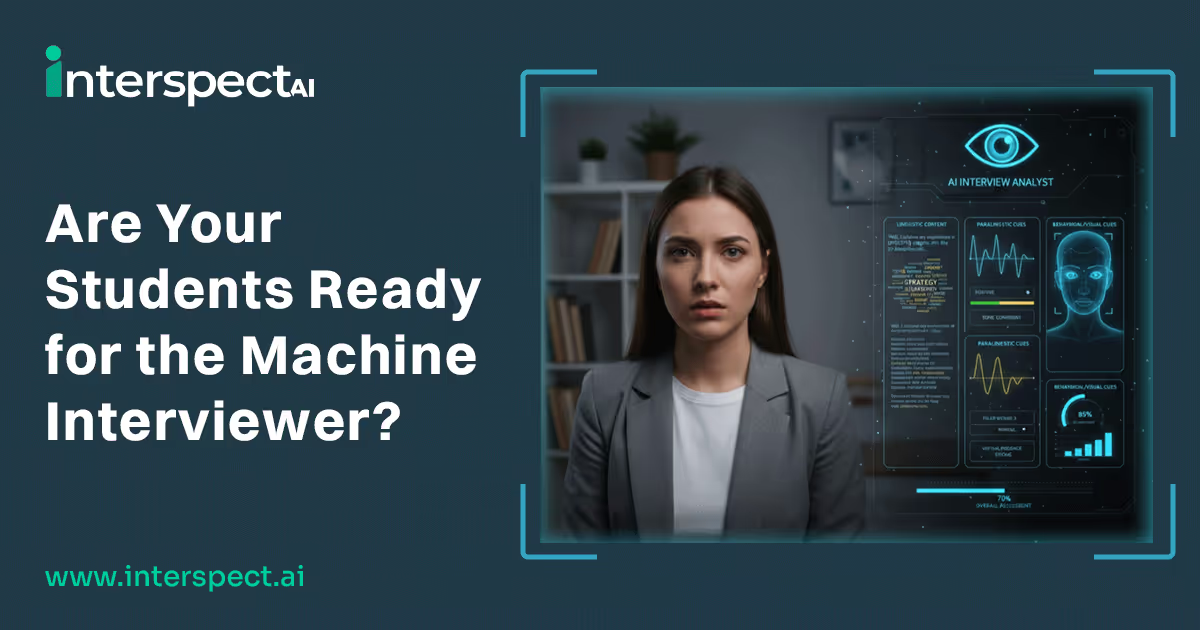
The Three Data Streams AI Analyzes
AI assessment systems rely on machine learning (ML) and natural language processing (NLP) to convert subjective performance into standardized, measurable signals:
- Linguistic Content: The AI transcribes speech and analyzes the response structure, use of industry keywords, and relevance to predefined job competencies.
- Paralinguistic Cues: This assesses the manner of speech, including tone, sentiment, and the frequency of filler words or hesitation.
- Behavioral/Visual Cues: For video interviews, the AI monitors non-verbal cues, eye contact (with the camera), and overall virtual presence.
For students, this makes technical delivery just as critical as content. A perfect answer delivered with excessive hesitation may receive a low score for 'confidence' or 'clarity,' regardless of the content's quality.
II. The Psychological Cost and Performance Drop-off
The non-human setting of the automated video interview creates a measurable performance drop-off for students.
- Anxiety and Rigidity: Candidates often report feeling depersonalized during AVIs, compelling them to adopt a rigid, unnatural behavioral style because they struggle to gauge the effectiveness of their responses.
- Performance Penalty: The stress of interviewing in an opaque setting is substantial. Research indicates that performance in stressful interview environments can drop by as much as 40%.
- This creates a detrimental cycle: lack of preparation increases stress, which leads to measurable flaws (like excessive filler words), which are then algorithmically penalized, lowering the final score. The only way to counter this is through high-fidelity, repeated interview simulation.
III. The Strategic Solution: Leveraging Digital Interview Tools
Universities can strategically help students prepare by integrating digital interview tools that normalize the process and provide instant, objective metric refinement.
SpectraSeek by InterspectAI is a leader in this field. Built on proprietary agentic AI, the platform acts as a powerful, hyper-realistic interview agent, providing continuous, 24/7 simulation practice.
Mastering the Algorithmic Scorecard
Preparation must shift from rote memorization to technical optimization:
- Optimize the Technical & Physical Environment: Students must confirm stable connectivity and optimize lighting and background. A clean visual area ensures the AI's video analysis software focuses entirely on the candidate, preventing scoring issues from glare or clutter.
- Focus on Virtual Presence: Candidates must practice maintaining direct eye contact with the camera lens (not the screen image), ensuring their voice is clear and confident, and using animation to project their personality.
- Refine Technical Metrics: Students must use the platform's feedback to practice minimizing negative predictors (filler words, hesitation) and maximizing positive ones (structure, clarity), which the AI specifically tracks. Curriculum alignment is key here; schools like the Villanova School of Business incorporate best practices for AI use into their professional development curriculum.
IV. The Institutional Imperative: Integrating AI Readiness
Integrating student interview prep technology is essential, as better-prepared graduates directly improve placement statistics.
- Mandatory Simulation: Career services must transition from occasional human-led mock interviews to scalable, mandatory AI simulation programs. Digital interview tools like Google's Interview Warmup and adaptive platforms like SpectraSeek provide the objective metrics and repetition needed to normalize the experience and reduce anxiety.
- Hybrid Coaching: The most effective model pairs AI-powered simulation (for scalable metrics) with human coaching. The human advisor’s role shifts from assessing content to interpreting the AI's feedback reports, helping students translate "low sentiment scores" into actionable physical and vocal adjustments.
Technical Mastery Leads to Authentic Performance
The automated video interviews used by major employers demand technical mastery of delivery mechanics. Success requires achieving authenticity by design—internalizing the technical requirements so completely, that students can deliver an optimized response while projecting genuine personality and confidence. By giving students access to sophisticated digital interview tools, institutions ensure the machine interviewer does not filter out their graduates but is instead technically optimized for success.
Ready to Optimize for the Machine?
The era of the automated video interview is here. Ensure your students are trained not just on what to say, but how the machine scores their delivery. SpectraSeek is the platform that provides the necessary technical optimization and personalized feedback for the modern AI hiring process. Discover how our agentic AI can transform student interview prep from guesswork into guaranteed performance.
Frequently Asked Questions
Q: What is the primary difference between a human interview and an automated video interview?
A: Automated video interviews are rigid and use AI to score specific technical metrics—such as vocal tone, hesitation frequency, and eye contact—that a human interviewer might overlook. They rely on standardized criteria applied equally to all candidates.
Q: How does the AI hiring process measure confidence?
A: Confidence is inferred through communication skills analytics metrics, including paralinguistic cues like voice tone, pace, and the absence of filler words. High confidence correlates with low hesitation and clear vocal projection.
Q: How do digital interview tools help reduce interview anxiety?
A: Interview simulation tools provide unlimited practice, normalizing the experience of talking to a camera. This rehearsal is crucial, as research indicates the stress of the machine interviewer can reduce candidate performance by up to 40%.
Q: Where is SpectraSeek positioned in preparing students for the AI hiring process?
A: SpectraSeek is an agentic AI-powered platform that specializes in high-fidelity interview simulation. It gives students the personalized, objective feedback necessary to optimize their non-verbal and linguistic delivery for AI screeners, ensuring they are prepared to succeed in the modern automated video interviews.
The shift from traditional, human-led interviews to automated video interviews (AVIs) is not a passing trend; it is the new standard for top employers. This structural change is driven by efficiency: virtual interviews are used in 82% of hiring processes globally, saving companies an average of 30% in costs.
The core challenge facing student interview prep is that AI acts as an objective, structured scorecard. Students prepared for human rapport are often penalized by the AI for technical or non-verbal errors they never knew were being measured, putting them at a competitive disadvantage.
I. The Algorithmic Gatekeeper: Decoding the AI Hiring Process
The machine interviewer is any automated tool—from asynchronous video platforms to AI-powered scoring systems used during the hiring process.
The widespread adoption is fueled by technology: 67% of employers currently use AI to manage their remote hiring processes. These systems bring consistency and scale, but students must understand how the machine scores them.
The Three Data Streams AI Analyzes
AI assessment systems rely on machine learning (ML) and natural language processing (NLP) to convert subjective performance into standardized, measurable signals:
- Linguistic Content: The AI transcribes speech and analyzes the response structure, use of industry keywords, and relevance to predefined job competencies.
- Paralinguistic Cues: This assesses the manner of speech, including tone, sentiment, and the frequency of filler words or hesitation.
- Behavioral/Visual Cues: For video interviews, the AI monitors non-verbal cues, eye contact (with the camera), and overall virtual presence.
For students, this makes technical delivery just as critical as content. A perfect answer delivered with excessive hesitation may receive a low score for 'confidence' or 'clarity,' regardless of the content's quality.
II. The Psychological Cost and Performance Drop-off
The non-human setting of the automated video interview creates a measurable performance drop-off for students.
- Anxiety and Rigidity: Candidates often report feeling depersonalized during AVIs, compelling them to adopt a rigid, unnatural behavioral style because they struggle to gauge the effectiveness of their responses.
- Performance Penalty: The stress of interviewing in an opaque setting is substantial. Research indicates that performance in stressful interview environments can drop by as much as 40%.
- This creates a detrimental cycle: lack of preparation increases stress, which leads to measurable flaws (like excessive filler words), which are then algorithmically penalized, lowering the final score. The only way to counter this is through high-fidelity, repeated interview simulation.
III. The Strategic Solution: Leveraging Digital Interview Tools
Universities can strategically help students prepare by integrating digital interview tools that normalize the process and provide instant, objective metric refinement.
SpectraSeek by InterspectAI is a leader in this field. Built on proprietary agentic AI, the platform acts as a powerful, hyper-realistic interview agent, providing continuous, 24/7 simulation practice.
Mastering the Algorithmic Scorecard
Preparation must shift from rote memorization to technical optimization:
- Optimize the Technical & Physical Environment: Students must confirm stable connectivity and optimize lighting and background. A clean visual area ensures the AI's video analysis software focuses entirely on the candidate, preventing scoring issues from glare or clutter.
- Focus on Virtual Presence: Candidates must practice maintaining direct eye contact with the camera lens (not the screen image), ensuring their voice is clear and confident, and using animation to project their personality.
- Refine Technical Metrics: Students must use the platform's feedback to practice minimizing negative predictors (filler words, hesitation) and maximizing positive ones (structure, clarity), which the AI specifically tracks. Curriculum alignment is key here; schools like the Villanova School of Business incorporate best practices for AI use into their professional development curriculum.
IV. The Institutional Imperative: Integrating AI Readiness
Integrating student interview prep technology is essential, as better-prepared graduates directly improve placement statistics.
- Mandatory Simulation: Career services must transition from occasional human-led mock interviews to scalable, mandatory AI simulation programs. Digital interview tools like Google's Interview Warmup and adaptive platforms like SpectraSeek provide the objective metrics and repetition needed to normalize the experience and reduce anxiety.
- Hybrid Coaching: The most effective model pairs AI-powered simulation (for scalable metrics) with human coaching. The human advisor’s role shifts from assessing content to interpreting the AI's feedback reports, helping students translate "low sentiment scores" into actionable physical and vocal adjustments.
Technical Mastery Leads to Authentic Performance
The automated video interviews used by major employers demand technical mastery of delivery mechanics. Success requires achieving authenticity by design—internalizing the technical requirements so completely, that students can deliver an optimized response while projecting genuine personality and confidence. By giving students access to sophisticated digital interview tools, institutions ensure the machine interviewer does not filter out their graduates but is instead technically optimized for success.
Ready to Optimize for the Machine?
The era of the automated video interview is here. Ensure your students are trained not just on what to say, but how the machine scores their delivery. SpectraSeek is the platform that provides the necessary technical optimization and personalized feedback for the modern AI hiring process. Discover how our agentic AI can transform student interview prep from guesswork into guaranteed performance.
Frequently Asked Questions
Q: What is the primary difference between a human interview and an automated video interview?
A: Automated video interviews are rigid and use AI to score specific technical metrics—such as vocal tone, hesitation frequency, and eye contact—that a human interviewer might overlook. They rely on standardized criteria applied equally to all candidates.
Q: How does the AI hiring process measure confidence?
A: Confidence is inferred through communication skills analytics metrics, including paralinguistic cues like voice tone, pace, and the absence of filler words. High confidence correlates with low hesitation and clear vocal projection.
Q: How do digital interview tools help reduce interview anxiety?
A: Interview simulation tools provide unlimited practice, normalizing the experience of talking to a camera. This rehearsal is crucial, as research indicates the stress of the machine interviewer can reduce candidate performance by up to 40%.
Q: Where is SpectraSeek positioned in preparing students for the AI hiring process?
A: SpectraSeek is an agentic AI-powered platform that specializes in high-fidelity interview simulation. It gives students the personalized, objective feedback necessary to optimize their non-verbal and linguistic delivery for AI screeners, ensuring they are prepared to succeed in the modern automated video interviews.
In today's algorithmic job market, technical competence is just the entry fee. Landing the job depends entirely on the intangibles: the unspoken qualities like genuine student confidence, clarity under pressure, and adaptability. These employability insights—the "human" factors are critical, yet they are the hardest traits to teach, measure, and refine using traditional methods.
When two candidates have equally strong résumés, the one who communicates their value with poise and conviction wins. This is why AI soft skills assessment is fundamentally reshaping career preparation. It replaces subjective human observation with objective data, giving students a measurable path toward mastering traits previously considered too elusive to quantify.
I. The Intangibles Gap: Why Soft Skills Elude Metrics
Soft skills like Communication, Adaptability, and Professionalism (core National Association of Colleges and Employers (NACE) ) remain difficult to assess for three main reasons:
- They are Behavioral: Unlike technical knowledge, soft skills are behavioral capacities, measured by observing how a candidate acts and speaks.
- Lack of Standardization: Traditional methods rely heavily on individual interviewer impressions, leading to low consistency and standardization.
- Human Bias: Assessment can be clouded by unconscious bias, potentially misjudging a candidate's competence based on non-relevant factors.
To achieve genuine mastery, students need objective interview performance data that isolates and quantifies these behavioral traits.
II. AI Soft Skills Assessment: The Multimodal Lens
AI achieves this granular analysis through multimodal technology, integrating specialized algorithms to analyze multiple data streams simultaneously (NLP - Natural Language Processing, Machine Learning, and Computer Vision).
SpectraSeek, a pioneer in digital career coaching, is built on proprietary agentic AI. Designed as an LLM-powered decision engine, it delivers verifiable, high-precision assessments. The platform’s ability to reason, analyze, and generate structured feedback enables it to surface critical performance traits directly from a candidate’s responses.
This depth of communication skills analytics provides objective feedback that human staff often cannot standardize across high volumes.
III. Measurable Growth Data and Predictive Validity
For students, the greatest value of AI soft skills assessment is the instant, measurable feedback loop. It transforms vague advice ("be more persuasive") into specific, actionable steps ("reduce your filler word rate").
Students using these AI simulation tools note a demonstrable increase in student confidence and improved articulation of complex concepts. The data shows that focusing on these quantified behaviors delivers tangible career advantages, proving the predictive validity of the metrics:
- Higher Offer Rates: Applicants who engage with AI assessment systems often experience better interview outcomes, as structured AI feedback helps them present clearer, more relevant responses.
- Long-Term Fit: These candidates also tend to show stronger early-stage job stability, suggesting that AI-guided preparation supports more accurate role alignment.
These employability insights establish AI assessment as the new standard for validating career readiness.
IV. Strategic Use for Career Services
For university career services, an AI soft skills assessment is invaluable for moving beyond basic support to a data-driven strategy.
- Curriculum Refinement: Aggregate performance data identifies cohort-wide soft-skill deficiencies (e.g., poor clarity or low confidence scores). This allows institutions to modify curriculum based directly on objective gaps, ensuring training prioritizes skills AI validates as critical for job success.
- Targeted Coaching: By automating the initial assessment, AI frees up human advisors to focus on high-touch coaching: addressing emotional anxiety, complex ethical discussions, and nuanced negotiation strategy.
- Equity and Access: The AI soft skills assessment provides a high-quality baseline of support 24/7. This democratizes access to sophisticated practice, neutralizing the resource scarcity that often causes systemic disparities in career outcomes.
The Future of Readiness is Data-Driven
The traits recruiters value most—confidence, clarity, and adaptability—are no longer intangible guesswork. AI soft skills assessment has provided the measurable framework necessary to quantify and master these core behaviors. By leveraging platforms like SpectraSeek, students gain personalized, objective interview performance data to refine their soft skills, while institutions gain the metrics needed to prove the real-world value of their career programs.
Ready to Quantify Your Soft Skills?
The real proof of career readiness lies in objective performance metrics. SpectraSeek is the platform that delivers this necessary data, quantifying the behavioral skills recruiters prioritize. Ready to move beyond guesswork and start measuring true success?
Whether you're a job seeker aiming for mastery or a university striving to prove graduate success, discover how our agentic AI can transform your metrics.
Frequently Asked Questions
What is the primary focus of AI soft skills assessment?
AI soft skills assessment in SpectraSeek focuses on verbal, behavioral, and response-based traits—such as clarity of explanation, communication quality, logical structure, and relevance of examples. These indicators help determine a candidate’s professionalism, preparedness, and role alignment, offering depth that traditional assessments often miss.
How does SpectraSeek measure confidence and clarity?
SpectraSeek uses advanced linguistic analysis powered by agentic AI to evaluate the clarity, coherence, and structure of a candidate’s responses. By examining factors like answer organization, relevance, filler-word usage, and communication quality, it provides students with objective insights into their verbal performance and overall interview readiness.
Does an AI soft skills assessment help with job placement?
Yes. Candidates assessed using AI are much more likely to receive a job offer and show higher retention rates, confirming that the objective soft-skill data measured by the AI is highly predictive of long-term job success.
How do universities use this performance data?
University career services use aggregated interview performance data to identify cohort-wide skill gaps. This allows them to refine curriculum, moving from generic instruction to targeted training that addresses the specific soft skills lacking in their student body.
In today's algorithmic job market, technical competence is just the entry fee. Landing the job depends entirely on the intangibles: the unspoken qualities like genuine student confidence, clarity under pressure, and adaptability. These employability insights—the "human" factors are critical, yet they are the hardest traits to teach, measure, and refine using traditional methods.
When two candidates have equally strong résumés, the one who communicates their value with poise and conviction wins. This is why AI soft skills assessment is fundamentally reshaping career preparation. It replaces subjective human observation with objective data, giving students a measurable path toward mastering traits previously considered too elusive to quantify.
I. The Intangibles Gap: Why Soft Skills Elude Metrics
Soft skills like Communication, Adaptability, and Professionalism (core National Association of Colleges and Employers (NACE) ) remain difficult to assess for three main reasons:
- They are Behavioral: Unlike technical knowledge, soft skills are behavioral capacities, measured by observing how a candidate acts and speaks.
- Lack of Standardization: Traditional methods rely heavily on individual interviewer impressions, leading to low consistency and standardization.
- Human Bias: Assessment can be clouded by unconscious bias, potentially misjudging a candidate's competence based on non-relevant factors.
To achieve genuine mastery, students need objective interview performance data that isolates and quantifies these behavioral traits.
II. AI Soft Skills Assessment: The Multimodal Lens
AI achieves this granular analysis through multimodal technology, integrating specialized algorithms to analyze multiple data streams simultaneously (NLP - Natural Language Processing, Machine Learning, and Computer Vision).
SpectraSeek, a pioneer in digital career coaching, is built on proprietary agentic AI. Designed as an LLM-powered decision engine, it delivers verifiable, high-precision assessments. The platform’s ability to reason, analyze, and generate structured feedback enables it to surface critical performance traits directly from a candidate’s responses.
This depth of communication skills analytics provides objective feedback that human staff often cannot standardize across high volumes.
III. Measurable Growth Data and Predictive Validity
For students, the greatest value of AI soft skills assessment is the instant, measurable feedback loop. It transforms vague advice ("be more persuasive") into specific, actionable steps ("reduce your filler word rate").
Students using these AI simulation tools note a demonstrable increase in student confidence and improved articulation of complex concepts. The data shows that focusing on these quantified behaviors delivers tangible career advantages, proving the predictive validity of the metrics:
- Higher Offer Rates: Applicants who engage with AI assessment systems often experience better interview outcomes, as structured AI feedback helps them present clearer, more relevant responses.
- Long-Term Fit: These candidates also tend to show stronger early-stage job stability, suggesting that AI-guided preparation supports more accurate role alignment.
These employability insights establish AI assessment as the new standard for validating career readiness.
IV. Strategic Use for Career Services
For university career services, an AI soft skills assessment is invaluable for moving beyond basic support to a data-driven strategy.
- Curriculum Refinement: Aggregate performance data identifies cohort-wide soft-skill deficiencies (e.g., poor clarity or low confidence scores). This allows institutions to modify curriculum based directly on objective gaps, ensuring training prioritizes skills AI validates as critical for job success.
- Targeted Coaching: By automating the initial assessment, AI frees up human advisors to focus on high-touch coaching: addressing emotional anxiety, complex ethical discussions, and nuanced negotiation strategy.
- Equity and Access: The AI soft skills assessment provides a high-quality baseline of support 24/7. This democratizes access to sophisticated practice, neutralizing the resource scarcity that often causes systemic disparities in career outcomes.
The Future of Readiness is Data-Driven
The traits recruiters value most—confidence, clarity, and adaptability—are no longer intangible guesswork. AI soft skills assessment has provided the measurable framework necessary to quantify and master these core behaviors. By leveraging platforms like SpectraSeek, students gain personalized, objective interview performance data to refine their soft skills, while institutions gain the metrics needed to prove the real-world value of their career programs.
Ready to Quantify Your Soft Skills?
The real proof of career readiness lies in objective performance metrics. SpectraSeek is the platform that delivers this necessary data, quantifying the behavioral skills recruiters prioritize. Ready to move beyond guesswork and start measuring true success?
Whether you're a job seeker aiming for mastery or a university striving to prove graduate success, discover how our agentic AI can transform your metrics.
Frequently Asked Questions
What is the primary focus of AI soft skills assessment?
AI soft skills assessment in SpectraSeek focuses on verbal, behavioral, and response-based traits—such as clarity of explanation, communication quality, logical structure, and relevance of examples. These indicators help determine a candidate’s professionalism, preparedness, and role alignment, offering depth that traditional assessments often miss.
How does SpectraSeek measure confidence and clarity?
SpectraSeek uses advanced linguistic analysis powered by agentic AI to evaluate the clarity, coherence, and structure of a candidate’s responses. By examining factors like answer organization, relevance, filler-word usage, and communication quality, it provides students with objective insights into their verbal performance and overall interview readiness.
Does an AI soft skills assessment help with job placement?
Yes. Candidates assessed using AI are much more likely to receive a job offer and show higher retention rates, confirming that the objective soft-skill data measured by the AI is highly predictive of long-term job success.
How do universities use this performance data?
University career services use aggregated interview performance data to identify cohort-wide skill gaps. This allows them to refine curriculum, moving from generic instruction to targeted training that addresses the specific soft skills lacking in their student body.
Higher education career centers are facing a crisis of capacity. The demand for high-quality, individualized interview guidance is soaring, but relying on the traditional one-on-one advising model is simply unsustainable.
Why is scaling so hard? Many universities today serve thousands of students with very small career services teams, creating an overwhelming advisor-to-student ratio. With limited staff, offering consistent, personalized support to every student—especially for something as preparation-heavy as interview coaching—becomes nearly impossible.
This capacity crisis creates an equity issue. When resources are scarce, personalized support is unevenly distributed, which disproportionately impacts students who lack professional networks. In fact, research shows that first-generation college graduates have a median household income substantially lower (by tens of thousands of dollars) than second-generation graduates, and this gap is compounded for students who intersect with other marginalized identity groups. Scaling personalized support, therefore, isn't just an efficiency goal; it's a moral and strategic necessity. The solution isn't hiring more human advisors; it's empowering the existing faculty through the strategic use of AI coaching for students.
I. The Strategic Shift: Augmentation, Not Replacement
The goal of implementing university AI tools is not to replace faculty but to liberate them. We must strategically redeploy human expertise where it matters most: on high-stakes, nuanced, and emotional coaching.
Research shows that AI can effectively provide up to 90% of day-to-day coaching functions, including repetitive tasks like goal definition, structured conversations, and role-playing practice. By automating this foundational layer, the existing human advisor is augmented, allowing them to dramatically scale their impact.
This transition moves advisors from transactional administrators to transformational coaches, focusing their finite time on critical, high-impact activities like negotiation strategy and emotional barriers to career success.
This scalable approach is pioneered by advanced platforms like SpectraSeek by InterspectAI. As a leader in digital career coaching, SpectraSeek is built on proprietary agentic AI. This means it acts as a smart, LLM-powered decision engine designed for verifiable, high-precision assessment. This technology enables the platform to deliver human-like, hyper-personalized interactions at scale for both job seekers and university career centers.
II. The Engine of Scale: 24/7 Personalized Practice
Effective, scalable interview prep hinges on three pillars: constant access, personalization, and instant feedback.
1. Instant, Personalized Feedback (24/7 Availability)
The greatest efficiency gain is achieved by delegating routine administrative tasks to a 24/7 intelligent support layer. Conversational AI provides support 24 hours a day, 7 days a week, a crucial feature for students with diverse schedules.
Digital career coaching tools accelerate learning by delivering feedback instantly, eliminating the time lag inherent in human advising. This allows for an iterative process where students can immediately correct their responses and try again, maximizing their practice time.
The financial and operational impact of this automation is significant:
- Operational Time Saved: AI-powered systems can significantly reduce the workload on human advisors by handling routine tasks such as answering common queries, scheduling, and generating first-draft materials. This frees advisors to focus on higher-value, student-facing work.
- Call Volume Reduction: When used effectively, AI virtual assistants can manage a large portion of repetitive student inquiries, lowering overall call and email volume and making support channels more efficient.
- Customization is Key: Crucially, AI-enabled feedback is not generic. Modern systems can tailor their responses to each student’s goals, strengths, and preparation needs—making it possible to deliver personalized guidance at scale without overwhelming staff.
2. Realistic Simulation and Deep Feedback
To be effective, scalable interview prep must be realistic. AI mock interview platforms generate comprehensive scenarios by analyzing target job descriptions from listing platforms and integrating expert-crafted questions. The AI uses conversational intelligence to craft follow-up questions intelligently adapted to the user’s previous responses, simulating the complexity of a human interviewer.
SpectraSeek's agentic AI performs holistic data analysis to provide interview feedback that goes beyond basic metrics. This analysis includes the following and much more:
- Overall Candidate Fit: Evaluates strengths, gaps, and recommends next steps
- Authenticity Score: Evaluates genuinity in responses through mentions of personal examples
- Role Alignment Score: Checks how much your experience matches with the job description
This depth of objective, data-rich feedback is what drives true mastery, ensuring students are preparing for the high-fidelity demands of the modern recruiter.
III. The Role of the Empowered Human Advisor
When AI handles the "how-to" (the structure, the pacing, the basic content), human advisors can focus on the "why," the complex emotional and strategic challenges that require true human judgment.
By using the AI platform's analytics as a diagnostic tool, advisors can step into sessions already knowing a student's technical and communication gaps. This allows them to focus immediately on high-touch coaching:
This partnership creates a powerful safety net. Scalable support models leverage predictive AI to proactively flag students who require specific human intervention before they fall behind, assuring that no student is disadvantaged by resource scarcity.
The Future of Readiness is Data-Driven
The traditional resource model is obsolete. The only way to provide universal, high-quality, and personalized support is through a strategic human-AI partnership. By embracing AI coaching for students, institutions can provide equitable, 24/7 access to practice, generate objective performance data, and empower their faculty to focus exclusively on transformational coaching. This is how you achieve scalable interview prep while maximizing the impact of every human advisor.
Ready to Scale Your Student Support?
Placement rates are only half the story. The real proof of career readiness lies in objective performance metrics. SpectraSeek is the platform that delivers this necessary data, quantifying the behavioral skills recruiters prioritize. Ready to move beyond guesswork and start measuring true success? Whether you're a job seeker aiming for mastery or a university striving to prove graduate success, discover how our agentic AI can transform your metrics.
Frequently Asked Questions
Q: What is the primary benefit of AI coaching for career services staff?
A: AI coaching for students automates up to 90% of routine, repetitive tasks such as scheduling and basic resume checks, allowing career center staff to save significant time, often 100+ hours monthly, and focus on high-impact strategic guidance.
Q: How does SpectraSeek ensure personalized feedback for every student at scale?
A: SpectraSeek is built on proprietary agentic AI that uses multimodal data analysis to deliver individualized feedback on interview readiness, content coherence and much more. This ensures that the coaching is tailored to each student’s specific needs.
Q: Can AI systems address the equity gap in student support?
A: Yes. Because AI provides 24/7 instant support, it guarantees a high-quality baseline of assistance for every student, regardless of their schedule or network. This democratizes career development resources, neutralizing the resource scarcity that often causes disparities in career outcomes.
Q: What is the critical role of the human advisor in an AI-augmented model?
A: The human advisor focuses on complex, high-stakes interactions that require unique human capabilities, such as discussions involving emotional intelligence (EI), personal values, ethical dilemmas, and complex job negotiation strategies.
Higher education career centers are facing a crisis of capacity. The demand for high-quality, individualized interview guidance is soaring, but relying on the traditional one-on-one advising model is simply unsustainable.
Why is scaling so hard? Many universities today serve thousands of students with very small career services teams, creating an overwhelming advisor-to-student ratio. With limited staff, offering consistent, personalized support to every student—especially for something as preparation-heavy as interview coaching—becomes nearly impossible.
This capacity crisis creates an equity issue. When resources are scarce, personalized support is unevenly distributed, which disproportionately impacts students who lack professional networks. In fact, research shows that first-generation college graduates have a median household income substantially lower (by tens of thousands of dollars) than second-generation graduates, and this gap is compounded for students who intersect with other marginalized identity groups. Scaling personalized support, therefore, isn't just an efficiency goal; it's a moral and strategic necessity. The solution isn't hiring more human advisors; it's empowering the existing faculty through the strategic use of AI coaching for students.
I. The Strategic Shift: Augmentation, Not Replacement
The goal of implementing university AI tools is not to replace faculty but to liberate them. We must strategically redeploy human expertise where it matters most: on high-stakes, nuanced, and emotional coaching.
Research shows that AI can effectively provide up to 90% of day-to-day coaching functions, including repetitive tasks like goal definition, structured conversations, and role-playing practice. By automating this foundational layer, the existing human advisor is augmented, allowing them to dramatically scale their impact.
This transition moves advisors from transactional administrators to transformational coaches, focusing their finite time on critical, high-impact activities like negotiation strategy and emotional barriers to career success.
This scalable approach is pioneered by advanced platforms like SpectraSeek by InterspectAI. As a leader in digital career coaching, SpectraSeek is built on proprietary agentic AI. This means it acts as a smart, LLM-powered decision engine designed for verifiable, high-precision assessment. This technology enables the platform to deliver human-like, hyper-personalized interactions at scale for both job seekers and university career centers.
II. The Engine of Scale: 24/7 Personalized Practice
Effective, scalable interview prep hinges on three pillars: constant access, personalization, and instant feedback.
1. Instant, Personalized Feedback (24/7 Availability)
The greatest efficiency gain is achieved by delegating routine administrative tasks to a 24/7 intelligent support layer. Conversational AI provides support 24 hours a day, 7 days a week, a crucial feature for students with diverse schedules.
Digital career coaching tools accelerate learning by delivering feedback instantly, eliminating the time lag inherent in human advising. This allows for an iterative process where students can immediately correct their responses and try again, maximizing their practice time.
The financial and operational impact of this automation is significant:
- Operational Time Saved: AI-powered systems can significantly reduce the workload on human advisors by handling routine tasks such as answering common queries, scheduling, and generating first-draft materials. This frees advisors to focus on higher-value, student-facing work.
- Call Volume Reduction: When used effectively, AI virtual assistants can manage a large portion of repetitive student inquiries, lowering overall call and email volume and making support channels more efficient.
- Customization is Key: Crucially, AI-enabled feedback is not generic. Modern systems can tailor their responses to each student’s goals, strengths, and preparation needs—making it possible to deliver personalized guidance at scale without overwhelming staff.
2. Realistic Simulation and Deep Feedback
To be effective, scalable interview prep must be realistic. AI mock interview platforms generate comprehensive scenarios by analyzing target job descriptions from listing platforms and integrating expert-crafted questions. The AI uses conversational intelligence to craft follow-up questions intelligently adapted to the user’s previous responses, simulating the complexity of a human interviewer.
SpectraSeek's agentic AI performs holistic data analysis to provide interview feedback that goes beyond basic metrics. This analysis includes the following and much more:
- Overall Candidate Fit: Evaluates strengths, gaps, and recommends next steps
- Authenticity Score: Evaluates genuinity in responses through mentions of personal examples
- Role Alignment Score: Checks how much your experience matches with the job description
This depth of objective, data-rich feedback is what drives true mastery, ensuring students are preparing for the high-fidelity demands of the modern recruiter.
III. The Role of the Empowered Human Advisor
When AI handles the "how-to" (the structure, the pacing, the basic content), human advisors can focus on the "why," the complex emotional and strategic challenges that require true human judgment.
By using the AI platform's analytics as a diagnostic tool, advisors can step into sessions already knowing a student's technical and communication gaps. This allows them to focus immediately on high-touch coaching:
This partnership creates a powerful safety net. Scalable support models leverage predictive AI to proactively flag students who require specific human intervention before they fall behind, assuring that no student is disadvantaged by resource scarcity.
The Future of Readiness is Data-Driven
The traditional resource model is obsolete. The only way to provide universal, high-quality, and personalized support is through a strategic human-AI partnership. By embracing AI coaching for students, institutions can provide equitable, 24/7 access to practice, generate objective performance data, and empower their faculty to focus exclusively on transformational coaching. This is how you achieve scalable interview prep while maximizing the impact of every human advisor.
Ready to Scale Your Student Support?
Placement rates are only half the story. The real proof of career readiness lies in objective performance metrics. SpectraSeek is the platform that delivers this necessary data, quantifying the behavioral skills recruiters prioritize. Ready to move beyond guesswork and start measuring true success? Whether you're a job seeker aiming for mastery or a university striving to prove graduate success, discover how our agentic AI can transform your metrics.
Frequently Asked Questions
Q: What is the primary benefit of AI coaching for career services staff?
A: AI coaching for students automates up to 90% of routine, repetitive tasks such as scheduling and basic resume checks, allowing career center staff to save significant time, often 100+ hours monthly, and focus on high-impact strategic guidance.
Q: How does SpectraSeek ensure personalized feedback for every student at scale?
A: SpectraSeek is built on proprietary agentic AI that uses multimodal data analysis to deliver individualized feedback on interview readiness, content coherence and much more. This ensures that the coaching is tailored to each student’s specific needs.
Q: Can AI systems address the equity gap in student support?
A: Yes. Because AI provides 24/7 instant support, it guarantees a high-quality baseline of assistance for every student, regardless of their schedule or network. This democratizes career development resources, neutralizing the resource scarcity that often causes disparities in career outcomes.
Q: What is the critical role of the human advisor in an AI-augmented model?
A: The human advisor focuses on complex, high-stakes interactions that require unique human capabilities, such as discussions involving emotional intelligence (EI), personal values, ethical dilemmas, and complex job negotiation strategies.

The modern job market presents a frustrating paradox: job seekers armed with technical expertise still fail to land offers. The root cause is an invisible employability skills gap—a deficit in communication, behavior, and emotional intelligence that traditional training fails to address. Conventional coaching focuses too heavily on structuring the content of answers, ignoring the critical non-verbal "how" that shapes recruiter expectations. In high-stakes interviews, recruiters evaluate confidence, clarity, and cultural fit, often prioritizing these elements over raw technical knowledge.
The Problem: Beyond the Transcript
Today, recruitment is increasingly standardized, but this doesn't eliminate the need to assess subtle, high-fidelity signals. While candidates perfect their spoken responses, recruiters and advanced AI screening systems are simultaneously evaluating behaviors that transcend the transcript. This employability skills gap centers on a candidate's inability to master non-verbal communication. Success depends on presence and conviction; a technically perfect answer delivered with hesitant body language or a flat vocal tone may be scored poorly. The challenge for career readiness is generating objective data to correct these non-verbal behaviors, a task difficult with vague peer review or human coaching.
The Agentic AI Advantage: Quantifying the Invisible
Next-generation AI platforms are built to address this gap by focusing on objective behavioral metrics. Unlike older Large Language Models (LLMs) that analyze only text, cutting-edge agentic AI systems are engineered as LLM-powered decision engines focused on generating high-precision, verifiable outcomes.
The technological edge of SpectraSeek lies in its foundation on the proprietary Spectra platform. This agentic AI system is built to “see, hear, reason, and speak,” enabling it to perform multimodal analysis beyond the Transcript. By processing the full video and audio data stream, SpectraSeek objectively uncovers data-rich feedback, using non-profiling algorithms to reduce bias, and delivers scores across both technical competencies and vital behavioral metrics that directly impact recruiter expectations.
The New Standard for AI Interview Prep: Comprehensive Capabilities
SpectraSeek transforms AI interview prep from a generic script generator into a personalized performance simulator. Operating as a robust decision engine built on agentic AI, SpectraSeek offers a comprehensive feedback loop that drives mastery:
- Tailored Simulation: Users upload their resume and job description to engage with human-like AI agent that generates realistic, role-specific questions, mirroring a true interview dialogue.
- Instant, Actionable Assessments: Receive automated scores, a performance summary, and detailed, question-by-question scoring with explanations immediately after the interview.
- Deep Review Capabilities: Users can replay full video recordings of the performance and instantly jump to any specific question for precise self-correction of both content and delivery.
This instant, iterative practice provides the repetition and objective data necessary to refine subtle delivery skills, shifting the value proposition to mastering the delivery of the answers. Premium users currently have access to Advanced Analytics and Skills Breakdown. Spectra Copilot, a dedicated personal AI interview coach will be introduced soon.
Maximizing Student Employability Through Objective Practice
For institutions focused on student employability, this objective feedback mechanism is invaluable. It allows universities and career centers to scale their services efficiently, offering students 24/7 access to critical AI-powered practice and instant feedback far beyond the capacity of human staff.
Ultimately, the traditional coaching model is insufficient to meet modern recruiter expectations. The future of career readiness lies in utilizing agentic AI that can objectify performance and provide behavioral metrics that directly correlate with success. By embracing tools like SpectraSeek, job seekers can finally gain clear visibility into what recruiters really see.
Ready to Close Your Employability Skills Gap?
Stop guessing what recruiters are looking for. SpectraSeek offers the next generation of AI interview preparation, providing objective, multimodal feedback on the crucial non-verbal and behavioral skills traditional training overlooks. Practice smarter, interview stronger, and join the waitlist today to master the hidden metrics that define success.
Frequently Asked Questions
Q: What is the primary focus of SpectraSeek’s assessment that traditional training misses?
SpectraSeek enables human-like, domain-specific interview simulations that closely mirror real-world scenarios. It provides instant AI feedback on your responses, communication style, interview readiness and role alignment, along with helping you understand your strengths and improvement areas. With progress tracking and anytime, anywhere access, it lets you prepare at your own pace—no scheduling or delays required..
Q: What technology powers SpectraSeek’s deep analysis?
The platform is built on InterspectAI’s proprietary Spectra platform, which uses agentic AI architecture. This AI is engineered as an LLM-powered decision engine, built with the ability to “see, hear, reason, and speak” to provide high-precision, verifiable assessments.
Q: Can SpectraSeek help me prepare for specific job roles?
Yes, SpectraSeek allows users to upload their resume and a specific job description. The AI agent then generates realistic, domain-specific interview questions tailored to that context, simulating a true interview dialogue.
Q: Does SpectraSeek offer solutions for institutions like universities?Yes, SpectraSeek specifically targets Universities and Career Centers (B2B2C). It helps institutions provide students with 24/7 access to AI-powered practice and instant feedback to enhance overall communication and student employability.
The modern job market presents a frustrating paradox: job seekers armed with technical expertise still fail to land offers. The root cause is an invisible employability skills gap—a deficit in communication, behavior, and emotional intelligence that traditional training fails to address. Conventional coaching focuses too heavily on structuring the content of answers, ignoring the critical non-verbal "how" that shapes recruiter expectations. In high-stakes interviews, recruiters evaluate confidence, clarity, and cultural fit, often prioritizing these elements over raw technical knowledge.
The Problem: Beyond the Transcript
Today, recruitment is increasingly standardized, but this doesn't eliminate the need to assess subtle, high-fidelity signals. While candidates perfect their spoken responses, recruiters and advanced AI screening systems are simultaneously evaluating behaviors that transcend the transcript. This employability skills gap centers on a candidate's inability to master non-verbal communication. Success depends on presence and conviction; a technically perfect answer delivered with hesitant body language or a flat vocal tone may be scored poorly. The challenge for career readiness is generating objective data to correct these non-verbal behaviors, a task difficult with vague peer review or human coaching.
The Agentic AI Advantage: Quantifying the Invisible
Next-generation AI platforms are built to address this gap by focusing on objective behavioral metrics. Unlike older Large Language Models (LLMs) that analyze only text, cutting-edge agentic AI systems are engineered as LLM-powered decision engines focused on generating high-precision, verifiable outcomes.
The technological edge of SpectraSeek lies in its foundation on the proprietary Spectra platform. This agentic AI system is built to “see, hear, reason, and speak,” enabling it to perform multimodal analysis beyond the Transcript. By processing the full video and audio data stream, SpectraSeek objectively uncovers data-rich feedback, using non-profiling algorithms to reduce bias, and delivers scores across both technical competencies and vital behavioral metrics that directly impact recruiter expectations.
The New Standard for AI Interview Prep: Comprehensive Capabilities
SpectraSeek transforms AI interview prep from a generic script generator into a personalized performance simulator. Operating as a robust decision engine built on agentic AI, SpectraSeek offers a comprehensive feedback loop that drives mastery:
- Tailored Simulation: Users upload their resume and job description to engage with human-like AI agent that generates realistic, role-specific questions, mirroring a true interview dialogue.
- Instant, Actionable Assessments: Receive automated scores, a performance summary, and detailed, question-by-question scoring with explanations immediately after the interview.
- Deep Review Capabilities: Users can replay full video recordings of the performance and instantly jump to any specific question for precise self-correction of both content and delivery.
This instant, iterative practice provides the repetition and objective data necessary to refine subtle delivery skills, shifting the value proposition to mastering the delivery of the answers. Premium users currently have access to Advanced Analytics and Skills Breakdown. Spectra Copilot, a dedicated personal AI interview coach will be introduced soon.
Maximizing Student Employability Through Objective Practice
For institutions focused on student employability, this objective feedback mechanism is invaluable. It allows universities and career centers to scale their services efficiently, offering students 24/7 access to critical AI-powered practice and instant feedback far beyond the capacity of human staff.
Ultimately, the traditional coaching model is insufficient to meet modern recruiter expectations. The future of career readiness lies in utilizing agentic AI that can objectify performance and provide behavioral metrics that directly correlate with success. By embracing tools like SpectraSeek, job seekers can finally gain clear visibility into what recruiters really see.
Ready to Close Your Employability Skills Gap?
Stop guessing what recruiters are looking for. SpectraSeek offers the next generation of AI interview preparation, providing objective, multimodal feedback on the crucial non-verbal and behavioral skills traditional training overlooks. Practice smarter, interview stronger, and join the waitlist today to master the hidden metrics that define success.
Frequently Asked Questions
Q: What is the primary focus of SpectraSeek’s assessment that traditional training misses?
SpectraSeek enables human-like, domain-specific interview simulations that closely mirror real-world scenarios. It provides instant AI feedback on your responses, communication style, interview readiness and role alignment, along with helping you understand your strengths and improvement areas. With progress tracking and anytime, anywhere access, it lets you prepare at your own pace—no scheduling or delays required..
Q: What technology powers SpectraSeek’s deep analysis?
The platform is built on InterspectAI’s proprietary Spectra platform, which uses agentic AI architecture. This AI is engineered as an LLM-powered decision engine, built with the ability to “see, hear, reason, and speak” to provide high-precision, verifiable assessments.
Q: Can SpectraSeek help me prepare for specific job roles?
Yes, SpectraSeek allows users to upload their resume and a specific job description. The AI agent then generates realistic, domain-specific interview questions tailored to that context, simulating a true interview dialogue.
Q: Does SpectraSeek offer solutions for institutions like universities?Yes, SpectraSeek specifically targets Universities and Career Centers (B2B2C). It helps institutions provide students with 24/7 access to AI-powered practice and instant feedback to enhance overall communication and student employability.