%201.svg)

Why AI-Powered Recruitment Interviews Are Ideal for Hybrid and Remote Teams


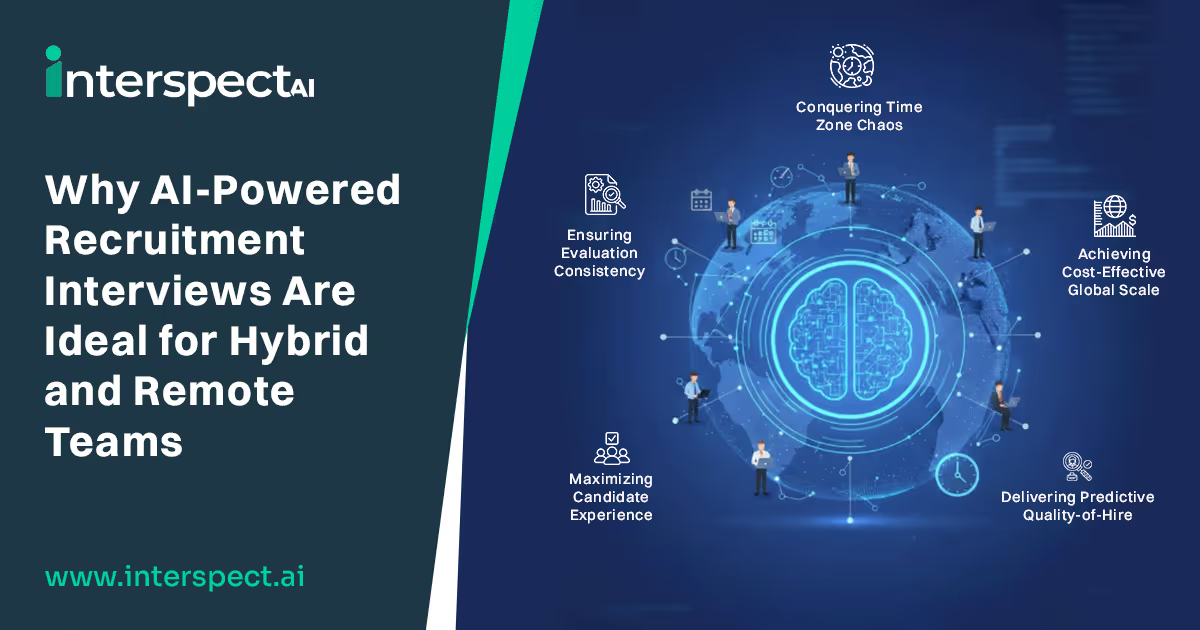
The modern shift to remote and hybrid work demands a new approach to talent acquisition. Traditional methods struggle with time zones, scheduling conflicts, and maintaining consistent evaluation standards across decentralized teams. AI-Powered Recruitment Interviews are the answer, providing the standardization, scalability, and objective data collection needed to hire high-quality talent anywhere in the world.
5 Ways AI Interviews Drive Remote Hiring Success
1. Conquering Time Zone Chaos (Boosting Time-to-Hire)
In traditional remote hiring, scheduling involves complex, manual coordination across continents, a bottleneck that significantly increases the Time-to-Hire (TTH). Automated candidate interviews solve this by offering true 24/7 access. This means a candidate in Tokyo can complete their screening at 2 AM their time, and the recruiter in London can review the objectively scored data during their standard workday. This asynchronous efficiency eliminates the delay caused by logistical friction, allowing hiring managers to move qualified candidates forward instantly and to secure global talent faster.
2. Ensuring Evaluation Consistency (Fostering Fairness)
Decentralized teams often struggle to maintain interview standards, where variations in interviewers' questions or biases can lead to unfair or inconsistent hiring decisions, harming the Bias Reduction Index. AI Candidate Evaluation Tools guarantee uniformity. Every candidate, regardless of their location or the time they interview, is subjected to the same standardized questions and scored against the same rubric. This removes the variable of human inconsistency, ensuring a consistently fair process that focuses purely on objective, job-relevant competencies like Role Alignment.
3. Maximizing Candidate Experience (Boosting CSAT)
For candidates, a drawn-out, fragmented remote hiring process is frustrating and can severely lower the Candidate Satisfaction Score (CSAT). AI-Powered Recruitment Interviews provide a seamless, reliable, and fast experience. The ability to complete the first screening immediately is a major convenience benefit. Furthermore, many AI systems provide candidates with personalized, actionable feedback (like a Skills Breakdown), which turns the interview into a valuable growth opportunity, fostering a positive view of the company even for those who are not hired.
4. Delivering Predictive Quality-of-Hire (QoH)
Traditional remote interviews can struggle to assess soft skills and behavioral fit accurately. AI transcends this by providing deep, objective behavioral analysis. By assessing communication patterns and consistency, AI makes data-driven predictions about a candidate's future performance and cultural fit, directly increasing your Quality-of-Hire (QoH). Metrics like the Overall Candidate Fit and Authenticity Score quantify fit with far greater precision than subjective human judgment, ensuring the remote hire is set up for long-term success in a distributed team environment.
5. Achieving Cost-Effective Global Scale (Lowering CPH)
Scaling a global remote recruiting effort using human recruiters is expensive due to increased labor hours for coordination and screening. By automating the most time-intensive tasks like screening, scheduling, and basic evaluation, AI-Powered Recruitment Interviews reduce the number of recruiter hours required per hire. This automation functions as a scalable infrastructure, enabling companies to expand their talent search globally without proportionally increasing their internal recruitment team size, resulting in a dramatic reduction in Cost-per-Hire (CPH).
SpectraHire: Quantifying Fit for Follow-Ups
To master candidate follow-up, recruiters need specific, granular data to make communication meaningful. SpectraHire is an agentic AI platform that provides this exact level of quantification, helping recruiters move beyond subjective impressions to objective, measurable metrics:
- Overall Candidate Fit: Provides a holistic score, evaluating an applicant's strengths, gaps, and next suggested steps. This ensures follow-up is relevant, whether the candidate is being advanced or pipelined.
- Role Alignment Score: Precisely checks how a candidate’s experience directly matches the Job Description requirements (critical for automated decision-making).
- Authenticity Score: Evaluates the genuineness in responses through the use of personal examples, ensuring honest candidate insight.
- Communication Skills/Confidence: Assesses clarity of explanations, including pacing, which are core indicators of effectiveness.
- Technical Proficiency: Assesses competency in technical interview rounds.
By leveraging these quantified insights, recruiters are armed with a much higher signal-to-noise ratio, ensuring automated follow-up is personalized and accurate, and that only the most qualified candidates move forward.
Conclusion
The "black hole" of recruitment is a choice, not a necessity. By deploying AI Agents to manage the entire spectrum of candidate follow-up—from instant acknowledgment to personalized feedback and future nurturing—companies demonstrate respect for every applicant. Recruiters leverage data provided by platforms like SpectraHire to quantify complex metrics such as Overall Candidate Fit and Authenticity Score. This investment proves that modern AI Candidate Evaluation Tools are not just an efficiency play; they are a strategic move to secure the highest quality talent faster, fairer, and cheaper than ever before, ensuring that even rejected applicants become advocates for the company.
Start hiring smarter. Request a SpectraHire demo today.
FAQs
How does AI for recruitment interviews ensure a fairer process?
AI ensures fairness by applying a standardized scoring rubric to every candidate, eliminating human unconscious biases. It focuses purely on objective metrics like Role Alignment to provide a transparent assessment based on required competencies.
Is Quality-of-Hire (QoH) measured solely by the AI tool?
No. AI improves the predictive aspect of QoH by analyzing communication and behavioral fit, providing metrics like the Overall Candidate Fit score, which strongly correlates with post-hire success. QoH is an organizational metric measured after the hire.
What is the main difference between an AI screening interview and an automated candidate interview?
AI screening is focused on early funnel filtering (e.g., basic qualification questions). An automated interview can be a more comprehensive assessment, including scenario-based questions to measure Technical Proficiency or providing a full Skills Breakdown report.
Can small and medium-sized businesses (SMBs) afford to use these AI recruitment tools?
Yes. The efficiency gains in Time-to-Hire and Cost-per-Hire often result in a rapid ROI, making the investment worthwhile for SMBs. Scalable AI for recruitment interview solutions is available for businesses of all sizes.
You might also like

If you’re on a lean hiring team, you know the juggling act all too well—managing multiple open roles, sorting through piles of resumes, and racing against the clock to find the right candidates. Every minute counts, and every unprepared interview can cost your team precious time and momentum.
Lean teams often face unique challenges, including limited recruiting resources, high hiring volumes, and the need to maintain quality without burning out their staff. Traditional recruiting processes—with manual scheduling, inconsistent candidate preparation, and subjective evaluations—can quickly become bottlenecks in the hiring process.
To succeed, lean hiring teams require tools that streamline workflows, enhance candidate readiness, and expedite hiring without compromising fairness or quality. That’s where AI interview platforms come in, helping teams work smarter, not harder.
The Challenge Lean Hiring Teams Face: More Than Just Volume
Lean hiring teams operate under intense pressure every day. The challenges go beyond just handling a high volume of open positions with fewer recruiters—they cover a range of operational and strategic hurdles that can slow down or compromise hiring quality:
- Overwhelming Workloads: Small teams juggle countless requisitions, often across diverse roles and departments, without the luxury of dedicated specialists for screening, scheduling, and candidate prep. This can lead to missed details or delayed processes.
- Time Crunch: Tight deadlines often prompt recruiters to rush initial screens and interviews, increasing the risk of overlooking qualified candidates or investing too much time in poorly prepared ones.
- Inconsistent Candidate Preparation: Candidates come from diverse backgrounds with different levels of interview readiness. Without a standardized approach to preparation, many applicants struggle to clearly demonstrate their fit, leading to inefficient interviews and longer hiring cycles.
- Bias Risks and Unequal Experiences: Manual, hurried processes can unintentionally introduce bias, while candidates might receive uneven coaching or interview experiences, impacting fairness and diversity goals.
- Communication and Scheduling Bottlenecks: Coordinating interviews across time zones and schedules consumes a significant amount of recruiter energy, causing delays and frustration.
Lean teams require a solution that not only accelerates the hiring process but also enhances candidate readiness, reduces recruiter workload, and ensures fairness and quality across every interaction.
How AI Interview Platforms Change the Game for Lean Teams
AI agents are stepping in as a force multiplier for small teams trying to do the work of many. By automating repetitive tasks and standardizing candidate interactions, these platforms free recruiters to focus on what really matters: evaluating potential and making confident hiring decisions.
Take SpectraHire, for example. Built specifically for teams that need to hire at scale without scaling their headcount, it transforms the interview process end-to-end. Instead of recruiters spending hours on manual scheduling or sifting through resumes, SpectraHire automates initial candidate assessments, delivers structured AI-led interviews, and generates consistent, data-backed insights recruiters can trust.
The result? Lean teams can evaluate more candidates in less time, while every applicant gets a fair, standardized experience that showcases their true potential. It’s speed without sacrificing quality, and efficiency without losing the human touch.
The Benefits of AI Interview Platforms for Lean Hiring Teams
Faster Hiring Cycles
AI-led interviews cut down the time spent on initial screenings and manual scheduling. Instead of days of back-and-forth emails, candidates can move through the process in hours, not weeks.
Consistent and Fair Assessments
With structured, standardized interviews, every candidate is evaluated on the same criteria. This not only reduces bias but also makes it easier for recruiters to compare candidates objectively.
Smarter Use of Recruiter Time
Rather than spending precious hours on repetitive tasks, recruiters can focus on high-value activities like building relationships with top talent and aligning hiring decisions with business goals.
Better Candidate Experience
Candidates feel more prepared and supported thanks to clear, structured interview flows. That translates to more confident responses and stronger overall performance during evaluations.
Data-Driven Decisions
AI platforms generate actionable insights after every interview, giving teams the data they need to make confident hiring decisions faster and with greater accuracy.
Platforms like SpectraHire bring all these advantages together in one place - helping lean teams scale their impact without scaling their workload.
Helping Lean Recruiters Win with AI-Powered Preparation
Hiring top talent with a lean team is challenging. AI-powered recruitment platforms like SpectraHire enable small recruitment teams to punch above their weight by cutting down screening time, improving candidate quality, and streamlining early interview stages, SpectraHire helps your lean team work smarter and faster—without stretching limited resources.
Ready to empower your lean hiring team?
Discover how SpectraHire can transform your recruiting today.
FAQs
1. How does SpectraHire support lean recruiting teams?
By automating repetitive tasks like screening, scheduling, and assessments, SpectraHire frees recruiters to focus on shortlisting and final decision-making. Lean teams get to do more with less, without burning out.
2. What makes SpectraHire’s interviews feel so natural?
The platform uses AI-driven interview agents designed to ask structured, role-specific questions in a conversational way—replicating the flow of a real interview while keeping it consistent and bias-free.
3. How does SpectraHire speed up hiring decisions?
Instead of waiting on multiple interview rounds, recruiters receive instant, data-backed insights on each candidate. This means faster shortlisting, fewer delays, and quicker time-to-hire.
4. Can SpectraHire handle different types of roles?
Yes. Whether it’s technical, behavioral, or creative roles, SpectraHire offers customizable interview templates and structured assessments tailored to each hiring need.
Your LinkedIn headline is the single most visible part of your profile. It appears in search results, connection requests, comments, and even recruiter dashboards. It decides whether someone clicks to learn more or scrolls past.
Data shows the impact: Optimized LinkedIn profiles get 40× more opportunities than the unoptimized ones and completed profiles gain 21× more views than the incomplete ones. A good headline alone can increase your visibility by 30%.
That’s why in 2025, when competition for attention is at its peak, headlines need to be sharp, keyword-rich, and value-driven.
5 Core Elements of an Irresistible Headline
1. State your professional identity clearly
People should instantly know who you are. Titles like “Project Manager” or “Software Engineer” set the base. But don’t stop there—add context.
Example:
Instead of “Marketing Manager,” try “Marketing Manager | B2B SaaS Growth & Demand Gen.”
Why this works: Recruiters often search using combinations like “Marketing + SaaS” or “Project + Agile.” Adding specifics makes you appear in more searches.
2. Use keywords strategically
LinkedIn functions like a search engine. Recruiters type keywords into the search bar to find candidates. If your headline doesn’t include those terms, you won’t show up - even if you’re the perfect fit.
Profiles with skills listed get more recruiter messages. The same logic applies to headlines.
How to find your keywords:
- Look at 5–10 job descriptions in your field.
- Note recurring skills or tools (e.g., “Python,” “Leadership,” “Data Analytics”).
- Weave them into your headline naturally.
3. Focus on value, not just job titles
Titles tell people what you are. Value tells them why you matter. A recruiter or client doesn’t just want to know your role—they want to know what you can deliver.
Example:
- Title-only: “HR Consultant”
- Value-driven: “HR Consultant | Cutting Employee Turnover by 40% Through Data-Driven People Strategies”
See the difference? The second version tells me why I should click your profile.
4. Add achievements or metrics
Numbers cut through noise. If you can quantify results, you instantly become more credible.
Example:
- Weak: “Sales Manager | SaaS”
- Strong: “Sales Manager | SaaS | Grew ARR from $2M to $5M in 12 Months”
Recruiters scan hundreds of profiles daily. Metrics make yours memorable.
5. Infuse personality (when relevant)
LinkedIn isn’t just about what you do, but also how you do it. Personality helps you stand out, especially in creative or people-focused industries.
Example:
- Traditional: “Chief People Officer | HR Strategy & Engagement”
- Memorable: “Chief People Officer | Building Workplaces People Actually Love”
Not every industry needs this. If you’re a compliance officer, playful language may not fit. But for marketers, consultants, or founders, it works well.
A Practical Formula for Writing Your Headline
Here’s a simple template you can adapt:
[Job Title] | [Core Skill/Keyword] | [Value/Impact or Achievement] | [Optional: Personal Brand/Passion]
Example:
Product Manager | AI & SaaS Platforms | Driving 30% Faster Time-to-Market | Advocating Inclusive Tech
This structure ensures your headline is both searchable and human.
Real examples that perform well
Notice how each one goes beyond just listing a job title. They either show results, solve problems, or highlight uniqueness.
Why being active on LinkedIn amplifies your headline
Even the best headline won’t work in isolation. LinkedIn rewards active members—those who post, comment, and engage.
A recruiter recently shared how she wasn’t job hunting but landed a contract with Apple simply because her optimized profile (and headline) kept her visible in searches.
In short - update your headline, but also stay active so the algorithm keeps pushing your profile forward.
Your headline is the single most important line on your LinkedIn profile.
To make it irresistible in 2025:
- State your identity clearly
- Use targeted keywords
- Show your value
- Highlight achievements
- Add personality where it fits
Get this right, and you won’t just be visible - you’ll be unforgettable.
And if you’re polishing your profile, don’t forget the next step - sharpening your interview game! That’s where SpectraSeek, our AI-powered interview prep tool, helps you practice and perform with confidence!

Think about all the critical interviews your company conducts in a week. Screening calls with candidates, in-depth user research sessions, customer feedback interviews, and candid exit interviews with departing employees.
Each one is a goldmine of information.
A critical insight from a frustrated user, a brilliant product idea from a new hire, or a recurring complaint that signals a market shift.
Now, where do all those insights go?
If you’re like most companies, they disappear. They’re trapped in scattered notes, siloed in department-specific software, or lost entirely the moment the interview ends.
Your company's collective intelligence is unstructured, unsearchable, and untapped. It's dark data.
It’s time to stop treating interviews as fleeting moments and start treating them as your most valuable data asset with Spectra.
From Unstructured Voice to Searchable Data
For years, the first step in conversational intelligence was transcription. Turning voice into text was a giant leap forward, but it's no longer enough.
A folder full of transcripts is a slightly more organized version of the original problem. You still can't query it at scale.
You can't ask: "Show me every time a user mentioned a competitor in an interview this quarter."
The real breakthrough comes when you structure the context within the interview. This is where Spectra's AI agents come in.
AI agents don't just hear words; they understand the meaning behind them. They perform advanced voice data structuring during every interview, automatically tagging conversations with rich metadata:
- Entities: People, products, companies, and locations mentioned.
- Topics: Key themes discussed, like "pricing," "onboarding," or "customer support."
- Sentiment & Tone: The emotional undertone of the conversation—is the customer happy, frustrated, hesitant?
- Events: Key moments, like action items, decisions, or follow-ups.
With structured data like this, a 30-minute interview becomes a structured, queryable data object. In addition to being used by the business teams, the data can also be used to train the model and agents further, improving their capabilities and leading to a continuously improving experience.
Building Your Single Source of Truth: The Spectra Knowledge Graph
When you consistently capture and review conversations using Spectra, you're not just documenting interviews—you’re creating a rich repository of insights that can power smarter decisions across your organization.
Think of it as the first step toward building your own Interview Knowledge Graph: a connected, searchable ecosystem of qualitative data.
Each conversation recorded through Spectra becomes a data point, tied to topics, people, and sentiment. Once exported, this structured data can be fed into your existing BI tools, data warehouses, or CRM systems to create a dynamic knowledge base.
How Businesses Use Their Knowledge Graph with Spectra
By integrating Spectra’s outputs into their analytics workflows, organizations can surface cross-functional insights that were previously buried in transcripts.
- For Product Teams: Analyze user feedback to track feature mentions and sentiment trends across time.
- For HR & Talent: Investigate patterns in exit interviews or performance conversations by asking, “What themes are common among top-performing employees who left voluntarily?”
- For Market Researchers: Run large-scale customer interviews with Spectra, then use your tools to group insights and identify emerging themes—faster and at scale.
- For Sales Teams: Identify sales enablement opportunities by reviewing instances where key objections came up and tracking changes in rep confidence.
Best of all, this structured data isn't locked away. With Spectra's data extraction capabilities, it can be easily exported as a configurable JSON file and piped directly into your BI tools, data warehouses, or CRM, integrating the qualitative "why" with your quantitative "what."
Your First Steps to Building an Interview Hub
The idea of building a comprehensive knowledge graph can feel daunting, but it doesn’t have to be.
Here’s a practical way to begin.
- Start with One High-Value Interview Type: Select one area where insights are consistently lost. Is it user research interviews? Candidate screening calls? Start there. This focus enables you to demonstrate value quickly in a controlled environment.
- Define Your Key Questions: Before conducting the first interview with Spectra, ask your team: "What are the 3-5 critical insights we need to track?" These could be competitor mentions for a product team or reasons for leaving for an HR team. This defines the initial structure of your data.
- Pilot with a Single Team: Empower one team to be your champion. Let them use Spectra to build their mini-knowledge hub. As they start sharing powerful, data-backed insights they couldn't access before, other departments will naturally want to follow suit.
Building an interview hub is an iterative process. Start small, show value, and scale from there.
From Interviews to Intelligence
Building an interview hub transforms isolated conversations into your company's most valuable, searchable asset.
By structuring interview data with AI agents, you move from simply listening to actively learning. Every conversation makes your organization smarter, shaping product roadmaps with direct user feedback and informing talent strategies with real-time sentiment.
The most innovative companies don't just listen—they learn. Are you ready to unlock the data hidden in your conversations?
Subscribe to The InterspectAI Blog