%201.svg)

Why Practicing in Your Head Is Not Enough to Ace a Job Interview


You’re about to face a big interview. You review the job description. You study sample questions. In your head, you rehearse your answers, imagining how you’ll “nail it” when the moment arrives.
But when the real conversation begins, what seemed smooth in your mind… suddenly feels awkward, rushed, or incomplete.
Here’s the simple truth:
Mental rehearsal alone isn’t enough. To truly stand out, you need to convert those imagined answers into verbal, practiced performance.
The Illusion of Mental Preparation
Visualizing success can help you calm nerves, organize key points, and build a sense of readiness. But silent practice misses three critical ingredients:
- Speaking Under Pressure: Thinking through answers is different from speaking them out loud—especially when you’re nervous.
- Timing and Concise: In your head, there’s no real clock. But interviews have limits. Rambling or losing track is common when practice stays silent.
- Real-Time Adaptation: Interviews are dynamic. You will be interrupted, asked follow-up questions, and required to adapt your responses on the spot.
Why "Mental Mirroring" Isn’t the Same as Speaking
It’s easy to imagine the perfect answer. It’s much harder to articulate it clearly when confronted by an actual person, especially if unexpected questions, tone, or body language unsettle you.
Research shows that practicing aloud activates completely different neural pathways than silent rehearsal—those responsible for language, recall, and emotion. By relying solely on inner monologue, you’re skipping the chance to build muscle memory for confident delivery.
The Power of Speaking Out Loud
When you practice real responses, several benefits emerge:
- Catches Tongue-Tied Moments: You’ll discover gaps, awkward transitions, or unclear explanations before the interview—not during.
- Builds Confidence in Delivery: Verbal repetition helps you speak with authority, pace, and clarity.
- Trains for Unexpected Turns: Real practice helps you adapt to follow-up questions and pivot when you’re surprised.
How AI Mock Interviews Take You Further
Platforms like SpectraSeek create a safe, realistic practice environment. Their intelligent AI agents ask role-specific questions, provide instant feedback, and simulate the pressure and pace of a live interview. You don’t just get repetition; you get actionable coaching on everything from filler words to answer structure and non-verbal cues.
Features include:
- Authentic interview simulation with timed, varied questions
- Immediate scoring and feedback on both content and delivery
- Adaptive follow-ups, training you to think on your feet
- Progress tracking so you see real improvement with every session
Success Is in the Real Practice
Mental preparation is a great starting point—but it’s just that: a start. The difference between a good candidate and a great one often lies in how effortlessly they convey ideas, handle interruptions, and answer on the fly.
AI-driven mock interviews help you bridge the gap, so when the big day arrives, your best answers aren’t just in your head—they’re ready to be spoken with confidence.
Ready to turn your interview practice into results? Experience the difference with SpectraSeek and let your next spoken answer set you apart.
Frequently Asked Questions (FAQs):
Why isn’t practicing in my head enough for interviews?
Because speaking aloud engages different brain functions essential for confidence, timing, and adapting to real-time questions, mental rehearsal alone can’t replicate these.
How does practicing with AI tools like SpectraSeek help?
AI platforms simulate real interviews, provide instant feedback on your answers and delivery, and adapt questions based on your performance to prepare you for live conditions.
Can AI mock interviews help reduce interview anxiety?
Yes, by increasing familiarity and providing real-time coaching, AI practice helps build confidence and reduce nervousness over repeated sessions.
How often should I practice to see improvement?
Daily sessions of 15-20 minutes are most effective, helping you build consistent habits and gradual improvement without burnout.
Will practicing with AI make my answers sound rehearsed or robotic?
No. AI coaching focuses on helping you articulate your authentic self clearly and confidently, not memorizing scripted responses.
You might also like


As Agentic AI is gaining more ground as days pass, companies across industries are exploring how autonomous AI agents can smooth out their operations and drive better innovation.
AI-powered agents are no longer just following instructions - they’re making decisions on their own. From virtual assistants and autonomous robots to intelligent software bots, these agents operate with increasing autonomy, driving efficiency, solving complex problems, and reshaping the way organizations function.
Yet, with greater autonomy comes a new layer of responsibility.
As these agents take independent actions, critical ethical challenges arise - Who is accountable for their decisions? How do we address unintended bias in their behavior? What safeguards ensure these agents align with human values and organizational goals?
In the sections ahead, we’ll explore the ethical complexities of autonomous AI agents and outline practical steps organizations can take to ensure innovation doesn’t come at the cost of responsibility.
What is Agentic AI?
Agentic AI is an AI system endowed with autonomy - the ability to perceive its environment, make decisions, and take actions without needing human intervention.
Unlike a regular software program that only does what it’s explicitly told, an AI agent can pursue objectives independently based on high-level goals set by humans. It might gather data, reason and decide the best course of action, and learn from the outcomes to improve over time. AI agents combine techniques like machine learning and real-time data processing so they can adapt to changing conditions on the fly.
For example, imagine a software agent tasked with managing your supply chain. Instead of waiting for a person to approve every move, it could automatically analyze inventory levels, track shipments, predict delays, and reroute orders proactively.
As these capabilities evolve, the impact of Agentic AI on businesses and professionals keeps growing. Importantly, today’s agentic AI systems still operate within boundaries set by humans - they don’t set their own ultimate goals (the AI isn’t deciding the company’s objective, only how to achieve a given objective). This keeps them task-focused and usually limited in scope for safety and practical use.
Key ethical challenges in autonomous decision-making
Empowering AI agents to make decisions introduces several ethical and practical challenges, with the four most critical areas being bias, safety, explainability, and unintended consequences.
- AI agents may inherit or even amplify biases present in their training data or programming
AI systems make decisions based on patterns they’ve learned, which means if the data reflects historical bias or discrimination, the agent’s actions could be biased as well. For instance, if an AI hiring agent is trained on past employment data that favored certain groups, it might unknowingly discriminate in its recommendations.
A well-known real-world example is Amazon’s experimental AI recruiting tool, which needed to be scrapped after it was discovered to systematically downgrade resumes that included the word “women’s” (e.g., “women’s chess club”) - effectively penalizing female candidates due to biased training data.
This case illustrates how even unintentional bias in an autonomous decision-maker can lead to unjust outcomes and reputational damage.
How to overcome this
Ensuring agents are fair and objective requires careful dataset curation, bias testing, and often putting limits or checks on the agent’s decision criteria. Companies deploying agentic AI need to implement bias audits and include diverse perspectives in development to catch biases early. Otherwise, an autonomous agent might make consistently prejudiced decisions at scale, which is unethical and potentially violates anti-discrimination laws.
- An autonomous system can cause harm if it malfunctions or makes a poor decision
Safety becomes paramount when AI agents have the freedom to act in the real world - especially in high-stakes domains like transportation, healthcare, or manufacturing. We’ve seen sobering examples in the realm of self-driving vehicles: in 2018, an Uber autonomous test car failed to recognize a pedestrian and tragically struck and killed her.
Investigators found the AI-driven car had blind spots (it literally could not identify particular pedestrians) and that there was insufficient human oversight to catch this in time
This incident shows the life-and-death stakes of AI decision-making in physical environments.
Even in non-physical domains (say, an AI agent managing financial portfolios), a lack of reliability can lead to significant economic damage or safety issues of a different kind.
How to overcome this
An AI agent that controls critical infrastructure or processes must be rigorously tested for edge cases and have safeguards.
Robustness - the ability to handle unexpected situations - is critical. Many experts advocate for fail-safes like “kill switches” or manual override mechanisms so humans can intervene if an AI agent goes awry.
In practice, companies should define clear protocols - under what conditions will a human step in? How do you know if and when the AI is acting outside acceptable bounds?
Building reliable Agentic AI systems also means continuous monitoring of their behavior in the field, much like having an air-traffic control system for your AI agents.
- Lack of explainability and transparency
By their nature, many advanced AI agents (especially those powered by machine learning and neural networks) operate as “black boxes.” They might make a complex decision - such as declining a loan application or diagnosing a patient - without a clear, human-readable rationale. This lack of explainability is a serious challenge. Both ethically and from a compliance standpoint, organizations need to be able to justify and explain AI-driven decisions.
If an autonomous agent recommends a medical treatment or rejects a job candidate, the people affected will reasonably want to know, “Why did it do that?”
How to overcome this
Requiring explainability is not just academic - it’s increasingly a legal expectation. For example, the EU’s proposed AI Act will impose specific transparency requirements on “high-risk” AI systems.
An AI that screens résumés or makes hiring decisions would need to provide information about how it works, its logic, and its data sources so that its decisions can be understood and challenged if required.
Explainable AI (XAI) techniques are an active area of research aiming to open up the black box - whether through feature importance, decision rules, or model visualization.
For companies, the takeaway is that transparency builds trust.
Stakeholders (from customers to regulators) are more comfortable with Agentic AI systems if there’s clarity about how decisions are made and assurances that the AI’s actions align with legal and ethical norms. Ensuring your AI agents are as explainable as possible (or at least provide clear documentation on their decision criteria) will be critical to the responsible use of autonomy.
- Giving AI agents full autonomy can lead to unintended consequences
An AI agent, especially a very advanced one, might find creative but undesirable ways to achieve its goals if not properly constrained. This is often discussed in terms of “alignment” - ensuring the AI’s objectives and values align with our human intentions. If an autonomous supply chain agent is told to minimize delivery times, for example, could it inadvertently start overworking drivers or bypassing quality checks to hit that target?
In the Paperclip maximizer thought experiment by Swedish philosopher Nick Bostrom, a highly advanced agent asked to manufacture paper clips might single-mindedly pursue that goal to the detriment of everything else (the “paperclip maximizer” scenario), illustrating the need to encode broader values and guardrails.
In real terms, companies must beware of AI agents making decisions that satisfy a narrow objective but produce side effects that are bad for business or society.
How to overcome this
Preventative steps include rigorous scenario testing, imposing ethical constraints on agent behavior, and starting with limited-scope autonomy. An agent should ideally have built-in checks (or rules) for safety and ethics. For example, a rule that a logistics AI cannot violate labor regulations or a healthcare AI must get a human doctor’s sign-off for high-risk decisions.
We need to reap the efficiencies of autonomous decision-making without relinquishing the values and high-level control that keep those decisions beneficial.
Responsible Agentic AI can offer significant value for companies
The ability for AI agents to autonomously handle complex tasks - rapidly adapt to changing conditions, analyze vast datasets, and execute precise, data-driven decisions - holds transformative potential across industries. At the same time, as we’ve detailed, this autonomy comes with serious responsibilities.
A critical safeguard in ensuring AI-driven decisions remain ethical, unbiased, and compliant is the use of Guardrail Classifiers (as outlined in this report’s Responsible AI framework). These classifiers act as an essential layer of protection, detecting and mitigating risks such as bias, toxicity, misinformation, and ethical misalignment.
If your organization is considering deploying autonomous AI agents, now is the time to ensure you have the right expertise and governance in place. With careful design and alignment to global best practices, agentic AI can be a real elevator for your business.
Interested in exploring what agentic AI could do for you? We encourage you to learn more about our company’s custom AI agent solutions, which are built with an emphasis on ethical safeguards and human-centric design.
With the right approach, you can harness the efficiency of autonomy and retain the control and trust that comes from a strong human-AI partnership.

The market for conversational technology has exploded, transforming workflows from customer service to candidate screening. But as businesses seek to automate high-stakes interactions, a critical distinction has emerged between two core technologies: traditional, rule-based chatbots and the more advanced paradigm of agentic AI.
While both technologies utilize conversational interfaces, they fundamentally differ in their intelligence, autonomy, and ability to generate meaningful, actionable data. For enterprises relying on objective insights—whether for hiring, market research, or compliance—understanding this difference is paramount to making innovative technology investments.
Here is a detailed breakdown of what separates a simple chatbot interview from a conversation powered by agentic AI.
1. Autonomy and Adaptive Intelligence
The most significant difference between a chatbot and an agentic AI system lies in its autonomy—its ability to set goals, monitor the environment, and dynamically adapt the conversation.
The Chatbot Limitation: Traditional chatbots or simple rule-based AI systems operate along a pre-programmed, static conversational tree. They excel at handling quick, repetitive, first-level queries. If a user’s response falls outside a programmed parameter, the bot often defaults to generic answers or prompts, leading to frustrating, mechanical, and shallow interactions.
The agentic AI Advantage: Agentic AI is designed to be truly adaptive and dynamic. It is built to "hear, see, reason, and speak," delivering human-like, hyper-personalized interactions at scale.
- Real-Time Guidance: Agentic AI uses machine learning, Natural Language Processing (NLP), and real-time data analysis not just to process conversations, but to guide them.
- Dynamic Adaptation: For example, if an interviewee seems confused or provides an inconsistent answer, the AI agent can intelligently probe deeper, ask specific follow-up questions, or dynamically shift the flow of the conversation to address that concern. This level of adaptive behavior ensures a more natural and engaging dialogue while capturing nuanced insights that static systems would miss.
2. Structured Data Extraction vs. Unstructured Logs
Interviews are qualitative interactions, but enterprise decision-making requires quantifiable, objective data. Agentic AI excels at converting this conversational interaction into a structured, consumable intelligence layer.
The Chatbot Limitation: Simple conversational tools typically leave behind unstructured data—a large volume of text logs or video recordings that still require time-intensive human analysis to process and score.
The agentic AI Advantage: Agentic platforms function as interview intelligence engines.
- Instant, Objective Assessment: Following a high-volume interview, the system provides instant assessments, automated scores, and behavioral insights. Every response is converted into quantifiable metrics.
- Structured Output: Crucially, agentic AI extracts all interview data into a structured format, which is configurable and delivered in JSON. This standardization allows the data to be seamlessly integrated into business intelligence (BI) tools for immediate analysis, without manual data entry.
3. Specialized Expertise and Bias Mitigation
In high-stakes environments like hiring and compliance, the ability to assess complex skills objectively and ethically is non-negotiable.
The Chatbot Limitation: General-purpose chatbots lack the specialized domain expertise needed to conduct nuanced, in-depth evaluations across various professional functions. They are also prone to perpetuating bias if their training data is not meticulously controlled.
The Agentic AI Advantage: Agentic systems are built for specialization and compliance:
- Bias Elimination: Agentic AI uses non-profiling algorithms designed to eliminate unconscious bias, focusing purely on objective, evidence-based metrics. For example, the system uses NLP to analyze behavioral answers (e.g., assessing a response to a question like “Describe overcoming a challenge”) to score hard skills such as problem-solving, rather than subjective traits like perceived charisma.
- Auditable Decisions: All decisions and metrics generated are auditable, providing essential transparency for corporate HR and legal teams.
- Functional Building Blocks: The underlying platform is designed with "functional building blocks" that allow it to deploy specialized AI agents across distinct domains, such as recruitment, education, and regulatory compliance.
Introducing Spectra: The Agentic Platform by InterspectAI
The Spectra platform by InterspectAI embodies the next generation of conversational intelligence. It is the core agentic AI-powered interview solution, explicitly built to "hear, see, reason, and speak," delivering human-like, hyper-personalized interactions at enterprise scale. Spectra functions using modular, functional building blocks, making it highly adaptable for complex workflows across industries.
Key to its enterprise readiness is its robust capability set:
- Video Recordings and Instant Assessments: The platform captures full video interviews and generates automated scores and insights instantly.
- Structured Data: All interview data is extracted into a structured format, configurable and delivered in JSON, ensuring easy integration and analysis by other business intelligence tools.
- Compliance Moat: Spectra is designed for strict data governance, claiming compliance with SOC2 Type 2, GDPR, CCPA, and HIPAA, which is essential for regulated sectors.
The flagship application, SpectraHire, provides an out-of-the-box AI-driven solution for recruitment teams, automating screening, scheduling, and candidate nurturing while reducing bias. This architectural approach allows businesses to leverage specialized AI agents for high-value tasks, driving smarter, faster decisions across the board.
4. Expanding the Enterprise Use Case.
While simple conversational AI is often confined to customer-facing Q&A, agentic AI provides a foundational layer of conversational intelligence that can transform multiple high-value enterprise workflows.
The Shift to Human-Agent Partnership
Agentic AI marks an evolution from simple automation tools to intelligent partners. The goal is not to replace human judgment, but to augment it.
In the agentic AI model, the AI agent's role is to autonomously conduct high-volume, consistent interviews, capture video, and generate instant, structured assessments. The human professional’s role is elevated: they use the rich, objective AI-generated insights—such as transcripts, skill assessments, and sentiment analysis—to make smarter, strategic decisions, identify key trends, and focus their invaluable time on the most promising candidates or market opportunities.
Ready to Transform Your Interview Workflows?
The future of assessment is autonomous, objective, and integrated. Stop relying on static forms and basic chatbots for high-stakes decisions.
Request a Demo of the Spectra today to see how seamless, scalable AI-driven interviews can fuel growth and provide clear, quantifiable insights across hiring, market research, and compliance.
FAQs
Q: How does agentic AI ensure the elimination of bias, unlike traditional interviewing methods?
Agentic AI uses "Non-profiling algorithms" designed specifically to eliminate unconscious bias in assessments. Instead of evaluating subjective traits, the system uses Natural Language Processing (NLP) to analyze behavioral answers (e.g., responses to a challenge) to score hard skills objectively, making the entire assessment process auditable and fair.
Q: What kind of data does agentic AI extract from an interview?
The platform extracts structured data, which is configurable and delivered in formats like JSON for easy integration with existing business intelligence tools. The output includes automated scores, behavioral metrics, skill match scores, answer consistency ratings, and deep sentiment scores, converting qualitative conversations into quantifiable metrics.
Q: Can agentic AI scale complex interviews across different business functions?
Yes. The platform is built using modular, "functional building blocks" that enable its agentic AI capabilities to be seamlessly integrated across various workflows. This allows it to scale for multiple use cases beyond hiring, including compliance checks, market research (Voice of Customer), academic assessments, and customer service training.
Q: How is agentic AI able to guide a conversation more naturally than a chatbot?
Agentic AI utilizes machine learning and Natural Language Processing (NLP) to assess and guide conversations in real-time. Unlike chatbots that follow a fixed script, the agentic AI can detect confusion or inconsistencies in an interviewee's response and dynamically probe deeper, ask relevant follow-up questions, or shift the conversation flow to capture nuanced insights, ensuring a more engaging, human-like interaction.
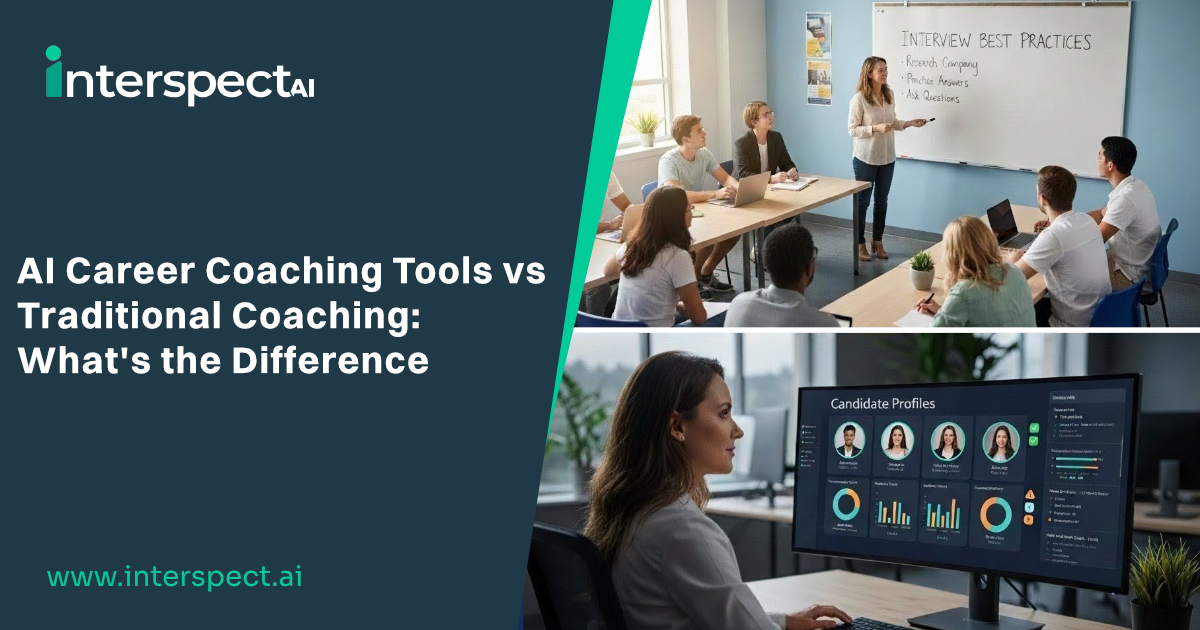
The landscape of career development is undergoing a profound shift. For decades, the gold standard of career preparation was the one-on-one session between a student and a human advisor. This relationship provided personalized guidance, emotional support, and industry wisdom. Today, however, a new player has entered the arena. AI career coaching tools are rapidly evolving from simple resume scanners into sophisticated, interactive systems capable of simulating complex interview scenarios.
For university career centers and institutional leaders, the emergence of these technologies often prompts a comparison. Is AI a replacement for the human coach? Is it a competitor? The answer lies in understanding the distinct capabilities of each approach. By dissecting the differences between traditional career coaching and AI-driven solutions, institutions can move past the fear of replacement and towards a strategy of augmentation. We are not looking at an either-or scenario, but rather the foundations of a hybrid coaching model that leverages the strengths of both silicon and carbon.
Accessibility and Scale: The Time Constraint
The most immediate difference lies in availability. Traditional coaching is inherently bound by time and space. A human advisor has a finite number of hours in a day. They require breaks, sleep, and weekends. In a university setting with thousands of students, this mathematical reality creates a bottleneck. Students often face long wait times for appointments, meaning they might only get one or two practice sessions before a major interview.
AI tools dismantle this barrier completely. A digital platform operates continuously, offering scalable career guidance without fatigue. A student preparing for an interview at midnight can receive the same level of attention and rigorous feedback as a student practicing at noon. This always-on availability ensures that practice is determined by the student's motivation rather than the office's calendar.
Subjectivity vs. Objectivity: The Feedback Loop
Feedback mechanisms represent another fundamental divergence. Human feedback is qualitative and often subjective. An advisor might tell a student they seem confident or that their answer felt a bit long. This feedback is valuable, as it mirrors the human reaction of a real recruiter. However, it can vary significantly from one coach to another.
AI provides a layer of objectivity that humans simply cannot process in real-time. When a student interacts with an AI tool, the system analyzes data points invisible to the human eye. It measures the precise rate of speech, counts the frequency of filler words, and tracks gaze aversion. This turns the subjective art of communication into measurable science. Instead of a feedback like they ‘speak too fast’, a student sees a feedback that reads, ‘words-per-minute count is above the recommended threshold’. This objective baseline allows students to make precise adjustments to their delivery.
Empathy vs. Accuracy: The Scope of Guidance
Where traditional coaching remains unrivaled is in the domain of empathy and complex strategy. A human coach understands the anxiety of a first-generation student or the subtle political dynamics of a specific industry. They can offer encouragement, help navigate imposter syndrome, and tailor advice based on deep personal knowledge of the student's background.
AI, conversely, excels at accuracy and breadth. An AI agent can instantly access a vast database of technical questions for niche roles, from aerospace engineering to investment banking. It can simulate a technical interview with a level of domain specificity that a generalist career coach might struggle to match. While the AI may not be able to empathize with a student's fear of failure, it can rigorously test their knowledge of Python or financial modeling, ensuring they are technically proficient.
The Hybrid Model: The Best of Both Worlds
The most effective career centers realize that these differences are complementary. By integrating AI tools, institutions can offload the repetitive, high-volume tasks of initial training and resume review. This allows human coaches to operate at the top of their license.
In this hybrid coaching model, the AI acts as the training ground. Students use the tools to build their foundational skills, perfect their elevator pitch, and clean up their resumes. When they finally meet with a human advisor, they are prepared. The conversation can skip the basics and focus on high-level career strategy, networking nuances, and emotional readiness.
InterspectAI: Bridging the Gap with Agentic Intelligence
While many tools offer basic text feedback, InterspectAI bridges the divide between human and machine interaction through its SpectraSeek platform. Unlike static chatbots, SpectraSeek utilizes agentic AI to create a high-fidelity simulation of a real interview.
Here is how InterspectAI serves as the ideal partner for the hybrid model:
- Simulated Human Interaction: SpectraSeek agents are designed to hear, see, and speak. They pick up on cues and respond with natural conversational flow. This creates an interactive interview experience that mirrors the pressure and dynamic nature of real hiring environments, helping students prepare more effectively for the job market.
- Vertical Expertise: The platform tailors each interview to the student’s background and goals. By analyzing the uploaded resume and job description, it adjusts questions to match the student’s experience, skill level, and target role. This ensures that every practice session feels relevant, challenging, and aligned with real hiring expectations.
- Data-Driven Handoff: When a student finishes a session on SpectraSeek, the data does not disappear. It generates detailed reports on role alignment and authenticity. A human coach can review this data before an appointment, gaining immediate insight into the student's strengths and weaknesses without needing to spend the first twenty minutes of the session diagnosing them.
Conclusion
The question is not whether AI is better than traditional coaching, but how AI can make traditional coaching better. By adopting tools that offer scalable, objective, and domain-specific practice, universities can enhance the value of their human advisors.
Institutions that embrace this dual approach will produce graduates who are technically sharp, communicatively polished, and strategically prepared. In the competitive arena of modern placement, the combination of high-tech tools and high-touch guidance is the winning formula.
Elevate your coaching capabilities. Empower your students with the rigorous practice they need and give your advisors the data they deserve. Partner with InterspectAI today to implement SpectraSeek and build a future-ready career center.
FAQs
Can AI tools really understand the nuance of human communication?
Yes, advanced agentic systems like those used by InterspectAI are designed to analyze more than just text. They evaluate factors such as Communication Skills/Confidence, Interview Readiness, Authenticity Score, and Overall Candidate Fit. This allows the AI to assess how effectively a student conveys their ideas—not just what they say—providing a more comprehensive view of their interview performance.
Will using AI tools make the coaching process feel impersonal?
Not if used correctly in a hybrid model. AI handles the repetitive drills and technical preparation, which actually frees up human coaches to spend more time on personal connection, mentorship, and complex problem-solving. The AI supports the human relationship rather than replacing it.
How does AI coaching help with specialized career paths?
Generalist human coaches cannot be experts in every field. AI tools can be trained on specific industry verticals, allowing them to ask highly technical questions relevant to fields like software engineering, healthcare, or finance. This ensures students get domain-specific practice even if their advisor has a different background.
Is the feedback from AI consistent?
One of the main advantages of AI is its consistency. Unlike human feedback, which can vary based on the advisor's mood or fatigue, AI evaluates every student against a standardized scoring rubric. This provides a fair and objective baseline for student performance tracking across the entire institution.
Subscribe to The InterspectAI Blog