%201.svg)

How to Scale Personalized Interview Prep Without Extra Faculty


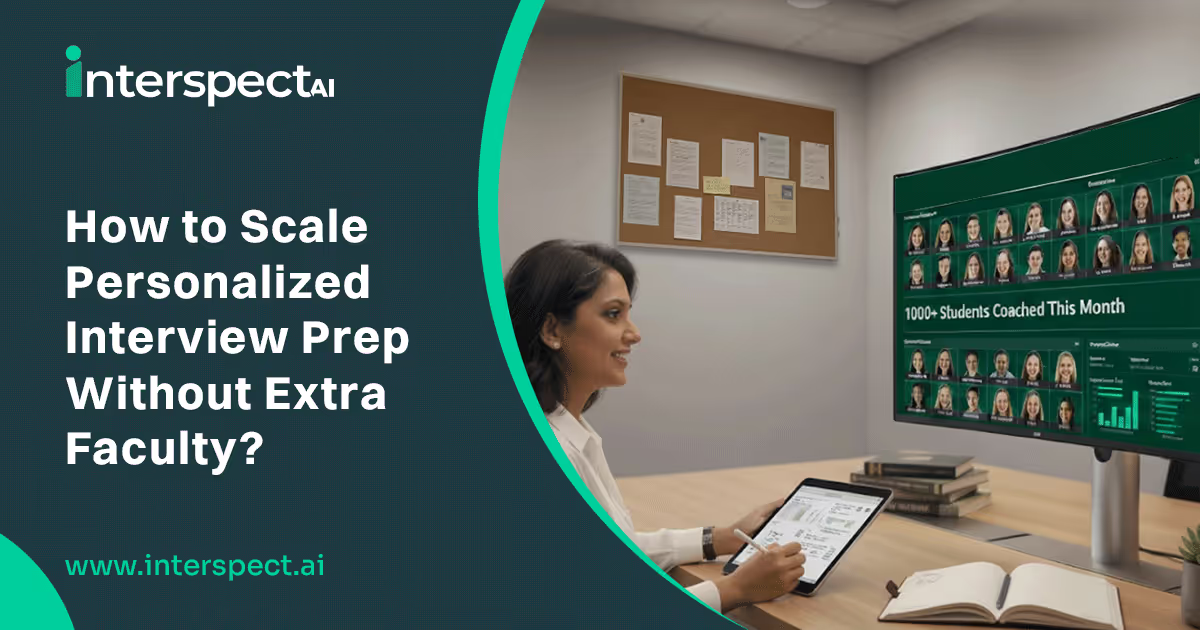
Higher education career centers are facing a crisis of capacity. The demand for high-quality, individualized interview guidance is soaring, but relying on the traditional one-on-one advising model is simply unsustainable.
Why is scaling so hard? Many universities today serve thousands of students with very small career services teams, creating an overwhelming advisor-to-student ratio. With limited staff, offering consistent, personalized support to every student—especially for something as preparation-heavy as interview coaching—becomes nearly impossible.
This capacity crisis creates an equity issue. When resources are scarce, personalized support is unevenly distributed, which disproportionately impacts students who lack professional networks. In fact, research shows that first-generation college graduates have a median household income substantially lower (by tens of thousands of dollars) than second-generation graduates, and this gap is compounded for students who intersect with other marginalized identity groups. Scaling personalized support, therefore, isn't just an efficiency goal; it's a moral and strategic necessity. The solution isn't hiring more human advisors; it's empowering the existing faculty through the strategic use of AI coaching for students.
I. The Strategic Shift: Augmentation, Not Replacement
The goal of implementing university AI tools is not to replace faculty but to liberate them. We must strategically redeploy human expertise where it matters most: on high-stakes, nuanced, and emotional coaching.
Research shows that AI can effectively provide up to 90% of day-to-day coaching functions, including repetitive tasks like goal definition, structured conversations, and role-playing practice. By automating this foundational layer, the existing human advisor is augmented, allowing them to dramatically scale their impact.
This transition moves advisors from transactional administrators to transformational coaches, focusing their finite time on critical, high-impact activities like negotiation strategy and emotional barriers to career success.
This scalable approach is pioneered by advanced platforms like SpectraSeek by InterspectAI. As a leader in digital career coaching, SpectraSeek is built on proprietary agentic AI. This means it acts as a smart, LLM-powered decision engine designed for verifiable, high-precision assessment. This technology enables the platform to deliver human-like, hyper-personalized interactions at scale for both job seekers and university career centers.
II. The Engine of Scale: 24/7 Personalized Practice
Effective, scalable interview prep hinges on three pillars: constant access, personalization, and instant feedback.
1. Instant, Personalized Feedback (24/7 Availability)
The greatest efficiency gain is achieved by delegating routine administrative tasks to a 24/7 intelligent support layer. Conversational AI provides support 24 hours a day, 7 days a week, a crucial feature for students with diverse schedules.
Digital career coaching tools accelerate learning by delivering feedback instantly, eliminating the time lag inherent in human advising. This allows for an iterative process where students can immediately correct their responses and try again, maximizing their practice time.
The financial and operational impact of this automation is significant:
- Operational Time Saved: AI-powered systems can significantly reduce the workload on human advisors by handling routine tasks such as answering common queries, scheduling, and generating first-draft materials. This frees advisors to focus on higher-value, student-facing work.
- Call Volume Reduction: When used effectively, AI virtual assistants can manage a large portion of repetitive student inquiries, lowering overall call and email volume and making support channels more efficient.
- Customization is Key: Crucially, AI-enabled feedback is not generic. Modern systems can tailor their responses to each student’s goals, strengths, and preparation needs—making it possible to deliver personalized guidance at scale without overwhelming staff.
2. Realistic Simulation and Deep Feedback
To be effective, scalable interview prep must be realistic. AI mock interview platforms generate comprehensive scenarios by analyzing target job descriptions from listing platforms and integrating expert-crafted questions. The AI uses conversational intelligence to craft follow-up questions intelligently adapted to the user’s previous responses, simulating the complexity of a human interviewer.
SpectraSeek's agentic AI performs holistic data analysis to provide interview feedback that goes beyond basic metrics. This analysis includes the following and much more:
- Overall Candidate Fit: Evaluates strengths, gaps, and recommends next steps
- Authenticity Score: Evaluates genuinity in responses through mentions of personal examples
- Role Alignment Score: Checks how much your experience matches with the job description
This depth of objective, data-rich feedback is what drives true mastery, ensuring students are preparing for the high-fidelity demands of the modern recruiter.
III. The Role of the Empowered Human Advisor
When AI handles the "how-to" (the structure, the pacing, the basic content), human advisors can focus on the "why," the complex emotional and strategic challenges that require true human judgment.
By using the AI platform's analytics as a diagnostic tool, advisors can step into sessions already knowing a student's technical and communication gaps. This allows them to focus immediately on high-touch coaching:
This partnership creates a powerful safety net. Scalable support models leverage predictive AI to proactively flag students who require specific human intervention before they fall behind, assuring that no student is disadvantaged by resource scarcity.
The Future of Readiness is Data-Driven
The traditional resource model is obsolete. The only way to provide universal, high-quality, and personalized support is through a strategic human-AI partnership. By embracing AI coaching for students, institutions can provide equitable, 24/7 access to practice, generate objective performance data, and empower their faculty to focus exclusively on transformational coaching. This is how you achieve scalable interview prep while maximizing the impact of every human advisor.
Ready to Scale Your Student Support?
Placement rates are only half the story. The real proof of career readiness lies in objective performance metrics. SpectraSeek is the platform that delivers this necessary data, quantifying the behavioral skills recruiters prioritize. Ready to move beyond guesswork and start measuring true success? Whether you're a job seeker aiming for mastery or a university striving to prove graduate success, discover how our agentic AI can transform your metrics.
Frequently Asked Questions
Q: What is the primary benefit of AI coaching for career services staff?
A: AI coaching for students automates up to 90% of routine, repetitive tasks such as scheduling and basic resume checks, allowing career center staff to save significant time, often 100+ hours monthly, and focus on high-impact strategic guidance.
Q: How does SpectraSeek ensure personalized feedback for every student at scale?
A: SpectraSeek is built on proprietary agentic AI that uses multimodal data analysis to deliver individualized feedback on interview readiness, content coherence and much more. This ensures that the coaching is tailored to each student’s specific needs.
Q: Can AI systems address the equity gap in student support?
A: Yes. Because AI provides 24/7 instant support, it guarantees a high-quality baseline of assistance for every student, regardless of their schedule or network. This democratizes career development resources, neutralizing the resource scarcity that often causes disparities in career outcomes.
Q: What is the critical role of the human advisor in an AI-augmented model?
A: The human advisor focuses on complex, high-stakes interactions that require unique human capabilities, such as discussions involving emotional intelligence (EI), personal values, ethical dilemmas, and complex job negotiation strategies.
You might also like
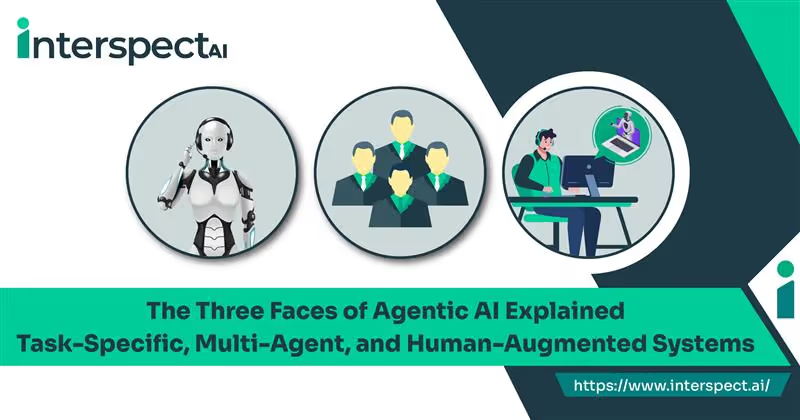

Agentic AI is moving software beyond simply providing answers. It now plans, uses tools, and takes actions to achieve goals with limited supervision. In enterprise settings, three main patterns stand out because they align well with real-world needs: task-specific agents that handle narrow workflows with speed and discipline, multi-agent systems that coordinate specialists for complex, cross-functional goals, and human-augmented agents that build trust by keeping people involved at key checkpoints for judgment and accountability.
Across all three domains, domain fit is decisive. What separates demo-grade systems from production-grade systems is the ability to integrate:
- Industry data, ensuring the agent works with the most relevant and contextual information.
- Validated tools, relying on tested and trusted resources rather than unverified ones.
Policy-aligned prompts and runtime guardrails, keeping outputs consistent with regulations and organizational standards.
Midway through, this article introduces InterspectAI’s practitioner perspective on vertical agents to illustrate how these patterns translate into dependable outcomes in regulated, high-stakes environments.
Task‑specific agents
Task-specific agents are narrow specialists designed to execute a single function or a tightly scoped workflow with consistency and speed. They wrap deterministic tools and rely on clear acceptance criteria, which makes them easier to measure and govern.
- Examples: Customer intent triage and retrieval-grounded answers, policy-aware refund checks, invoice or claim parsing with validation, and symptom capture with intake structured into Electronic Health Record (EHR) ready fields.
- Where this fits: Repetitive, rules-driven work with stable inputs and clear outputs. Goals center on latency, accuracy, and throughput at a single step.
- Industry implications: Retail and e-commerce improve first-contact resolution; BFSI (banking, financial services, and insurance) shortens KYC (Know Your Customer), invoice capture, and claims intake with auditability; healthcare standardizes intake and prior-authorization prechecks with traceability.
Multi‑agent systems
Multi-agent systems coordinate several specialists—planner, researcher, solver, and reviewer—under an orchestration layer to tackle complex, cross-functional objectives. The upside is adaptability and coverage; the trade‑off is coordination overhead and a stronger need for runtime guardrails.
- Examples: Supply chain control towers that combine forecasting, inventory, logistics, and exception handling; cloud operations copilots that align observability, auto-scaling, and cost control; research automation with roles for researcher, summarizer, and critic.
- Where this fits: Objectives that span multiple steps or domains, benefit from parallelism and role specialization, and require resilience when one path fails.
- Industry implications: Manufacturing reduces downtime by aligning planning, quality, and maintenance teams; logistics preserves Service Level Agreements (SLAs) through dynamic routing and carrier negotiation; capital markets separate alpha discovery from risk and compliance teams.
Human‑augmented agents
Human-augmented agents keep people in the loop at explicit checkpoints (plan review, action gating, or post-hoc verification), with explanations on record. This pattern prioritizes trust, accountability, and explainability over maximum autonomy.
- Examples: Clinical summarization and coding with clinician sign‑off before EHR commit; underwriting assistants that draft decisions and route exceptions for human approval; legal discovery copilots that propose categorizations with cited evidence for attorney review.
- Where this applies: Regulated, high-liability, or ethically sensitive workflows; ambiguous data or context where expert judgment is crucial; situations that require documented oversight.
- Industry implications: Healthcare improves documentation speed while preserving quality and fairness; insurance increases throughput without weakening compliance posture; public sector enhances accuracy for citizen services with auditability.
Choosing the right pattern
- Scope and complexity: Choose task-specific agents for narrow, stable workflows; multi-agent systems for cross-functional, multi-step goals; and human-augmented agents when oversight is mandatory or risk is high.
- Risk and governance: As autonomy and coordination increase, invest in runtime guardrails (allowlists, monitoring, reason codes, immutable logs) and add human checkpoints where potential harm or cost is significant.
- Operating model: Start with a narrow, high‑ROI agent; extend orchestration once data quality and governance are proven; layer human review into sensitive decisions to build durable trust.
InterspectAI, in context
InterspectAI is a practitioner of vertical, domain‑specific agent deployments for interviewing, assessments, and other high‑stakes conversational workflows. The approach emphasizes:
- Verticalization: Tuning agents to industry data, tools, and policies so outputs match real‑world constraints and language.
- Guardrails by design: Encoding fairness, privacy, and safety principles into pre‑ and post‑decision checks, scoping tool access, and capturing explanations of records.
- Evidence and traceability: Replayable sessions, structured outputs, and audit‑ready logs that accelerate governance without slowing delivery.
These principles reflect the day-to-day realities in regulated environments such as healthcare, finance, and the public sector, where accuracy, transparency, and compliance must coexist with speed and efficiency.
Conclusion
Viewing agentic AI through three lenses (task-specific, multi-agent, and human-augmented) helps align architecture with reality: speed and consistency for narrow tasks, adaptability for cross-domain objectives, and trust where human judgment is essential. The standard multiplier is verticalization, which combines domain data, validated tools, and policy-aligned prompts with runtime guardrails and immutable evidence.
A pragmatic path is to start narrow, prove value and data quality, then scale orchestration while adding human checkpoints where the stakes rise. This is the discipline InterspectAI practices in high-stakes conversational workflows: design for the domain first, embed guardrails by default, and make decisions auditable. Done this way, agentic systems move beyond demos to dependable, industry-grade outcomes.
FAQs
1. What’s the core difference among the three categories?
Task-specific agents execute one narrow function; multi-agent systems coordinate specialists for multi-step goals; human-augmented agents add explicit human checkpoints for judgment and decision-making.
2. Do multi‑agent systems consistently outperform single agents?
No. They excel at complex objectives but add overhead due to orchestration; for simple tasks, single agents are faster and easier to manage.
3. When is human‑in‑the‑loop non‑negotiable?
In regulated, safety‑critical, or high‑liability workflows where documented human judgment and traceability are required.
4. What’s a pragmatic adoption path?Start with a high-impact, task-specific agent, add orchestration for adjacent steps once it's stable, and introduce human checkpoints for sensitive decisions.
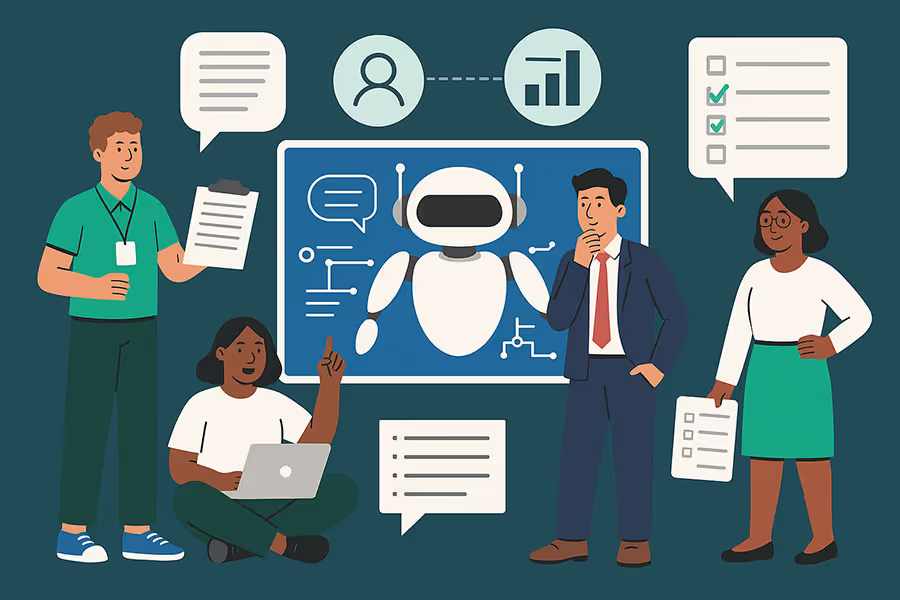
Agentic AI interviews - where autonomous AI “agents” conduct conversations to gather information - are changing how businesses interact with people and data.
These autonomous agents can act independently, make decisions, and adapt to changing situations with minimal human oversight.
In recruiting, for example, AI-driven interviews have already gone mainstream - 58% of companies use AI for video interview analysis during hiring.
But the power of agentic AI-enabled interviews doesn’t stop at hiring. Enterprises are now applying this technology in unexpected ways.
Click here to learn more about AI Agents.
Market Research – AI Interviews for Deeper Consumer Insights
Market researchers traditionally rely on surveys, focus groups, and human interviews to understand customers.
Autonomous agents offer a fresh approach – AI-driven interviews that engage consumers in natural conversations. Instead of filling out static questionnaires, respondents chat with an AI moderator that asks questions, probes for details, and adapts based on responses - much like a human interviewer, but available 24/7 and at massive scale.
This approach is gaining traction. Nearly 47% of researchers worldwide now use AI regularly in their market research activities. Yet fully automated AI interviewing is still in its infancy (currently only ~5% usage among qualitative research methods), so companies adopting it now can leap ahead of the curve. As shown time and again, early adopters will reap the most benefits.
Unprecedented scale and speed
AI interview agent can hold hundreds of conversations simultaneously, reaching far more participants than a human team. This means faster insights and the ability to hear from a large, diverse sample of customers across geographies.
Richer, adaptive conversations
Unlike static forms, an AI agent can ask personalized follow-up questions to dig into interesting answers. This dynamic probing captures nuances and emotions that traditional surveys might miss. Researchers get deeper qualitative insights, not just superficial checkbox data.
Higher engagement, less survey fatigue
Chatting with an AI-powered agent can feel more like a friendly conversation than an interrogation. Early evidence shows it pays off – conversational surveys have boosted response rates by about 27% on average by making the experience more engaging. Participants are more willing to open up when the format is interactive and tailored to them.
Automated analysis
Modern autonomous AI agents don’t just conduct interviews - the agents can transcribe and analyze them in real time. Natural-language processing algorithms pick out key themes, sentiment trends, and common pain points from hundreds of transcripts within minutes.
This saves researchers countless hours that would otherwise be spent coding open-ended responses, allowing teams to act on findings faster.
AI interview agents enable market research that is faster, scalable, and deeply insightful
An autonomous interview agent never gets tired or biased, so every participant gets a thorough, unbiased interview.
For enterprises seeking to truly listen to their customers, that capability is a game-changer.
Looking to conduct thousands of interviews in hours, not months? Analyze trends, extract key insights, and make data-driven decisions at scale with SpectraResearch! Let’s connect.

The idea of practicing with an AI agent before an important interview might seem impersonal—or even intimidating. Many job seekers assume that interview prep, like real interviews, is best done with another human across the table, someone who brings empathy, nuance, and conversation into the process.
But that assumption is changing fast. A growing number of candidates are not only comfortable using AI-powered mock interview tools—they actually prefer them. This trend isn’t about adopting new technology for the sake of novelty. It’s about something more meaningful: the need for a fairer, more transparent way to prepare for the hiring process.
Traditional mock interviews, when available, can feel inconsistent, unclear, or even anxiety-inducing. Feedback is often vague, leaving candidates uncertain whether their performance has actually improved. Many also find it hard to know what hiring managers truly look for.
In this context, AI-powered mock interviews offer something rare: clarity and control. They give candidates a structured environment to practice, learn from objective feedback, and build confidence—before stepping into the real interview room.
Why Mock Interviews Still Matter—And Where AI Helps
The value of mock interviews is well known. They allow candidates to test their thinking, refine their verbal delivery, anticipate tough questions, and reduce nerves before the real thing. However, traditional mock interviews come with their own set of challenges: they can be expensive, difficult to schedule, and sometimes inconsistent, subject to the same human variability as actual interviews.
That’s where AI-powered platforms fundamentally change the game. With agentic AI tools like SpectraSeek, mock interviews are now:
- Available on-demand—practice anytime, anywhere
- Objective and standardized—no guesswork or inconsistent feedback
- Deeply personalized—feedback is tailored to your pace, tone, and content
- Confidence-boosting—no judgment, just progress
Objective Evaluation Builds Trust
At the heart of any interview is a fundamental anxiety: “Will I be judged fairly?” Every candidate wonders whether their background, personality, or presentation style might influence how they’re perceived. These worries are often amplified for individuals from non-traditional backgrounds, underrepresented groups, or those interviewing for the first time.
AI interview agents help neutralize that anxiety. Unlike a human coach or panelist, an AI doesn’t rely on opinions or impressions. It evaluates candidates using criteria directly tied to the role's requirements. Every person is evaluated on the same terms, with no personal bias or favoritism.
For job seekers, this means the focus stays where it belongs: on substance over style. Your content matters more than your charisma. Your clarity matters more than your connections.
This objective approach is one reason so many job seekers now trust AI tools more than traditional coaching sessions. They know the system—whether used during practice with SpectraSeek or in real assessments with SpectraHire—is designed to keep the playing field level.
Consistency Without the "Luck of the Draw"
Another challenge with traditional interviews—and traditional preparation—is inconsistency. One mock coach might provide generous and detailed feedback. Another might be scattershot or rushed. Much like in real hiring, the experience a candidate gets depends heavily on who’s on the other side of the virtual desk.
AI removes that variability. Every interview session is governed by the same structure, pacing, and scoring model. For users, this is incredibly empowering. You don’t have to wonder if someone just “didn’t vibe with you.” The system is built to measure performance, not perception.
You also get the chance to do things human-led interviews rarely allow: re-record your answer. Try different phrasings. Practice until it lands.
This repeatable, reliable structure provides job seekers with a platform where they can truly improve on their own terms.
Feedback That Actually Helps
One of the most frustrating aspects of both real interviews and prep sessions is the lack of clear and helpful feedback. Vague phrases like “be more confident” or “tighten your answers” don’t help candidates grow.
AI-powered mock interviews offer something different: real-time, actionable insight. After answering a question, users receive detailed feedback on:
- How clearly and concisely they communicated
- The relevance of their key points
- Their pacing, tone, and delivery style
- Nonverbal signals via video (like confidence or energy)
This feedback loop helps users not only see what needs improvement, but also how to improve it. And because they can practice as many times as they like, they can turn that feedback into progress before the real interview happens.
A Co-Pilot in a Lonely Journey
Finding a job can often feel isolating. There’s uncertainty at every stage, from writing a resume to hearing the results of an interview. Most of that process happens independently and silently.
That’s why candidates increasingly describe AI-powered preparation tools like SpectraSeek as a “confidence-building co-pilot.” These platforms don’t just test you—they help you grow. And they do it with patience, neutrality, and accessible guidance. Whether you're applying for your first internship or your fifth management position, you'll receive reliable support that aligns with your schedule and goals.
Aligning With Real Hiring Workflows
Perhaps most importantly, candidates are starting to trust AI-powered mock interviews because they know companies are using the same technology to make real decisions. Tools like SpectraHire are being increasingly deployed to conduct structured, bias-resistant interviews at scale.
This offers a unique kind of preparation because the mock interview experience aligns directly with the real-world evaluation. Candidates can walk in knowing not just what to expect, but also how they’ll be measured. That consistency from prep to performance creates a sense of continuity that traditional coaching can’t replicate.
So—Are They Worth It?
Yes. For job seekers who want fairness, clarity, and confidence, AI-powered mock interviews are absolutely worth it.
They don’t replace the human elements of interviewing, but they do replace guesswork with insight, uncertainty with standards, and doubt with preparation. Whether used alone or alongside traditional coaching, AI-led prep is quickly becoming an essential tool in the modern candidate toolkit.
Looking to sharpen your interview skills with objective feedback and real impact? Try SpectraSeek to experience AI-powered preparation that actually works. And when it’s time for the real conversation, count on SpectraHire to deliver structure, fairness, and scale across the hiring journey.
Join the future of hiring—practice smarter, interview stronger, and get hired with confidence.
Subscribe to The InterspectAI Blog