%201.svg)

Are Your Students Ready for the Machine Interviewer?


The shift from traditional, human-led interviews to automated video interviews (AVIs) is not a passing trend; it is the new standard for top employers. This structural change is driven by efficiency: virtual interviews are used in 82% of hiring processes globally, saving companies an average of 30% in costs.
The core challenge facing student interview prep is that AI acts as an objective, structured scorecard. Students prepared for human rapport are often penalized by the AI for technical or non-verbal errors they never knew were being measured, putting them at a competitive disadvantage.
I. The Algorithmic Gatekeeper: Decoding the AI Hiring Process
The machine interviewer is any automated tool—from asynchronous video platforms to AI-powered scoring systems used during the hiring process.
The widespread adoption is fueled by technology: 67% of employers currently use AI to manage their remote hiring processes. These systems bring consistency and scale, but students must understand how the machine scores them.
The Three Data Streams AI Analyzes
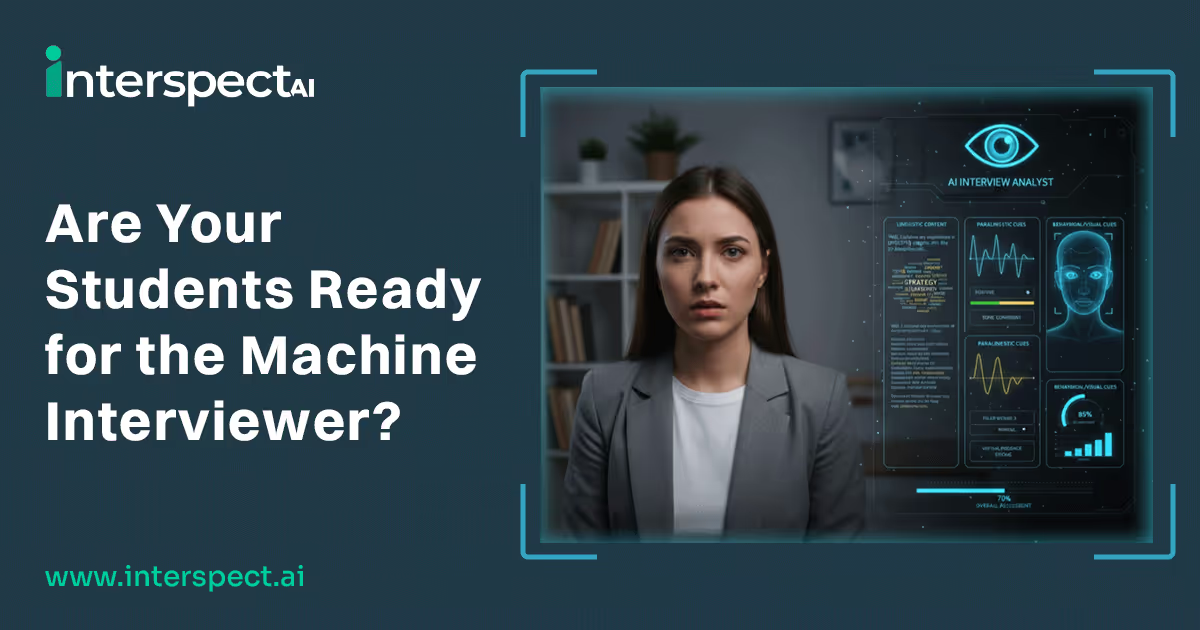
AI assessment systems rely on machine learning (ML) and natural language processing (NLP) to convert subjective performance into standardized, measurable signals:
- Linguistic Content: The AI transcribes speech and analyzes the response structure, use of industry keywords, and relevance to predefined job competencies.
- Paralinguistic Cues: This assesses the manner of speech, including tone, sentiment, and the frequency of filler words or hesitation.
- Behavioral/Visual Cues: For video interviews, the AI monitors non-verbal cues, eye contact (with the camera), and overall virtual presence.
For students, this makes technical delivery just as critical as content. A perfect answer delivered with excessive hesitation may receive a low score for 'confidence' or 'clarity,' regardless of the content's quality.
II. The Psychological Cost and Performance Drop-off
The non-human setting of the automated video interview creates a measurable performance drop-off for students.
- Anxiety and Rigidity: Candidates often report feeling depersonalized during AVIs, compelling them to adopt a rigid, unnatural behavioral style because they struggle to gauge the effectiveness of their responses.
- Performance Penalty: The stress of interviewing in an opaque setting is substantial. Research indicates that performance in stressful interview environments can drop by as much as 40%.
- This creates a detrimental cycle: lack of preparation increases stress, which leads to measurable flaws (like excessive filler words), which are then algorithmically penalized, lowering the final score. The only way to counter this is through high-fidelity, repeated interview simulation.
III. The Strategic Solution: Leveraging Digital Interview Tools
Universities can strategically help students prepare by integrating digital interview tools that normalize the process and provide instant, objective metric refinement.
SpectraSeek by InterspectAI is a leader in this field. Built on proprietary agentic AI, the platform acts as a powerful, hyper-realistic interview agent, providing continuous, 24/7 simulation practice.
Mastering the Algorithmic Scorecard
Preparation must shift from rote memorization to technical optimization:
- Optimize the Technical & Physical Environment: Students must confirm stable connectivity and optimize lighting and background. A clean visual area ensures the AI's video analysis software focuses entirely on the candidate, preventing scoring issues from glare or clutter.
- Focus on Virtual Presence: Candidates must practice maintaining direct eye contact with the camera lens (not the screen image), ensuring their voice is clear and confident, and using animation to project their personality.
- Refine Technical Metrics: Students must use the platform's feedback to practice minimizing negative predictors (filler words, hesitation) and maximizing positive ones (structure, clarity), which the AI specifically tracks. Curriculum alignment is key here; schools like the Villanova School of Business incorporate best practices for AI use into their professional development curriculum.
IV. The Institutional Imperative: Integrating AI Readiness
Integrating student interview prep technology is essential, as better-prepared graduates directly improve placement statistics.
- Mandatory Simulation: Career services must transition from occasional human-led mock interviews to scalable, mandatory AI simulation programs. Digital interview tools like Google's Interview Warmup and adaptive platforms like SpectraSeek provide the objective metrics and repetition needed to normalize the experience and reduce anxiety.
- Hybrid Coaching: The most effective model pairs AI-powered simulation (for scalable metrics) with human coaching. The human advisor’s role shifts from assessing content to interpreting the AI's feedback reports, helping students translate "low sentiment scores" into actionable physical and vocal adjustments.
Technical Mastery Leads to Authentic Performance
The automated video interviews used by major employers demand technical mastery of delivery mechanics. Success requires achieving authenticity by design—internalizing the technical requirements so completely, that students can deliver an optimized response while projecting genuine personality and confidence. By giving students access to sophisticated digital interview tools, institutions ensure the machine interviewer does not filter out their graduates but is instead technically optimized for success.
Ready to Optimize for the Machine?
The era of the automated video interview is here. Ensure your students are trained not just on what to say, but how the machine scores their delivery. SpectraSeek is the platform that provides the necessary technical optimization and personalized feedback for the modern AI hiring process. Discover how our agentic AI can transform student interview prep from guesswork into guaranteed performance.
Frequently Asked Questions
Q: What is the primary difference between a human interview and an automated video interview?
A: Automated video interviews are rigid and use AI to score specific technical metrics—such as vocal tone, hesitation frequency, and eye contact—that a human interviewer might overlook. They rely on standardized criteria applied equally to all candidates.
Q: How does the AI hiring process measure confidence?
A: Confidence is inferred through communication skills analytics metrics, including paralinguistic cues like voice tone, pace, and the absence of filler words. High confidence correlates with low hesitation and clear vocal projection.
Q: How do digital interview tools help reduce interview anxiety?
A: Interview simulation tools provide unlimited practice, normalizing the experience of talking to a camera. This rehearsal is crucial, as research indicates the stress of the machine interviewer can reduce candidate performance by up to 40%.
Q: Where is SpectraSeek positioned in preparing students for the AI hiring process?
A: SpectraSeek is an agentic AI-powered platform that specializes in high-fidelity interview simulation. It gives students the personalized, objective feedback necessary to optimize their non-verbal and linguistic delivery for AI screeners, ensuring they are prepared to succeed in the modern automated video interviews.
You might also like

Hiring has always been a balancing act. Move too fast, and you risk costly mistakes. Take too long, and top candidates slip away. For years, recruitment meant choosing between speed and quality.
But today’s hiring landscape moves faster than ever. Top talent can accept another offer within days, and expectations for a smooth, fair process are higher than ever. This is why the old trade-off of sacrificing one for the other is no longer viable, successful recruiting now demands both speed and quality.
AI interview agents are changing the game, enabling teams to hire quickly without sacrificing accuracy, fairness, or depth of evaluation.
Why Hiring Has Felt Like a Tug-of-War
The pressure is constant. Teams must act quickly to secure talent, but they can’t afford to cut corners on evaluation. In the rush to move candidates through the pipeline, deeper vetting is sometimes skipped, interviews vary wildly from one panelist to another, and decisions are made on gut feeling rather than consistent evidence.
Slow the process down, and you face a new set of problems: frustrated candidates, competing offers, unfilled critical roles, and hiring managers pushing to “just make a decision.” This is a tension every recruiter knows too well.
The AI Shift: Turning Conflict Into Clarity
AI interview agents remove much of this friction. Structured, role-specific interviews can be completed by candidates at their convenience, without waiting for calendar alignment. Every candidate benefits from a structured, thoughtfully designed interview process that ensures a truly level playing field. The AI agents are more than a static script; they ask tailored questions and adapt in real-time based on the candidate's answers, much like a seasoned human interviewer would. This approach allows the platform to analyze a candidate’s reasoning, articulation, and clarity, extracting valuable insights a rushed human might miss.. This means you can assess far more candidates in far less time, with a standard of depth and accuracy that’s hard to match manually.
SpectraHire: Speed Meets Precision
SpectraHire is an autonomous AI interviewing platform designed to boost hiring speed without compromising evaluation quality. By conducting human-like, role-specific interviews at scale, SpectraHire provides instant, standardized candidate assessments that streamline decision-making and enhance recruiter efficiency. Candidates benefit from a seamless, fair, and engaging interview experience available at any time.
Key Capabilities:
- Autonomous AI Interviews: AI agents hold realistic, role-tailored conversations without requiring manual scheduling.
- 24/7 Candidate Access: Candidates interview on their own time, removing scheduling delays.
- High-Volume Processing: Hundreds of interviews can run simultaneously, supporting fast pipeline movement.
- Consistent AI Scoring: Objective assessments, including sentiment analysis, reasoning analysis, and communication analysis, reduce bias.
- Instant Results: Immediate candidate rankings and detailed summaries accelerate hiring decisions.
- Real-Time Dashboards: Hiring metrics and process insights are readily available at a glance, enabling you to track performance.
- Seamless ATS Integration: Easily fits into existing applicant tracking and recruitment workflows.
Spectra: The Foundation Platform for All Interview Needs
Spectra serves as the core AI interview platform that powers intelligent conversations across any use case or industry. Rather than being limited to hiring, Spectra provides the foundational technology that can be embedded into any product or workflow requiring human-like interview capabilities. From recruitment and market research to compliance audits and academic assessments, Spectra adapts to meet diverse conversational needs.
Key Features:
- Agentic AI Conversations: Engages participants with dynamic, context-relevant dialogue, simulating natural, insightful interactions
- Video Recordings: Allows users to replay full interviews or jump instantly to specific questions and answers
- Instant Automated Insights: Provides immediate scoring and detailed assessments of participant behavior and communication
- Structured Data Extraction: Exports configurable, structured interview data in JSON for easy integration with other systems and analytics platforms
- Bias Reduction: Employs non-profiling algorithms designed to minimize unconscious bias and promote fairness and objectivity
- Seamless Integration: Easily integrates into any application via minimal code, supporting scalable and flexible deployment across different workflows
SpectraHire and Spectra: Platform Relationship
To better understand how these two platforms work together to deliver both speed and quality in hiring, here’s a detailed comparison of their core features:
What This Means for Your Hiring Process
When speed and quality finally work together, the impact is tangible. Candidates appreciate a transparent and respectful process that proceeds at a comfortable pace. Recruiters can spend their time where it counts in building relationships, assessing cultural fit, and supporting hiring managers, instead of juggling endless scheduling and repetitive screening.
Every decision-maker gets a complete, unbiased view of each candidate, supported by rich data. The result? Faster hires, better hires, and far less second-guessing.
Final Take: Hiring Without Compromise
The belief that you must choose between speed and quality in hiring is outdated. With AI interview agents like SpectraHire, strengthened by Spectra’s deep analytics, you can conduct interviews at scale, evaluate with consistency and accuracy, and make confident, well-supported decisions — all in a fraction of the time compared to what traditional processes require.
Ready to stop choosing between speed and quality?
See how SpectraHire and Spectra can work together to transform your recruitment!
FAQs
How do AI interview agents maintain quality while moving fast?
By using standardized, role-specific questions combined with AI-driven analysis to deliver consistent, objective evaluations immediately.
Will AI interviewers replace human recruiters?
No. AI handles repetitive, early-stage screenings, allowing recruiters to focus on the high-value, human elements of hiring.
Can AI help reduce bias?
Yes. AI can be a powerful tool for reducing bias. Spectra specifically addresses this by using non-profiling algorithms to ensure fair and objective interviews.
What is the difference between Spectra and SpectraHire?SpectraHire is the AI interviewer that conducts and scores interviews; Spectra is the analytics engine that turns that data into strategic hiring insights.

As a UX researcher, you live for the "aha!" moment. That flash of insight when you finally understand why a user hesitated, sighed, or abandoned a task. You know the most valuable feedback isn't just about what users click—it's about how they feel.
But capturing that feeling is tough.
Traditional UX interviews are powerful, but they’re manual and slow. You can only talk to a handful of users. You spend hours transcribing, coding, and trying to connect the dots.
By the time you have a report, the sprint is already over.
And the subtlest clues—a moment's pause, a slight change in tone—are often lost in your notes or simply impossible to quantify across interviews.
What if you could bottle that "aha!" moment and get it at scale?
Scale, Nuance, and Context: Why Agentic AI-Powered Interviews Are Simply Better
Imagine deploying an AI agent trained for UX interviews to conduct one-on-one sessions with hundreds of users simultaneously.
With AI agents for UX, you get:
- Instant, Perfect Transcripts: Every conversation is transcribed and searchable the moment it ends.
- Structured Data: The AI agent can extract key themes, mentions, and sentiment, turning unstructured conversations into structured, analyzable data.
- The Nuance Layer: This is the real superpower. Our AI agents are built for emotional tone analysis. They capture the unspoken feedback hidden in human conversation—the hesitation before an answer, the frustration in a user's voice, or the excitement when they discover a feature they love.
The Emotional Edge: What Traditional Tools Can’t Hear
Most UX researchers have a good ear. You know when a user’s saying something nice but actually means, “This sucks.” But multiply that by hundreds of conversations, and your brain will start tuning out the subtleties.
That’s where a UX AI agent shines. It doesn’t just log user actions or scan transcripts—it listens like a therapist with perfect memory.
Pauses? Noted. Rising pitch when discussing pricing? Logged. A sudden drop in energy when a certain feature is mentioned? Flagged.
This isn’t just emotional tone analysis—it’s empathy at machine scale. It’s what lets teams go beyond the surface of what users say and uncover how they actually feel about their experience.
Building the Feedback Flywheel with AI
Imagine this: Every product feedback interview your AI agent conducts feeds a loop of continuous improvement. Not quarterly. Not monthly. Weekly, even daily.
When you use AI agents for UX, you're not just testing usability—you’re capturing sentiment in near real time. The result? A living, breathing insights engine that grows smarter over time.
For fast-moving product teams, this means:
- Releasing features that actually land
- Catching emotional friction before it becomes churn
- And testing hypotheses before they even hit your roadmap
Think of it as the difference between having a suggestion box... and having 100 candid, insightful coffee chats with your users every week.
How to Integrate AI Agents into Your UX Workflow
Bringing UX research AI into your process is straightforward. Here are a few best practices:
- Start with Open-Ended Questions: Don't lead the user. Design questions that encourage storytelling, and let the AI agent handle the follow-ups.
- Focus on "Why," Not "What": Use AI agents for exploratory research. Let them uncover the emotional drivers and pain points that you can later validate with quantitative testing.
- Combine Insights: Layer the emotional and tonal insights from your AI interviews on top of your existing analytics and usability data for a complete picture of the user experience.
- Test, Learn, Iterate: Start with a small batch of interviews. Use the insights to refine your questions and hypotheses, then scale up to gather more data.
What to Look for in a UX AI Agent
Not all AI tools are created equal. Some are glorified transcription engines. Others are souped-up survey bots. Here's what truly matters when evaluating a UX research AI tool:
- Conversational UX fluency: Can it hold natural, unscripted conversations without sounding robotic?
- Real-time emotion detection: Does it capture tone, pace, hesitation, and tell you why it matters?
- UX-native analytics: Are the outputs usable for product, design, and leadership? Or are you just handed a data dump?
Spectra checks these boxes because it was purpose-built for carrying out human-like conversations. That means more natural interviews, richer insights, and fewer “how did we miss this?” moments.
The Next Chapter in UX Research
At the heart of UX is a simple truth: people don’t always say what they mean.
They pause. They hedge. They say “it’s fine” when something isn’t. And when you’re running lean, chasing deadlines, and juggling a million priorities, it’s easy to miss the stuff that really matters.
That’s where AI can help—not by replacing the researcher’s eye, but by amplifying it.
With AI-led interviews, you don’t just get more data. You get a deeper understanding. You hear the hesitation, the excitement, the subtle emotional friction that tells you what no heatmap ever could.
And that means better products—not because a machine told you what to build, but because it helped you hear your users a little more clearly.
In the end, it’s still about empathy. You’re just bringing a little extra firepower to the job.
Buzzwords -action verbs like "implemented" or adjectives like "innovative" can elevate your resume from bland to alive. They catch the eye, demonstrate action, and add clarity.
Yet, not all buzzwords carry real weight. Overused clichés like "team player" or "results-driven" have become resume wallpaper - seen so often they’ve lost meaning. Recruiters often skip them, sensing filler, not substance.
Buzzwords that often cringe recruiters out
Here are some resume cliches to avoid, and why they backfire,
- “Team player,” “detail-oriented,” “results-driven,” “hardworking,” “problem solver,” “creative,” “go-getter” - These are vague and overused, which makes them forgettable at best and cringe-inducing at worst.
- “Responsible for,” “proven track record,” “strong work ethic” - Empty fluff. Saying you’re responsible or ethical is less impactful than showing what you achieved.
- “Hard worker,” “self-motivated,” “born leader,” “excellent communication skills,” “detail-oriented” - All common in job-seeker soundbites, but rarely backed with concrete evidence.
One recruiter on Reddit put it bluntly:
"Do you think using terms like 'detail-oriented', 'driven', or 'highly motivated' are gonna cut it? Absolutely not."
Instead, they want real data - years of experience, industries, measurable impact.
Use buzzwords wisely by being impactful and not generic
Here’s what works and how to use it right.
1. Opt for Strong Action Verbs
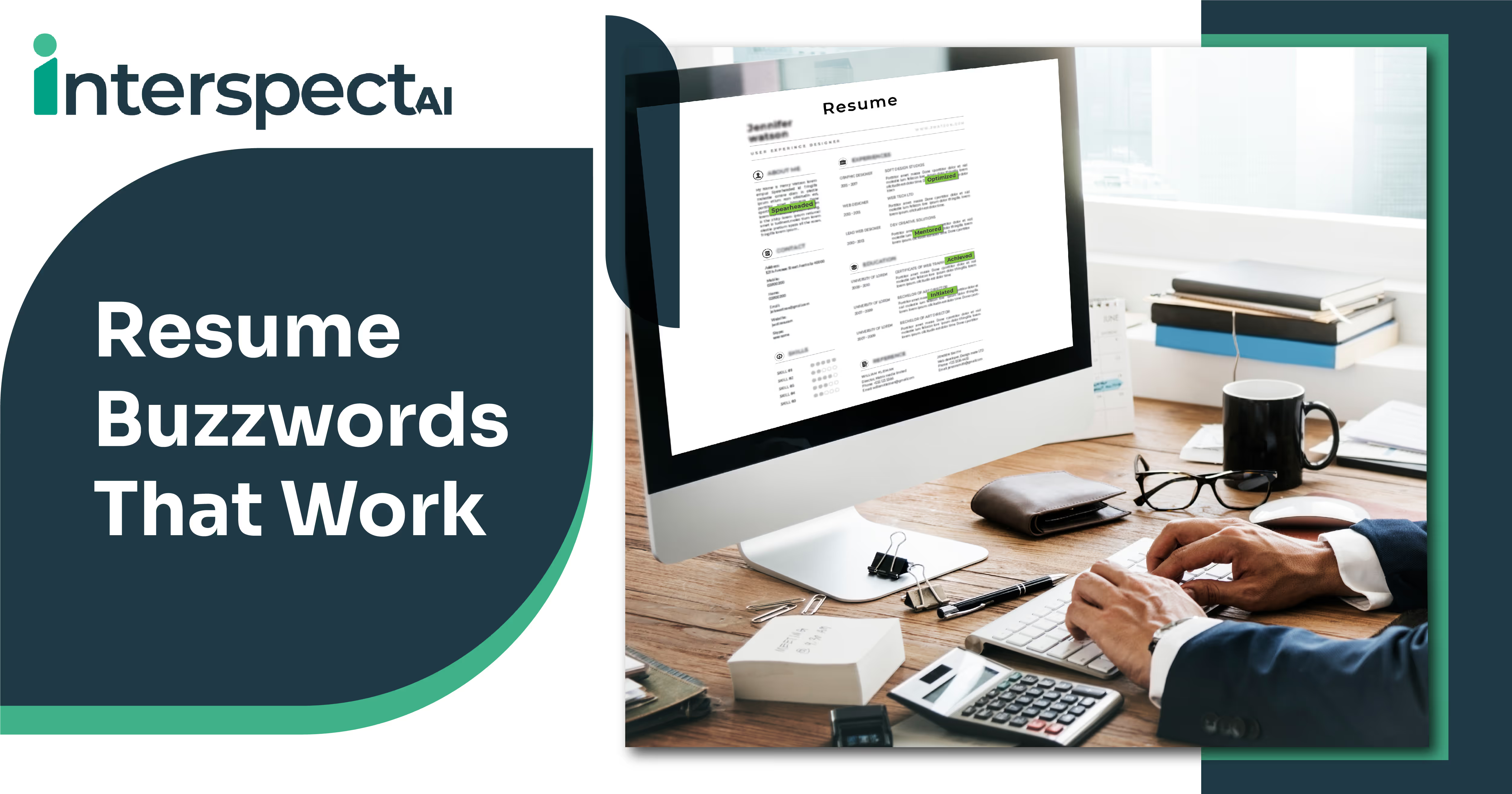
Choose verbs like "achieved," "managed," "implemented," "spearheaded," "optimized," "resolved" - they frame you as someone who does, not just is.
2. Quantify Your Impact
Replace vague claims with measurable outcomes:
- Instead of "improved sales," say “increased sales by 25% in Q1”.
- Swap “led a team” with “managed a team of 8 to deliver a project two weeks ahead of schedule”.
3. Tailor to Job Context
Mirror keywords from the job posting - ATS (Applicant Tracking Systems) value accuracy - but only if you can substantiate them with real examples.
4. Be Specific, Not Generic
Instead of saying you’re a "creative thinker," talk about the campaign you designed that drove 50% traffic growth.
Buzzwords that actually work when used thoughtfully
Here’s a curated list of effective buzzwords - powerful, specific, and action-focused:
- Active achievement verbs: Achieved, Initiated, Managed, Implemented, Led, Designed, Resolved, Improved, Analyzed, Developed, Spearheaded, Innovated, Negotiated, Orchestrated, Optimized, Collaborated, Mentored, Exceeded.
- Alternatives to tired adjectives: Use domain-specific, measurable language instead of fluff like “creative.” Provide outcomes.
- Industry-specific terms (when real):
- Marketing: SEO, Omnichannel marketing, SERP, AI, Customer journey.
- Project Management: Risk management, Cost management, Gantt chart, Process improvement.
- Teaching: Blended learning, Accessibility, Mastery-based grading.
Quick Table: Buzzwords to Avoid vs. Better Alternatives
Make every word earn its place!
Keep it real. Use terms you can back up - false claims risk credibility.
Mix sentence length for flow. Start with a short punch, then expand with context.
Use transition words like “however,” “meanwhile,” “in short,” to guide the reader.
Focus on achievements, not adjectives. Every bullet should show what and how you did something.
Buzzwords aren't inherently bad - misused ones are. Avoid the clichés that blur into the background. Instead, choose words that show, not tell. Quantify impact. Tailor each resume. That’s how your resume becomes memorable, not just legal-sized.
Your resume gets you noticed, but your interview seals the deal. Practice smarter with SpectraSeek, the AI tool that helps you refine answers and leave clichés behind!
Subscribe to The InterspectAI Blog