%201.svg)


The landscape of career development is shifting beneath our feet. For years, the conversation around technology in recruitment focused on Applicant Tracking Systems (ATS) and keyword optimization. Today, that narrative is shifting. We are entering an era defined by AI in career coaching trends that go far beyond simple resume scanning. The emergence of autonomous agents, sophisticated behavioral analysis, and skills-based evaluation models is fundamentally changing how companies hire and, consequently, how universities must prepare their students.
For career coaches, staying relevant means understanding these shifts. It is no longer enough to teach students how to write a resume. Coaches must now prepare the future of work for graduates' literacy, helping students navigate a hiring ecosystem where they are just as likely to interview with a machine as with a human.
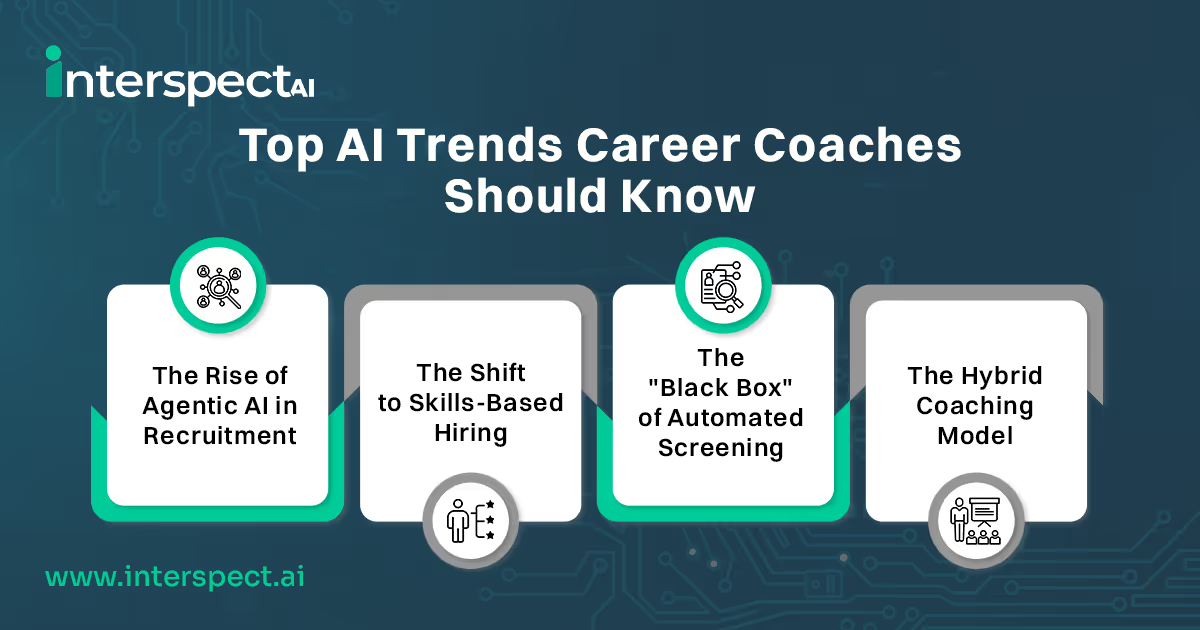
Trend 1: The Rise of Agentic AI in Recruitment
The most significant technological leap in hiring is the move from passive tools to active agents. Traditional AI tools were reactive. They waited for a recruiter to input a query. Agentic AI is proactive. These systems can autonomously source candidates, schedule interviews, conduct screening calls, and even answer candidate questions about company culture.
For the career coach, this means students are facing a new kind of gatekeeper. They are not just trying to get past a keyword filter; they are interacting with a system that can reason. These agents are designed to probe for competency and consistency. A student can no longer rely on rehearsed, generic answers because an agentic interviewer will ask specific follow-up questions based on the real-time content of their response. Coaches must train students to handle dynamic, multi-turn conversations with AI, emphasizing clarity, logic, and specific examples over buzzwords.
Trend 2: The Shift to Skills-Based Hiring
We are witnessing a decline in the primacy of the degree and a rise in the currency of the skill. Automated recruitment tools now emphasize demonstrable capabilities over background, evaluating candidates purely on the quality and relevance of their skills. These platforms use complex algorithms to infer a candidate’s potential by analyzing their project outcomes, portfolios, assessments, and other verifiable indicators of competence.
This trend requires a pivot in coaching strategy. Instead of emphasizing broad experience summaries, the focus now needs to shift toward articulating specific, verifiable skills that AI-driven systems can easily interpret. Coaches must help students audit their skill sets and make those competencies visible to AI-based assessment models. This calls for a deeper level of resume optimization, where project descriptions are structured to highlight the tools, techniques, and problem-solving approaches used rather than listing general responsibilities.
Trend 3: The "Black Box" of Automated Screening
One of the most daunting coaching technology trends is the opacity of the initial screening process. Major enterprises now use AI to conduct the first round of video interviews. These systems analyze not just what a candidate says, but how they say it. They measure paralinguistic cues like tone, pace, and hesitation to infer traits such as confidence and communication ability.
This creates a black box for students. They complete a video interview and receive a rejection without ever knowing if it was their technical answer or the speaking pace that disqualified them. Career coaches must step in to demystify this process. Training must now include ‘performance’ coaching, helping students understand how to project confidence and engagement through a camera lens, as this is often the primary metric by which they are initially judged.
Trend 4: The Hybrid Coaching Model
The final trend is internal to the career center itself. The sheer volume of students and the increasing complexity of the job market are making the traditional, purely human-led coaching model unsustainable. Forward-thinking centers are adopting a hybrid model. They use AI tools to handle the repetitive, high-volume tasks of resume review and initial interview practice, reserving human advisors for high-level strategy and emotional support.
This allows the career coach to evolve from a generalist practitioner into a specialized strategist. Instead of spending hours correcting grammar on resumes, coaches can use data from AI platforms to identify systemic weaknesses in a student's profile and develop targeted intervention plans.
InterspectAI: The Coach’s Secret Weapon
Adapting to these trends requires the right infrastructure. InterspectAI offers a solution that aligns perfectly with this new reality through its SpectraSeek platform. Unlike generic tools, SpectraSeek is designed to reflect the advanced AI-driven hiring workflows that students increasingly encounter in modern recruitment processes.
Here is how InterspectAI empowers coaches to stay ahead:
- Simulating the Agentic Interview: SpectraSeek allows students to practice with AI agents that conduct dynamic, multi-turn interviews, similar to the structured, reasoning-based interactions used in modern hiring workflows. These agents ask domain-specific follow-up questions, encouraging students to think critically, provide clearer examples, and move beyond memorized responses.
- Making the Screening Process Transparent: The platform surfaces objective, structured feedback that students rarely receive from real interviews. It generates insights such as Overall Candidate Fit, Interview Readiness, Authenticity Score, Role Alignment, Communication Skills/Confidence, Skills Breakdown, Technical Proficiency, Experience Areas, and detailed Response Insights. This gives coaches a clear picture of where a student is performing well and where targeted coaching is needed.
- Meaningful Skills-Based Feedback: InterspectAI’s evaluation framework goes beyond keyword matching. It assesses the technical relevance, clarity, and accuracy of a student's responses, helping them refine how they articulate their skills for AI-driven assessments and real-world interviews.
Conclusion
The era of AI in recruitment is not coming; it is already here. For career coaches, the choice is to ignore these trends and risk obsolescence or to embrace them and become more effective than ever. By integrating tools that mirror the reality of the market, coaches can ensure their students are not just surviving the algorithmic hiring process but thriving in it.
The future of coaching is not about competing with machines. It is about leveraging them to unlock the full potential of every student.
Prepare your students for the agentic future. Equip your career center with the technology that mirrors the modern hiring landscape. Partner with InterspectAI today to bring SpectraSeek to your campus and give your students the competitive edge they deserve.
FAQs
What is agentic AI, and how does it differ from a chatbot?
Unlike a standard chatbot that follows a rigid script, agentic AI has the ability to reason, plan, and pursue goals autonomously. In recruitment, this means an agent can conduct a dynamic interview, asking follow-up questions based on the candidate's specific answers and adapting the conversation flow in real-time, much like a human recruiter would.
How can career coaches help students prepare for AI assessments?
Coaches should focus on "AI literacy" and communication mechanics. This involves training students to speak clearly and logically, as AI tools analyze structure and coherence. Using simulation platforms like SpectraSeek allows students to practice against these algorithms and receive objective data on their performance, which coaches can then use to refine their guidance.
Will AI tools make the role of the career coach obsolete?
No. AI tools are designed to handle the repetitive, high-volume tasks of preparation, such as mock interviews and basic resume checks. This actually enhances the value of the human coach, allowing them to focus on high-stakes strategy, networking, and providing the emotional support that machines cannot emulate.
Why is skills-based hiring becoming more popular?
Employers are increasingly finding that degrees alone do not predict job performance. AI skill assessment tools allow companies to verify actual competencies and practical abilities, leading to better quality hires. This shift democratizes opportunity but requires students to be able to articulate and demonstrate their specific skills clearly.
You might also like

When was the last time you genuinely enjoyed filling out a long survey or a tedious form? Probably never.
Forms and surveys, although traditionally popular, often lack the depth, context, and human touch that meaningful interactions require.
Smart teams have noticed - and they're rapidly switching to AI-powered interview agents to revolutionize assessments, market research, and qualitative insights.
Let’s explore why businesses are making this shift and how it can profoundly enhance your team's efficiency and outcomes.
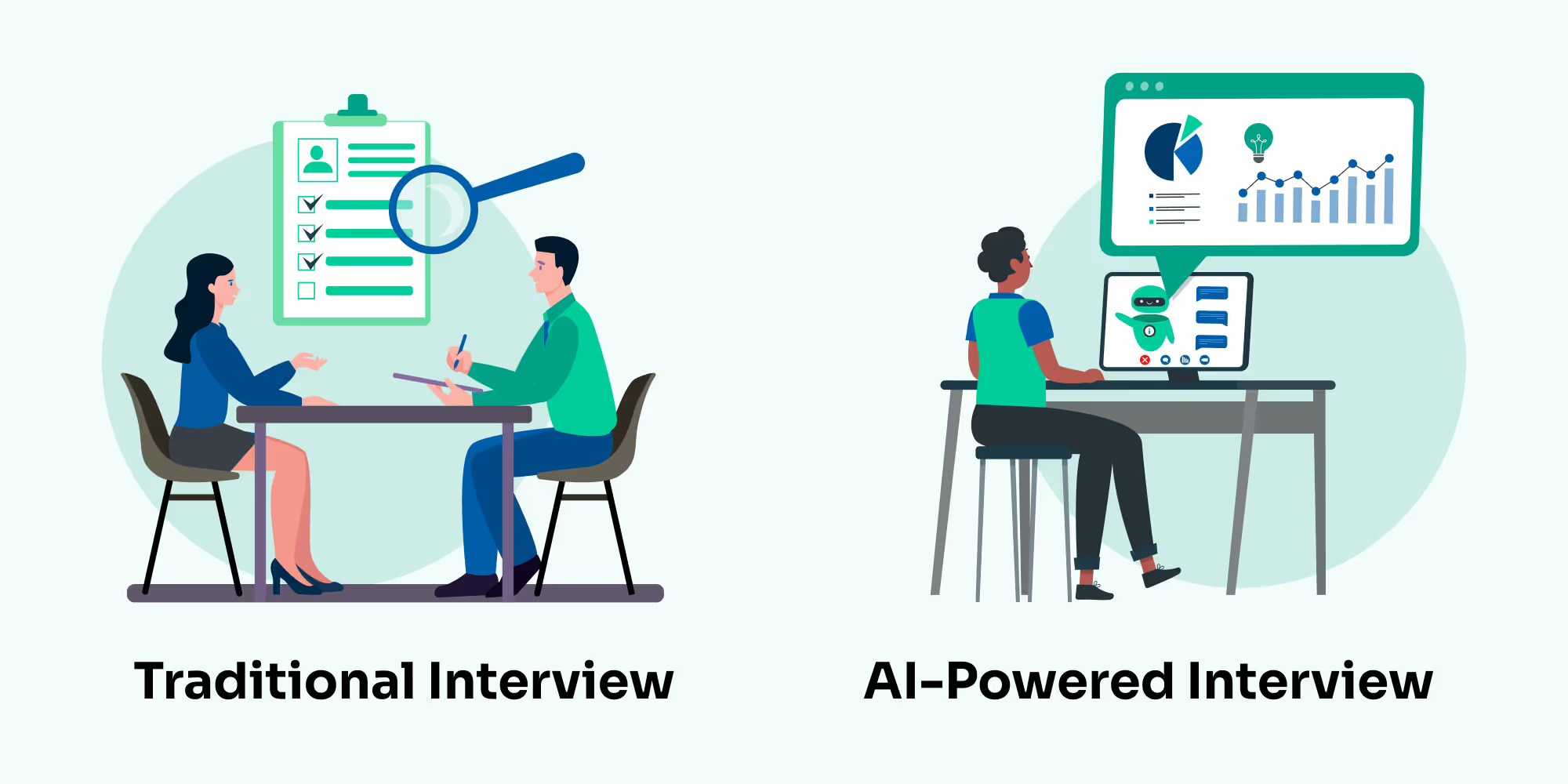
Forms are out, conversations are in
Traditional methods like surveys and static forms can be limiting. Respondents often lose interest quickly, leading to incomplete or inaccurate data. AI interview agents, however, leverage conversational intelligence, making interactions intuitive, engaging, and incredibly insightful.
According to Gartner, the number of organizations adopting conversational AI agents for customer interactions and internal assessments have drastically increased.
By 2029, agentic AI is expected to autonomously resolve 80% of common customer service issues without human intervention, leading to a 30% reduction in operational costs. Gartner further predicts that conversational AI deployments within contact centers will reduce agent labor costs by $80 billion by 2026.
Conversational AI can automate all or part of a customer interaction through voicebots or chatbots across both voice and digital channels, with transformational benefits for customer service and support organizations within two years.
Automating full interactions can lead to significant cost savings, and even partial automation, such as identifying a customer's name and reason for calling, could reduce interaction time by up to a third for human agents.
AI agents for interviews is not just trendy - it's highly impactful
We’ve all rolled our eyes at another “quick” form that turns into a scroll marathon. Turns out, the better way to get real answers? Just talk to people (or rather, let your AI agent do it).
Personalization that engages and retains attention
Traditional forms and surveys adopt a one-size-fits-all approach, often neglecting individual preferences and nuances. AI-powered interview agents, however, dynamically adapt questions based on real-time interactions and prior responses.
This not only keeps respondents engaged but also ensures higher-quality insights and deeper context, thanks to how AI agents personalize interviews.
Real-time insights for agile decision-making
With static forms, insights usually arrive long after the information is gathered, limiting actionable intelligence. AI-driven interviews, on the other hand, offer real-time data collection and analysis.
This instant feedback loop empowers teams to quickly identify trends, pivot strategies, and make informed decisions with agility and confidence, giving businesses a competitive advantage.
Enhanced scalability without compromising quality
Scaling traditional surveys and forms can be cumbersome, costly, and often results in diminishing returns on data quality. AI-powered interview agents effortlessly scale to engage thousands of respondents simultaneously, consistently maintaining interaction quality.
Businesses can rapidly expand their data collection efforts without substantial resource investment, achieving broader reach and deeper insights.
Uncover hidden patterns with advanced analytics
AI interview agents aren't just adept at conversation - they excel at data interpretation. Leveraging advanced natural language processing (NLP) and machine learning algorithms, these agents analyze nuanced responses, extracting sentiment, emotions, and subtle contextual cues often overlooked in conventional methods.
This capability enables organizations to uncover hidden patterns, anticipate customer needs, and predict future trends with remarkable accuracy.
Elevating user experience and brand perception
A seamless and engaging interaction significantly enhances user experience, directly impacting brand perception. AI conversational agents create natural, enjoyable interactions, reflecting positively on the brand and fostering long-term loyalty.
Teams adopting conversational AI find that users not only provide richer data but also view the company as innovative, empathetic, and customer-centric.
Getting started on transitioning from forms to AI interviews
Switching from traditional methods to AI-powered conversational agents may sound daunting, but it doesn't have to be.
Begin by identifying critical areas where deeper insights are essential. Pilot AI interviews for internal assessments or targeted customer segments. Measure the improvements in engagement, response quality, and insights gained, and iterate quickly.
With incremental adoption, teams can smoothly transition to this transformative method of collecting and utilizing data.
Want to position your team for smarter decisions, deeper insights, and sustained growth? Let’s connect!
Every spring, career services offices celebrate their strongest cohorts. Students with stellar GPAs, polished resumes, and impressive internships head into recruiting season with confidence. And every spring, a troubling pattern repeats: some of the most talented graduates stumble at the interview stage, not because they lack knowledge, but because they never learned to perform under the conditions modern employers now use.
The problem is not aptitude. It is preparation misalignment.
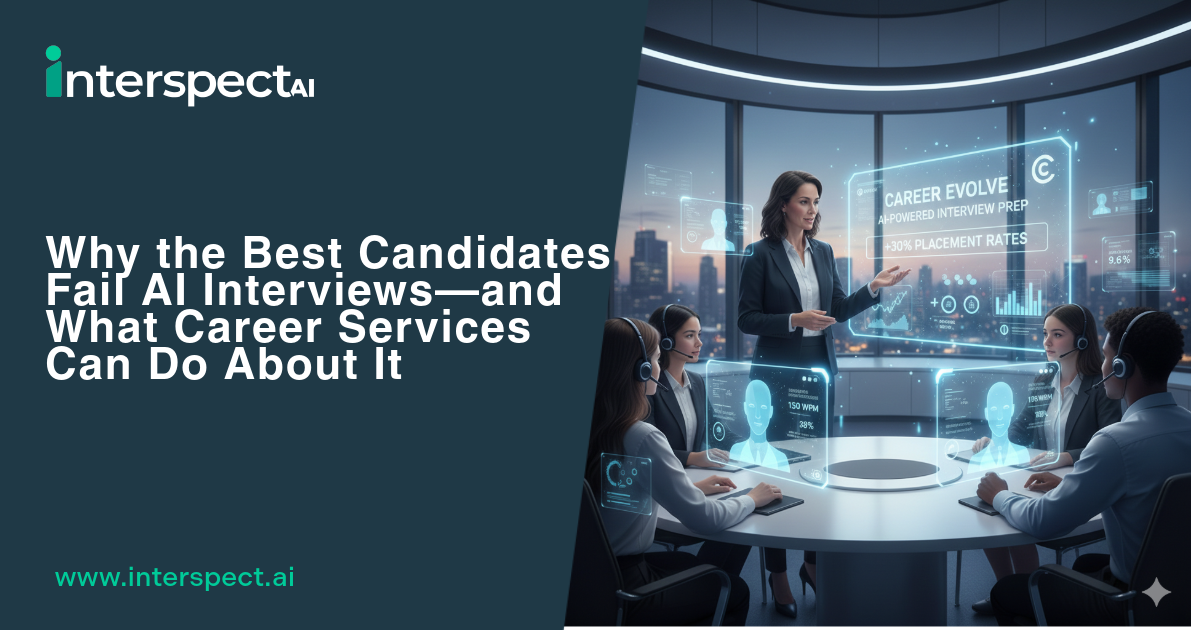
In recent years, hiring processes at mid- to large employers have shifted dramatically. According to surveys conducted in 2025, more than 60 percent of companies with more than 500 employees now use some form of AI-assisted interviewing in their first-round screening. These systems evaluate candidates on dimensions that traditional mock interviews rarely address: speech pacing, response structure, filler word frequency, facial engagement, and the coherence of answers under adaptive follow-up questioning.
Students trained through conventional career center workshops—where a counselor conducts a 20-minute behavioral interview once or twice a semester—are practicing for a format that increasingly does not exist. The gap is not one of intelligence. It is one of exposure.
Consider what a typical AI video interview measures. The candidate sits in front of a camera and responds to questions delivered by an automated system. There is no conversational warmth, no encouraging nod from a human interviewer. The system logs speaking pace in words per minute, counts filler words, tracks eye contact as a percentage of total response time, and evaluates answer relevance against a rubric. Students who have never encountered this format often underperform, not because their answers are weak, but because their delivery patterns trigger low scores on metrics they did not know existed.
This creates a paradox for universities. Their strongest students may be the ones most affected, because high-achievers often rely on interpersonal rapport to shine in interviews. When that rapport is removed—replaced by an algorithm—their advantage disappears.
The solution is not to abandon human career advising. It is to augment it.
Universities that have introduced AI-powered interview practice platforms report significant improvements. When students can rehearse against an adaptive AI interviewer that mirrors the systems employers actually use, they learn to calibrate their delivery to algorithmic evaluation. They discover their unconscious habits—the verbal tics, the tendency to ramble, the nervous glance away from the camera—and they correct them before those habits cost them an offer.
The data supports this approach. Institutions that integrated AI practice tools into their career readiness programs in 2024 and 2025 saw measurable gains. Placement rates at pilot universities rose between 20 and 35 percent within a single academic year. Student satisfaction with career services increased because counselors, freed from repetitive mock-interview sessions, could devote more time to high-value activities such as salary negotiation coaching, industry-specific strategy, and networking guidance.
For career services directors weighing this shift, the calculus is straightforward. The cost of an AI interview platform is a fraction of a single counselor’s salary. The return—measured in placement outcomes, student satisfaction, alumni engagement, and institutional reputation—compounds over time.
The question is no longer whether AI interview preparation belongs in higher education. It is whether your institution will adopt it proactively or reactively—and how many graduating classes will pass through underprepared before the change is made.
Career services teams that act now position their universities as leaders in student outcomes. Those that wait will find themselves explaining why their placement rates lag behind peer institutions that moved faster.
The best candidates deserve preparation that matches the reality they face. AI-driven hiring is that reality. It is time career services caught up.
Hiring is changing at breakneck speed. And it’s not just on the companies’ side.
Where once job seekers sharpened their answers in front of friends and mirrors, they now reach for AI‐powered interview agents.
Since employers are turning to AI-powered hiring tools, AI interview preparation is becoming central to job readiness for candidates.
Candidates are already using AI – and it’s not just for résumés
AI isn’t some fringe tech used by a few early adopters. In iHire’s 2025 multi‑generational workforce survey, 40.7% of U.S. job seekers said they have used AI tools (ChatGPT, Perplexity, Gemini, and similar) to make their job search more efficient.
Writing and customizing résumés are the most common use cases (19% and 16.2% respectively), but 11.5% of candidates already use AI to prepare for interviews or create practice questions.
Adoption is strongest among younger professionals – 17.2% of millennials use AI tools for interview prep Meanwhile, 31.5% of candidates who haven’t used AI yet plan to do so.
This widespread adoption coincides with a surge in AI usage by recruiters. Research shows that 72% of recruiters find AI particularly helpful for candidate sourcing, 56% say AI is most advantageous in screening candidates and 55% use it for nurturing applicants.
Clearly, both sides of the hiring equation are turning to technology.
AI interview agents are practice partners, not human replacements
AI interview agents (sometimes called Agentic AI powered interview prep tools) simulate real interviews. They ask behavioural and technical questions, evaluate responses, and provide data‑driven feedback. Unlike static question lists, these systems adjust questions based on the candidate’s skill level and job requirements, making practice sessions far more realistic.
The benefits extend beyond convenience.
Personalized feedback and analytics. AI systems can parse tone, body language, and keywords to highlight strengths and areas for improvement. This goes far beyond generic “good job” praise and helps candidates build specific skills.
Scalability and accessibility. Candidates can practice anytime, anywhere without scheduling a coach. Recruiters also benefit; companies like Hilton have reduced their time‑to‑fill ratio by 90% and improved their hiring rate by 40% after using AI‑powered recruitment tools.
Reduced anxiety and improved confidence. AI mock interviews allow candidates to practice repeatedly, reducing the “fear of the unknown.” Although hard numbers are still emerging, early studies suggest candidates selected by AI are 14% more likely to pass the interview stage and 18% more likely to accept a job offer than those selected by humans.
Importantly, these tools aren’t meant to replace human coaches. ResumeBuilder’s survey of hiring managers found that 85 % of companies using AI interviews still rely on humans to make final decisions. AI interview prep is best viewed as a “sparring partner” that helps candidates hone their responses before meeting a human interviewer.
How AI interview prep improves job readiness
Job readiness is no longer just about ticking boxes on a checklist, as being able to communicate your value clearly, confidently, and consistently is what’s sought after. And AI interview prep is helping candidates do exactly that.
Whether you're applying to your first role or your fifth promotion, AI-powered mock interviews offer something traditional prep cannot - real-time feedback that evolves with you. These intelligent tools don’t just ask questions - they assess your tone, pacing, content, and even your confidence levels.
Here’s how AI interview prep sharpens your edge.
Smarter practice, faster progress. Unlike a rehearsed script with a friend, AI agents adjust questions based on your role, industry, and previous answers. That means every session pushes you a little further.
Clarity through feedback. These tools don’t sugarcoat. They give detailed, actionable feedback, flagging filler words, vague responses, and unclear storytelling, so you can polish your pitch.
Confidence built through repetition. The more you practice, the more natural it feels. AI lets you rehearse tough questions anytime, reducing interview anxiety and helping you show up prepared, not panicked.
Prep that mirrors real interviews. With more companies using AI in hiring, it only makes sense to prep with the same tools. Practicing with AI interview agents means you’re training on the same playing field as today’s tech-savvy recruiters.
AI interview prep builds the soft skills that matter - clarity, composure, and credibility -while aligning candidates with the realities of modern hiring, making it a catalyst for readiness.
AI interview preparation is a reflection of a broader trend toward data‑driven hiring and self‑directed learning.
With 40.7% of job seekers already using AI tools in their search and nearly half of employers planning to use AI interviews, AI interview agents are poised to become the standard.
The key for recruiters, CHROs and company founders is to embrace these tools responsibly.
As with most technology, the goal isn’t to replace humans but to amplify their impact.
Candidates who practice with AI arrive more confident and self‑aware; recruiters who leverage AI have more time for meaningful interactions.
Together, these forces usher in a future where job readiness is accessible, data‑driven and, most importantly, human‑centred.
Subscribe to The InterspectAI Blog