%201.svg)

The Confidence Gap in Campus Recruiting: How Structured Practice Outperforms Talent Alone


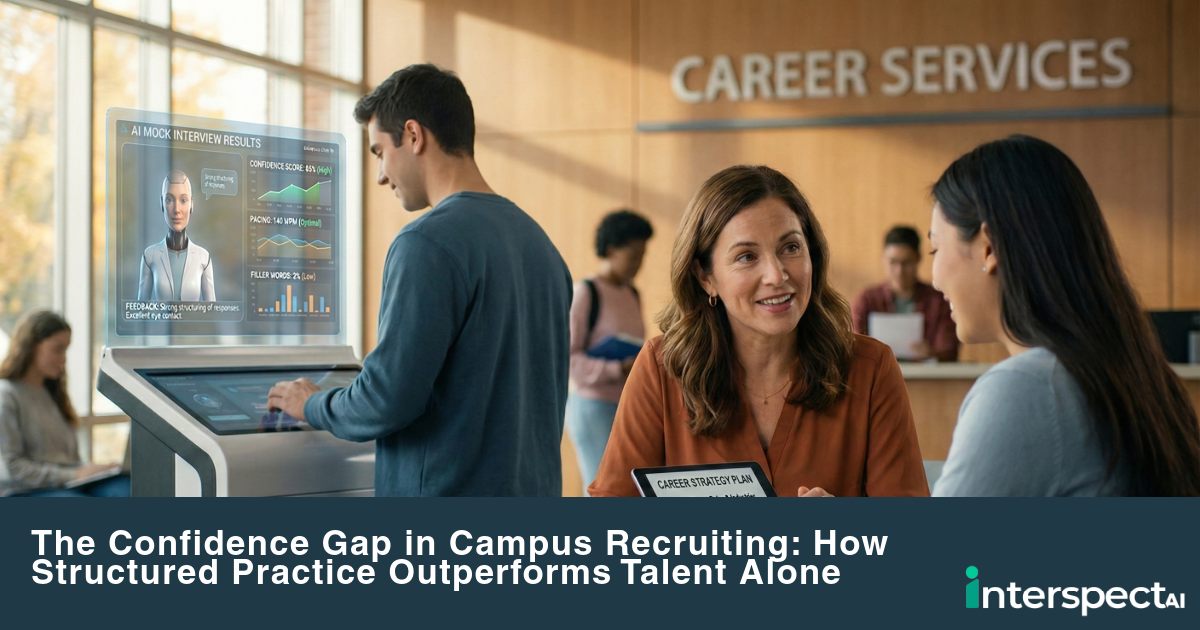
There is a moment in every job interview where preparation either holds or it doesn’t. It’s not the first question, which most candidates expect. It’s the follow-up—the unexpected probe, the “tell me more about that,” the curveball that tests whether a candidate truly understands their own experience or was simply reciting rehearsed lines. That moment is where confidence separates the hired from the rejected.
And confidence, it turns out, is not a personality trait. It is a practice outcome.
This distinction matters enormously for universities. Career services teams often categorize students informally: the naturally confident ones who will do fine, and the anxious ones who need extra support. But research in organizational psychology tells a different story. Interview confidence correlates far more strongly with preparation volume—the number of practice repetitions a student completes—than with any measure of baseline personality or even academic achievement.
This finding reframes the career services challenge. The problem is not that some students are inherently less confident. The problem is that most students do not have access to enough practice opportunities to build the confidence that comes from repetition.
Traditional career centers cannot solve this with human resources alone. The ratio of students to career counselors at most universities makes it nearly impossible to provide each student with the volume of practice the data says they need. A counselor serving 400 students can offer perhaps two mock interviews per student per year. The research says they need ten or more.
This is where structured, technology-enabled practice changes the equation.
AI interview platforms provide what human-only models cannot: unlimited, on-demand practice sessions with consistent, objective feedback. A student can complete their first session at midnight, their fifth session during a lunch break, and their tenth session the weekend before a real interview. Each session provides specific, measurable feedback on dimensions the student can actually improve—response structure, filler word frequency, pacing, and relevance.
The psychological mechanism is straightforward. Repeated exposure to the interview format in a low-stakes environment reduces the novelty and perceived threat of the real event. The student’s brain learns that the situation is survivable, then manageable, then familiar. By the time they face an actual employer, the format feels routine. That feeling—the absence of panic, the presence of calm focus—is what we call confidence.
Career counselors in these programs also report higher job satisfaction. Freed from conducting repetitive mock interviews, they spend more time on work that requires human judgment: career strategy, industry networking, salary negotiation, and emotional support for students navigating complex transitions.
The evidence points to a simple principle: confidence is built through volume, and volume requires scale. Universities that provide scalable, structured interview practice are not just improving placement statistics; they are also improving student outcomes. They are democratizing access to the single most important factor in interview success.
The question for career services leaders is not whether structured practice works. The question is whether your institution provides enough of it.
You might also like


As Agentic AI is gaining more ground as days pass, companies across industries are exploring how autonomous AI agents can smooth out their operations and drive better innovation.
AI-powered agents are no longer just following instructions - they’re making decisions on their own. From virtual assistants and autonomous robots to intelligent software bots, these agents operate with increasing autonomy, driving efficiency, solving complex problems, and reshaping the way organizations function.
Yet, with greater autonomy comes a new layer of responsibility.
As these agents take independent actions, critical ethical challenges arise - Who is accountable for their decisions? How do we address unintended bias in their behavior? What safeguards ensure these agents align with human values and organizational goals?
In the sections ahead, we’ll explore the ethical complexities of autonomous AI agents and outline practical steps organizations can take to ensure innovation doesn’t come at the cost of responsibility.
What is Agentic AI?
Agentic AI is an AI system endowed with autonomy - the ability to perceive its environment, make decisions, and take actions without needing human intervention.
Unlike a regular software program that only does what it’s explicitly told, an AI agent can pursue objectives independently based on high-level goals set by humans. It might gather data, reason and decide the best course of action, and learn from the outcomes to improve over time. AI agents combine techniques like machine learning and real-time data processing so they can adapt to changing conditions on the fly.
For example, imagine a software agent tasked with managing your supply chain. Instead of waiting for a person to approve every move, it could automatically analyze inventory levels, track shipments, predict delays, and reroute orders proactively.
As these capabilities evolve, the impact of Agentic AI on businesses and professionals keeps growing. Importantly, today’s agentic AI systems still operate within boundaries set by humans - they don’t set their own ultimate goals (the AI isn’t deciding the company’s objective, only how to achieve a given objective). This keeps them task-focused and usually limited in scope for safety and practical use.
Key ethical challenges in autonomous decision-making
Empowering AI agents to make decisions introduces several ethical and practical challenges, with the four most critical areas being bias, safety, explainability, and unintended consequences.
- AI agents may inherit or even amplify biases present in their training data or programming
AI systems make decisions based on patterns they’ve learned, which means if the data reflects historical bias or discrimination, the agent’s actions could be biased as well. For instance, if an AI hiring agent is trained on past employment data that favored certain groups, it might unknowingly discriminate in its recommendations.
A well-known real-world example is Amazon’s experimental AI recruiting tool, which needed to be scrapped after it was discovered to systematically downgrade resumes that included the word “women’s” (e.g., “women’s chess club”) - effectively penalizing female candidates due to biased training data.
This case illustrates how even unintentional bias in an autonomous decision-maker can lead to unjust outcomes and reputational damage.
How to overcome this
Ensuring agents are fair and objective requires careful dataset curation, bias testing, and often putting limits or checks on the agent’s decision criteria. Companies deploying agentic AI need to implement bias audits and include diverse perspectives in development to catch biases early. Otherwise, an autonomous agent might make consistently prejudiced decisions at scale, which is unethical and potentially violates anti-discrimination laws.
- An autonomous system can cause harm if it malfunctions or makes a poor decision
Safety becomes paramount when AI agents have the freedom to act in the real world - especially in high-stakes domains like transportation, healthcare, or manufacturing. We’ve seen sobering examples in the realm of self-driving vehicles: in 2018, an Uber autonomous test car failed to recognize a pedestrian and tragically struck and killed her.
Investigators found the AI-driven car had blind spots (it literally could not identify particular pedestrians) and that there was insufficient human oversight to catch this in time
This incident shows the life-and-death stakes of AI decision-making in physical environments.
Even in non-physical domains (say, an AI agent managing financial portfolios), a lack of reliability can lead to significant economic damage or safety issues of a different kind.
How to overcome this
An AI agent that controls critical infrastructure or processes must be rigorously tested for edge cases and have safeguards.
Robustness - the ability to handle unexpected situations - is critical. Many experts advocate for fail-safes like “kill switches” or manual override mechanisms so humans can intervene if an AI agent goes awry.
In practice, companies should define clear protocols - under what conditions will a human step in? How do you know if and when the AI is acting outside acceptable bounds?
Building reliable Agentic AI systems also means continuous monitoring of their behavior in the field, much like having an air-traffic control system for your AI agents.
- Lack of explainability and transparency
By their nature, many advanced AI agents (especially those powered by machine learning and neural networks) operate as “black boxes.” They might make a complex decision - such as declining a loan application or diagnosing a patient - without a clear, human-readable rationale. This lack of explainability is a serious challenge. Both ethically and from a compliance standpoint, organizations need to be able to justify and explain AI-driven decisions.
If an autonomous agent recommends a medical treatment or rejects a job candidate, the people affected will reasonably want to know, “Why did it do that?”
How to overcome this
Requiring explainability is not just academic - it’s increasingly a legal expectation. For example, the EU’s proposed AI Act will impose specific transparency requirements on “high-risk” AI systems.
An AI that screens résumés or makes hiring decisions would need to provide information about how it works, its logic, and its data sources so that its decisions can be understood and challenged if required.
Explainable AI (XAI) techniques are an active area of research aiming to open up the black box - whether through feature importance, decision rules, or model visualization.
For companies, the takeaway is that transparency builds trust.
Stakeholders (from customers to regulators) are more comfortable with Agentic AI systems if there’s clarity about how decisions are made and assurances that the AI’s actions align with legal and ethical norms. Ensuring your AI agents are as explainable as possible (or at least provide clear documentation on their decision criteria) will be critical to the responsible use of autonomy.
- Giving AI agents full autonomy can lead to unintended consequences
An AI agent, especially a very advanced one, might find creative but undesirable ways to achieve its goals if not properly constrained. This is often discussed in terms of “alignment” - ensuring the AI’s objectives and values align with our human intentions. If an autonomous supply chain agent is told to minimize delivery times, for example, could it inadvertently start overworking drivers or bypassing quality checks to hit that target?
In the Paperclip maximizer thought experiment by Swedish philosopher Nick Bostrom, a highly advanced agent asked to manufacture paper clips might single-mindedly pursue that goal to the detriment of everything else (the “paperclip maximizer” scenario), illustrating the need to encode broader values and guardrails.
In real terms, companies must beware of AI agents making decisions that satisfy a narrow objective but produce side effects that are bad for business or society.
How to overcome this
Preventative steps include rigorous scenario testing, imposing ethical constraints on agent behavior, and starting with limited-scope autonomy. An agent should ideally have built-in checks (or rules) for safety and ethics. For example, a rule that a logistics AI cannot violate labor regulations or a healthcare AI must get a human doctor’s sign-off for high-risk decisions.
We need to reap the efficiencies of autonomous decision-making without relinquishing the values and high-level control that keep those decisions beneficial.
Responsible Agentic AI can offer significant value for companies
The ability for AI agents to autonomously handle complex tasks - rapidly adapt to changing conditions, analyze vast datasets, and execute precise, data-driven decisions - holds transformative potential across industries. At the same time, as we’ve detailed, this autonomy comes with serious responsibilities.
A critical safeguard in ensuring AI-driven decisions remain ethical, unbiased, and compliant is the use of Guardrail Classifiers (as outlined in this report’s Responsible AI framework). These classifiers act as an essential layer of protection, detecting and mitigating risks such as bias, toxicity, misinformation, and ethical misalignment.
If your organization is considering deploying autonomous AI agents, now is the time to ensure you have the right expertise and governance in place. With careful design and alignment to global best practices, agentic AI can be a real elevator for your business.
Interested in exploring what agentic AI could do for you? We encourage you to learn more about our company’s custom AI agent solutions, which are built with an emphasis on ethical safeguards and human-centric design.
With the right approach, you can harness the efficiency of autonomy and retain the control and trust that comes from a strong human-AI partnership.
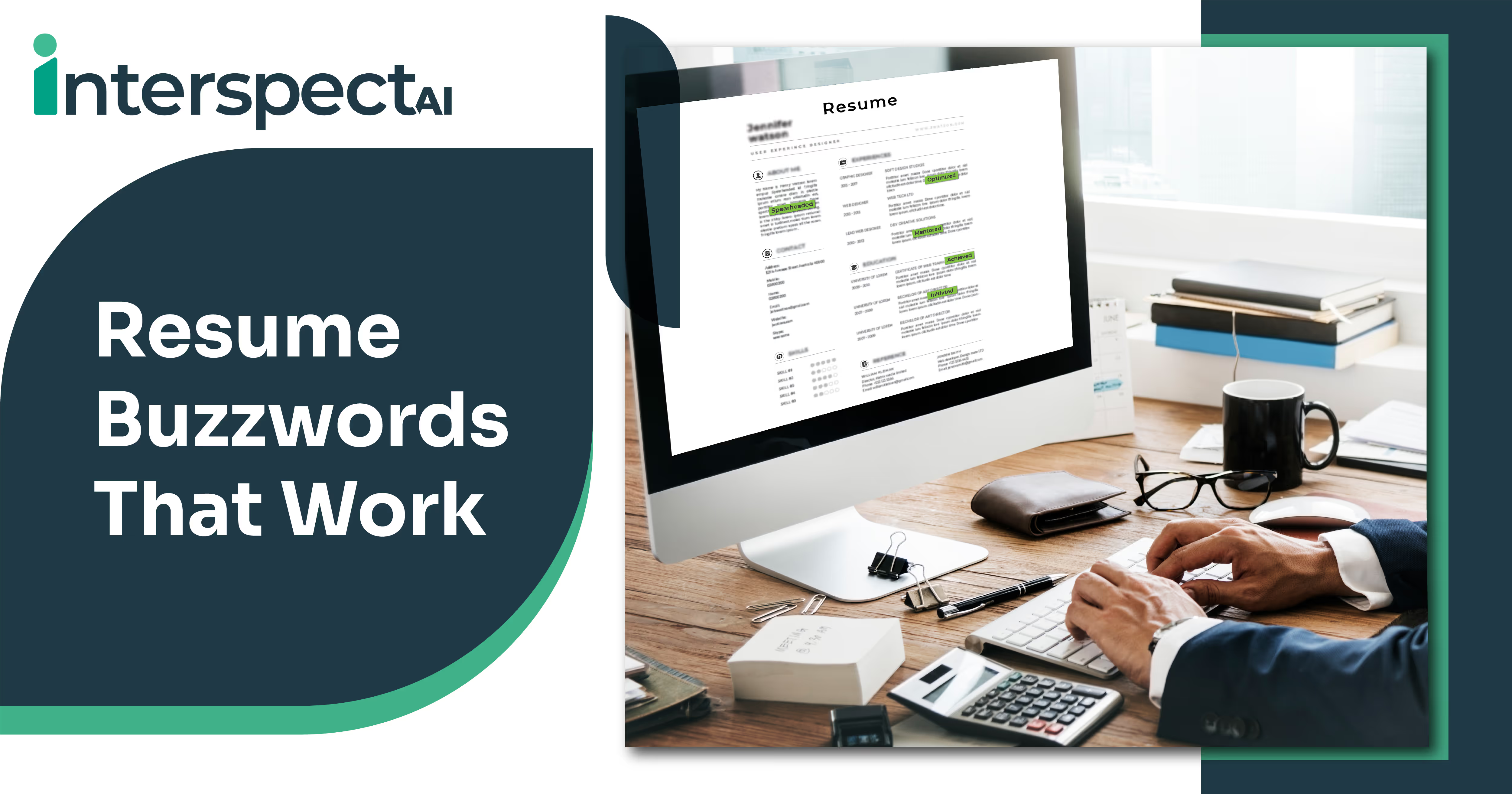
Buzzwords -action verbs like "implemented" or adjectives like "innovative" can elevate your resume from bland to alive. They catch the eye, demonstrate action, and add clarity.
Yet, not all buzzwords carry real weight. Overused clichés like "team player" or "results-driven" have become resume wallpaper - seen so often they’ve lost meaning. Recruiters often skip them, sensing filler, not substance.
Buzzwords that often cringe recruiters out
Here are some resume cliches to avoid, and why they backfire,
- “Team player,” “detail-oriented,” “results-driven,” “hardworking,” “problem solver,” “creative,” “go-getter” - These are vague and overused, which makes them forgettable at best and cringe-inducing at worst.
- “Responsible for,” “proven track record,” “strong work ethic” - Empty fluff. Saying you’re responsible or ethical is less impactful than showing what you achieved.
- “Hard worker,” “self-motivated,” “born leader,” “excellent communication skills,” “detail-oriented” - All common in job-seeker soundbites, but rarely backed with concrete evidence.
One recruiter on Reddit put it bluntly:
"Do you think using terms like 'detail-oriented', 'driven', or 'highly motivated' are gonna cut it? Absolutely not."
Instead, they want real data - years of experience, industries, measurable impact.
Use buzzwords wisely by being impactful and not generic
Here’s what works and how to use it right.
1. Opt for Strong Action Verbs
Choose verbs like "achieved," "managed," "implemented," "spearheaded," "optimized," "resolved" - they frame you as someone who does, not just is.
2. Quantify Your Impact
Replace vague claims with measurable outcomes:
- Instead of "improved sales," say “increased sales by 25% in Q1”.
- Swap “led a team” with “managed a team of 8 to deliver a project two weeks ahead of schedule”.
3. Tailor to Job Context
Mirror keywords from the job posting - ATS (Applicant Tracking Systems) value accuracy - but only if you can substantiate them with real examples.
4. Be Specific, Not Generic
Instead of saying you’re a "creative thinker," talk about the campaign you designed that drove 50% traffic growth.
Buzzwords that actually work when used thoughtfully
Here’s a curated list of effective buzzwords - powerful, specific, and action-focused:
- Active achievement verbs: Achieved, Initiated, Managed, Implemented, Led, Designed, Resolved, Improved, Analyzed, Developed, Spearheaded, Innovated, Negotiated, Orchestrated, Optimized, Collaborated, Mentored, Exceeded.
- Alternatives to tired adjectives: Use domain-specific, measurable language instead of fluff like “creative.” Provide outcomes.
- Industry-specific terms (when real):
- Marketing: SEO, Omnichannel marketing, SERP, AI, Customer journey.
- Project Management: Risk management, Cost management, Gantt chart, Process improvement.
- Teaching: Blended learning, Accessibility, Mastery-based grading.
Quick Table: Buzzwords to Avoid vs. Better Alternatives
Make every word earn its place!
Keep it real. Use terms you can back up - false claims risk credibility.
Mix sentence length for flow. Start with a short punch, then expand with context.
Use transition words like “however,” “meanwhile,” “in short,” to guide the reader.
Focus on achievements, not adjectives. Every bullet should show what and how you did something.
Buzzwords aren't inherently bad - misused ones are. Avoid the clichés that blur into the background. Instead, choose words that show, not tell. Quantify impact. Tailor each resume. That’s how your resume becomes memorable, not just legal-sized.
Your resume gets you noticed, but your interview seals the deal. Practice smarter with SpectraSeek, the AI tool that helps you refine answers and leave clichés behind!

AI interviews score things human interviewers miss. But is your current interview style helping you stand out, or are you unknowingly hurting your score?
In a traditional interview, you rely on your knowledge of the subject and your ability to read the room. You build rapport and adjust your delivery based on the interviewer’s reactions. But in an automated video interview, the rules of engagement are rewritten. There is no recruiter to nod encouragingly while you find your thoughts. There is only a lens, a timer, and an algorithm measuring thousands of data points per minute. For many candidates, this shift is jarring. You might be the most qualified person for the job, but if you trigger specific algorithmic red flags, your application could be rejected before a human ever sees it.
The good news? These red flags are fixable. Here are the 7 clear signs that you are not yet ready for the camera, and the AI video interview tips you need to turn your performance around.
Sign #1: You Are Using Too Many Filler Words
We all do it. In casual conversation, words like "um," "uh," "like," and "you know" act as glue while our brains construct the next sentence. To a human ear, they are often filtered out as background noise.
To an AI, however, they are data. A high frequency of filler words can impact your Communication Skills/Confidence score. The algorithm may interpret excessive hesitation not just as a speech habit, but as a lack of certainty in your own experience. If you are saying "um" every three words, the machine calculates that you are struggling to retrieve information.
How to Fix It: The solution is not to silence yourself, but to embrace the pause. In video interview practice, train yourself to stop speaking when you need to think. A silent pause projects confidence and thoughtfulness. A vocalized pause ("ummmm") projects anxiety. Record yourself answering a standard question and count the fillers. Your goal is to reduce them by 50% in your next attempt.
Sign #2: Your Eye Contact Is Inconsistent
It feels unnatural to stare at a black dot on your laptop bezel. Our instinct is to look at ourselves on the screen or to look down at our notes.
In a virtual interview practice scenario, looking away frequently can be flagged as "low engagement" or even dishonesty. Some advanced proctoring AI might even flag erratic eye movement as a sign that you are reading from a script or looking up answers on a different monitor.
How to Fix It: Treat the camera lens as the interviewer's eye. Place a small sticky note with a smiley face right next to the camera to draw your gaze. During your preparatory sessions, practice delivering your entire answer while maintaining visual lock with that sticky note. It feels intense at first, but on the other side of the recording, it looks like deep, focused engagement.
Sign #3: You Ramble Without Structure
In a human conversation, you can wander a bit. A recruiter might interrupt you to guide you back to the point. An AI will not save you. It will simply let you run out the clock.
If your answer lacks a clear beginning, middle, and end, the AI may struggle to categorize your competencies. It searches for specific markers of a story (Situation, Task, Action, Result). If you ramble, your score drops because the system cannot identify the "Action" you actually took.
How to Fix It: Practice using a framework (say STAR) for structuring your answer:
- Situation: Briefly set the context (10% of time).
- Task: Define the challenge (10% of time).
- Action: Detail what YOU did (60% of time).
- Result: Quantify the outcome (20% of time). Use signposting language like "The action I took was..." or "As a result..."
This will help the AI parse your answers better.
Sign #4: You Haven't Practiced Speaking Out Loud
Reading your notes is not the same as speaking them. Many candidates prepare by writing bullet points but never actually vocalize them until the interview starts.
This leads to "cognitive traffic jams." You know what you want to say, but your mouth stumbles over the phrasing because you haven't built the fluency to articulate it. You might freeze up or restart your sentences, which eats into your time limit.
How to Fix It: Use an AI mock interview platform like SpectraSeek to get "reps" in. You need to bridge the gap between your brain and your voice. Speak your answers out loud until the phrasing feels muscular and automatic. This is the core of automated video interview preparation, moving from theory to execution.
Sign #5: Your Environment Is Distracting
You might think the pile of laundry behind you doesn't matter, or that the shadow casting over your face is "moody." The AI disagrees.
Poor lighting and background noise interfere with the AI's ability to analyze your facial expressions and voice clarity. If the audio is muddy, the speech-to-text transcription (which the AI actually analyzes) will be full of errors. If the transcription is wrong, your keyword matches will be wrong, and your score will plummet.
How to Fix It: Control your variables.
- Light: Face a window or a lamp. Never have the light source behind you.
- Sound: Use a headset with a microphone rather than your laptop's built-in mic to eliminate echo.
- Background: A plain wall is better than a messy room. Eliminate visual noise so the AI focuses solely on you.
Sign #6: You Pause Too Long Before Answering
When the question appears, the clock starts. Taking 30 seconds to gather your thoughts before speaking might be acceptable in a relaxed human chat, but in a timed AI environment, it eats up valuable seconds and can be interpreted as a lack of readiness.
Long silences at the start of a recording can also mess with the pacing analysis. It signals that you do not have the information readily available.
How to Fix It: Develop "buffer phrases" to buy yourself a moment while keeping the flow going. Phrases like, "That is a great question. I encountered a similar situation when I was working at..." allow you to start speaking immediately while your brain retrieves the specific details of the story.
Sign #7: You Sound Rehearsed Instead of Authentic
This is the most common trap for prepared candidates. You find a "perfect" answer on a career blog, memorize it, and recite it word-for-word.
Modern AI platforms evaluate for Authenticity Scores. If your content is full of generic buzzwords (like "I'm a hard worker" or "I'm a perfectionist") without specific details to back them up, the AI flags you as "scripted." Employers use these tools to find unique human experiences, not candidates who can memorize a Google search result.
How to Fix It: This is where SpectraSeek is invaluable. The platform provides an Authenticity Score that specifically analyzes if you are providing unique, personal evidence or just reciting common clichés.
- Ditch the memorization. Do not write out full sentences. Memorize your key bullet points so you formulate the sentences naturally in the moment.
- Inject personal details. Don't just say, "I am a proactive problem solver." Tell the story of the time you noticed client tickets piling up and built a new triage system that reduced response times by 40%.
- Avoid the "Dictionary Definition" trap. Don't define a skill (e.g., "Leadership is about guiding people"). Instead, describe a moment where you exercised that skill.
Conclusion
If you recognize yourself in any of these signs, don't panic. These are not character flaws; they are simply performance habits that can be adjusted.
The only difference between a candidate who fails an AI interview and one who passes is data. The failing candidate guesses how they are coming across. The successful candidate knows.
By using tools like SpectraSeek, you can diagnose these issues before the real interview. You can see your Overall Candidate Fit, check your Interview Readiness, and fix your eye contact or pacing in a safe, private environment.
Stop sabotaging your score. Visit InterspectAI to turn these red flags into green lights.
TL;DR
AI video interviews shift the focus from human connection to data-driven performance, meaning even the most qualified candidates can face rejection if their non-verbal cues trigger algorithmic red flags. Success in this new format requires more than just subject knowledge; it demands that you diagnose and adjust your performance habits using tools like SpectraSeek to ensure your performance is just as polished as your credentials
FAQs
Can an AI really tell if I am making eye contact?
Yes. Some modern video interview technologies use facial tracking to monitor gaze direction. While it doesn't need to be 100% perfect, consistent engagement with the camera lens is impactful.
Is it bad to look at my notes during an AI interview?
It is okay to glance, but do not read. If your eyes are tracking left-to-right constantly, the AI (and human reviewers) will know you are reading a script. This can impact your score.
How do I fix my "filler words" if I don't realize I'm saying them?
This is why recording yourself is essential. You often cannot hear your own "ums" in real-time. An AI video interview tips tool like SpectraSeek will bring it to your notice.
What is the best lighting for an AI interview?
Soft, front-facing light is best. Avoid harsh overhead lights that create raccoon shadows under your eyes, and never sit with a bright window behind you (backlighting), as it turns you into a silhouette that the AI cannot analyze.
Subscribe to The InterspectAI Blog