%201.svg)

Compliance Audits - Why Enterprises Should Automate Oversight with AI Agents


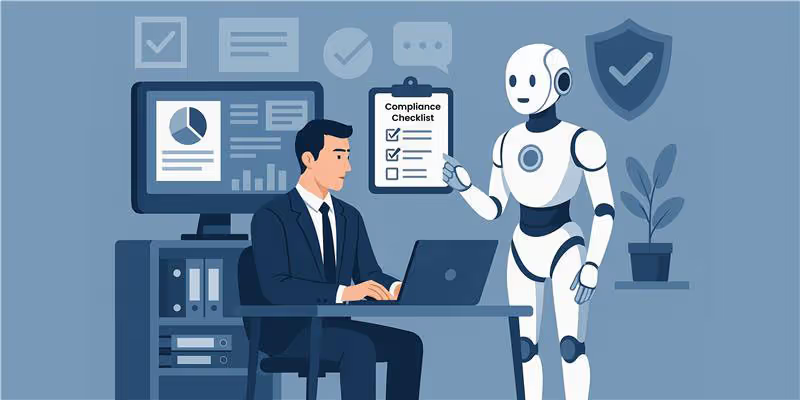
Ensuring regulatory and policy compliance is a heavy burden for enterprises. Compliance officers must regularly audit processes, verify controls, and chase down documentation – a process often involving endless questionnaires and interviews with staff.
It’s costly and labor-intensive - the average U.S. business allocates between 1.3% and 3.3% of total payroll just to stay compliant. And many compliance professionals are still in survival mode - nearly half (47%) say their primary goal is just finding simpler ways to deal with legal obligations. Only a small segment (around 16%) is able to focus on making compliance a strategic advantage.
But AI-powered interview/conversational agents can step in to lighten the load.
AI-driven compliance agents can conduct interactive audits continuously, instead of auditors doing annual check-ups. For instance, an AI interviewer could periodically “chat” with department heads and employees about compliance matters, asking the same kind of questions an auditor would - but in an automated, non-intrusive dialogue.
It might request proof of a safety check, quiz a manager on protocol knowledge, or walk an employee through an internal ethics checklist. All the responses and evidence are logged automatically for review.
Why automate with AI agents?
Efficiency and coverage
An AI agent acting as an auditor can be everywhere at once. It can autonomously sift through thousands of documents in minutes to check for compliance issues and simultaneously interview multiple teams about their procedures. This broad, rapid coverage means minor issues are caught early before they escalate. A job that might take a human audit team weeks (or be skipped due to time constraints) can be done continuously by autonomous AI agents.
And this matters more than ever as organizations nowadays are juggling six or more compliance frameworks, especially around data privacy and security. Over 59% of IT and security leaders report maintaining multiple compliance systems simultaneously. The complexity has grown - and so has the need for continuous monitoring.
Consistency and objectivity
The AI agent follows the same script and criteria every time, eliminating human error or bias. Every department and vendor get asked the full set of required questions, ensuring nothing slips through cracks. The result is a more standardized audit process that you can trust to be fair and thorough across the organization.
This standardized rigor is becoming expected. In fact, 70% of compliance professionals report a clear shift from "check-the-box" audits toward more strategic and structured compliance programs.
Reduced compliance fatigue
Because the AI-powered agent can handle routine check-ins, compliance teams are freed from a lot of tedious work. Instead of inundating employees with massive yearly surveys, the autonomous AI agent can spread out the queries into smaller, conversational check-ins. This feels less overwhelming for staff and maintains a constant compliance posture without “audit panic mode.”
No wonder 80% of compliance professionals say their departments are now seen as critical business advisory units, not just rule enforcers. There's increasing pressure to show real value, and tools that reduce friction help build that perception.
Real-time issue flagging
When an AI-powered interview agent uncovers a potential non-compliance, say an out-of-date certification or a policy misunderstanding, it can instantly alert compliance officers. This proactive monitoring helps enterprises fix problems before regulators or external auditors discover them. Considering that non-compliance can amplify breach costs by hundreds of thousands of dollars, catching issues early has tangible financial benefits.
Recent surveys show that 83% of compliance professionals see regulatory alignment as central to decision-making, and 76% say building an ethical compliance culture is a high-priority boardroom concern. Proactive tools that help flag and fix issues aren’t just helpful - they’re essential.
AI agents are all set to cut down the man-hours and costs to stay in line with regulations.
AI agents are all set to handle the repetitive Q&A and evidence gathering, while human experts focus on complex cases and remediation. The outcome is a stronger compliance culture with less stress.
Want to see how AI agents can take the load off for your team? Let’s talk.
You might also like

For decades, the human interviewer has been the gold standard of hiring. Relying on instinct, experience, and personal rapport, hiring managers have made countless decisions based on gut feelings and the nuances of face-to-face interaction. However, this human-centric approach is also prone to a wide range of unconscious biases and oversights. In the fast-paced, high-volume world of modern talent acquisition, these seemingly minor missed cues can lead to major hiring mistakes.
This is where AI-powered interview platforms like InterspectAI are not just a tool for efficiency but a crucial partner in objectivity. While a human interviewer might be distracted by a resume detail or a charming anecdote, an AI agent analyzes every element of an interaction with unwavering consistency. It can detect subtle behavioral patterns that a human brain, even the most experienced one, is trained to ignore.
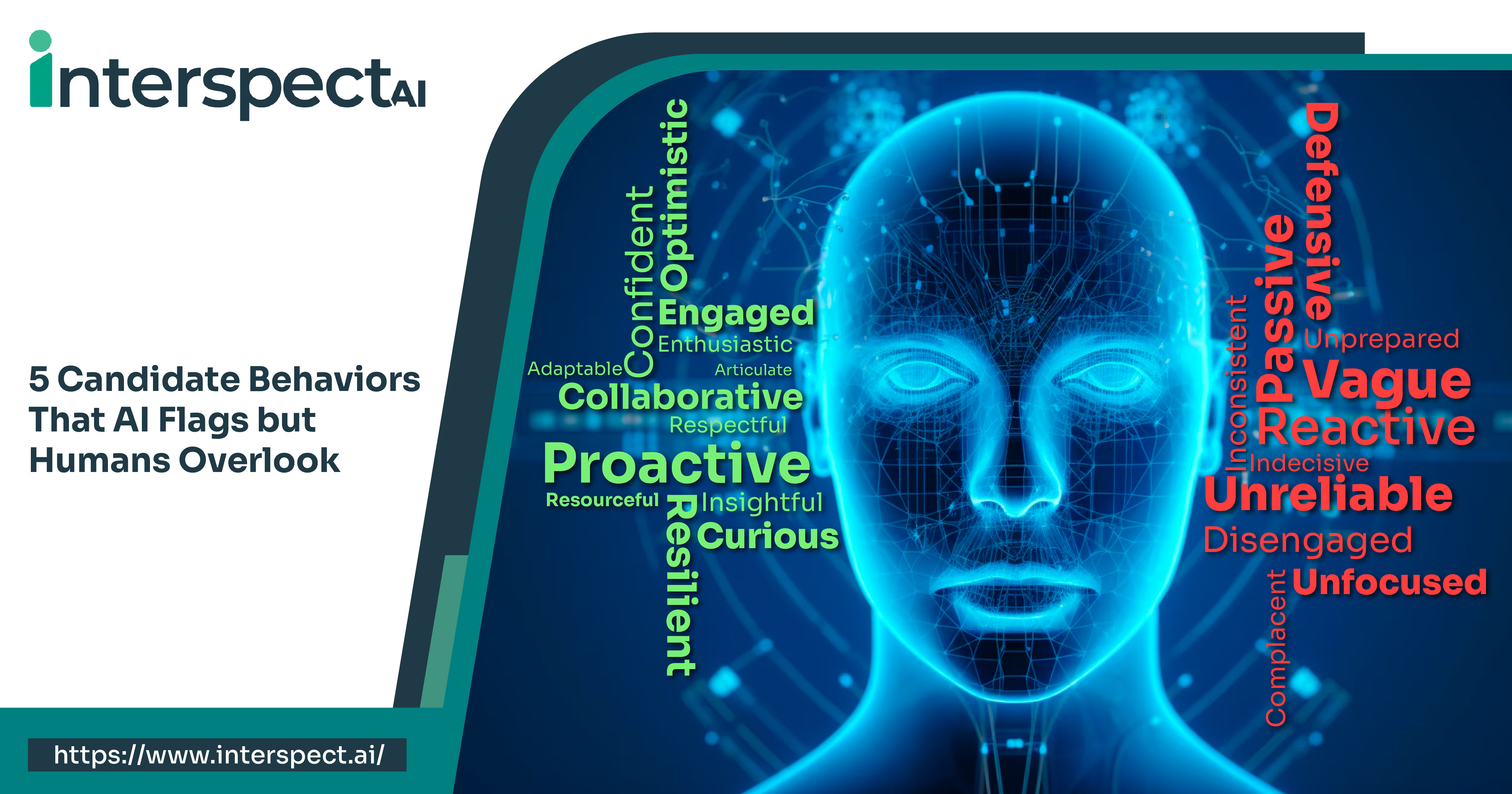
Here are five key candidate behaviors that AI flags but humans often overlook, and why they matter.
1. Inconsistent Behavioral Patterns
A human interviewer relies on a candidate's single, curated performance during a 30-minute meeting. If the candidate is prepared and articulate, they may get a glowing review. But what if their answers are subtly inconsistent across different questions or with information on their resume?
InterspectAI's agentic AI-powered interview platform, including its hiring solution SpectraHire, is designed to track and analyze these patterns. They can detect inconsistencies in a candidate's responses by cross-referencing their answers about past experiences. This level of cross-analysis ensures the candidate's stories are not just well-told, but also logically consistent with their stated skills.
2. Leveraging AI for Contextual Communication Analysis
Video interviews provide a glimpse into a candidate's non-verbal communication, but human analysis is often subjective. A nervous candidate might fidget, a quiet one might be misinterpreted as disengaged, and a soft-spoken one might be seen as lacking authority.
InterspectAI's platform analyzes voice, video, and text inputs to provide richer contextual understanding of candidate responses. Its advanced NLP models evaluate the clarity, depth, completeness, and relevance of answers, helping hiring teams gain an objective and structured view of a candidate’s communication style and problem-solving approach. This ensures assessments remain data-driven and consistent, reducing the influence of subjective interpretation.
3. Unstructured and Unclear Language
We've all been in interviews where a candidate's nervousness manifests as rambling, unclear answers. While a human interviewer might dismiss this as normal jitters, AI goes deeper. InterspectAI's platform can score for "relevance and accuracy". This allows it to evaluate not just what a candidate says, but also how they say it, flagging a potential lack of clarity in communication or a tendency to be vague when put on the spot. This insight is a strong predictor of effective communication and problem-solving skills.
4. The Absence of Curiosity
A candidate who is truly engaged with a role will have questions. They will want to know about the company culture, the team, and the challenges of the job. But in a rushed, half-hour interview, a human can easily overlook a candidate's lack of questions or their reliance on generic, pre-prepared inquiries.
InterspectAI's AI agents facilitate a conversational, two-way interview, providing "real-time responses to candidate questions." The absence of genuine curiosity is a significant flag, signaling low enthusiasm, which is an invaluable insight for identifying candidates who are genuinely invested in a role.
5. Lack of "Overall Fit" Metrics
Humans often rely on a gut feeling for "culture fit," which is a highly subjective and often biased assessment.
InterspectAI's platform provides "automated interview scores and insights instantly post-interviews across technical and behavioral metrics and overall fit." This data-driven approach allows hiring teams to move past subjective impressions and make a more objective assessment of a candidate's compatibility with the role and organization. This metric, combined with other insights, helps create a comprehensive and objective candidate profile, ensuring you're hiring for true alignment, not just personal chemistry.
Conclusion
AI is not here to replace human expertise; it's here to augment it. By providing an objective, data-driven layer of analysis, platforms like InterspectAI give hiring teams the insights they need to make truly informed decisions. AI acts as a safeguard against the biases and distractions that can cloud human judgment, ensuring you never overlook a great candidate again.
Ready to uncover the hidden potential in your candidates?
Learn more about InterspectAI and request a demo today.
FAQs
Q1: Does AI analysis of behaviors introduce new biases?
InterspectAI is built with "non-profiling algorithms" to minimize bias. By standardizing the assessment and focusing on skills and competencies, the platform removes subjective human judgment, which is far more susceptible to unconscious bias. The AI provides an objective report to guide, not replace, human decision-making.
Q2: Can a candidate "trick" the AI by rehearsing their answers?
While a candidate can rehearse, AI is designed to look beyond surface-level answers. It analyzes subtle cues like consistency, language complexity, and emotional tone. A truly honest and prepared candidate will always perform better on a behavioral assessment, as the AI can detect discrepancies that may indicate a fabricated persona.
Q3: How does InterspectAI ensure data privacy and security?InterspectAI adheres to rigorous security and compliance standards. The platform is SOC2 Type 2, GDPR, CCPA, and HIPAA compliant, with end-to-end encryption. This means data is handled with the highest level of security and in accordance with global privacy regulations, providing peace of mind for both companies and candidates.
You’ve crafted your resume. Rewritten your LinkedIn bio. Spent an hour Googling “most common interview questions.”
Still feeling a little… unprepared?
Agentic AI-powered mock interviews can give you the much-needed boost of confidence!
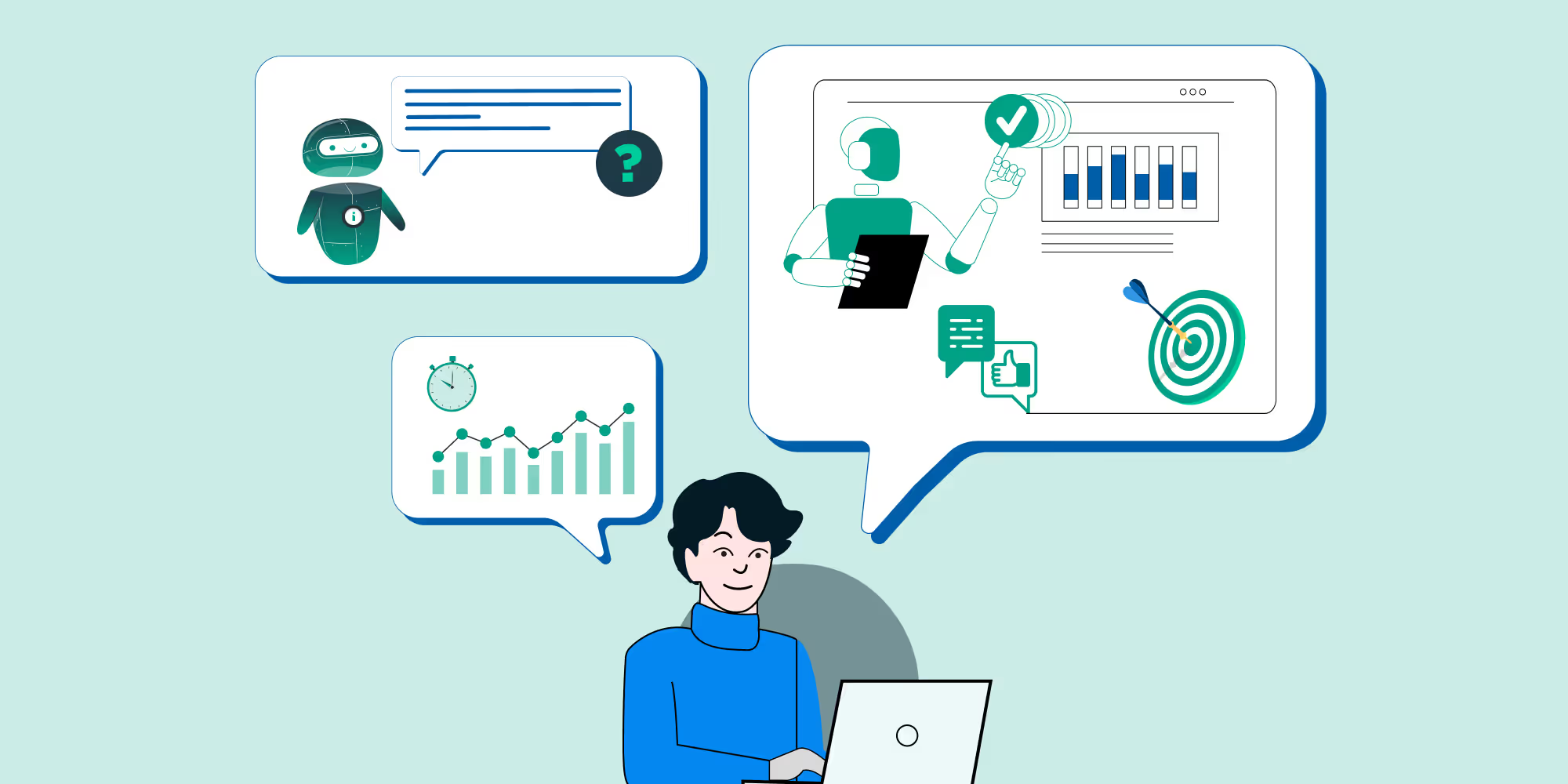
These aren’t the robotic scripts you might remember from early job portals. Today’s AI interview practice tools simulate real-world job interviews - with smart follow-up questions, tone analysis, and structured feedback - giving you a safe, judgement-free space to improve and avoid common mistakes.
Let’s get into why taking a mock interview online (especially with an AI agent) before your real one can be beneficial for acing interviews.
1. Interviews are getting tougher and more unpredictable
Hiring isn’t what it used to be.
From behavioral interviews to case studies and technical rounds, today’s job interviews can feel like running a gauntlet.
According to a report, close to two-thirds (64.8%) of employers surveyed reported using skills-based hiring practices for new entry-level hires, with 90% of these employers incorporating it at the interview stage that dig deep into competencies, not just qualifications.
That means prep has to be specific, and tailored to each role.
AI practice interviews help here by adapting questions based on your responses. Instead of generic lists, you get personalized question paths that better mirror how real recruiters think.
2. Real-time feedback that’s actually useful
“Tell me about yourself.”
It seems simple - until you say it out loud and realize you rambled for three minutes without making a point.
AI mock interview tools can pick that up instantly. Many offer real-time feedback on:
- Speech clarity and filler words
- Eye contact and facial expressions (if video-enabled)
- Length and structure of your answers
- Confidence score (based on tone and delivery)
Tools like SpectraSeek take it a step further with video recordings and transcripts of your practice sessions, so you can review, reflect, and fine-tune your performance like a pro.
3. Builds confidence without the pressure
Interview anxiety is real, and practicing with an AI interview prep tool takes the edge off.
You’re not being judged. There’s no awkward silence. You can restart as many times as you like, pause midway, or try different styles.
You build muscle memory for speaking clearly, structuring responses, and staying calm. And when you walk into the real thing? You’ve already done it 10 times in your head.
4. Available anytime, anywhere
Not everyone has access to a mentor or a professional coach. And not everyone has the budget for one.
Whether you’ve got 20 minutes before bed or you’re sneaking in a session during lunch, AI is always ready.
Platforms like Google’s Interview Warmup, Pramp, or more comprehensive solutions like SpectraSeek (which offers AI-led practice with recordings, feedback, and resume scoring) give you flexibility without friction.
5. Helps you tailor responses to the role
Interviewing for a sales role? Expect questions on negotiation, KPIs, and pipeline management.
Applying for a data analyst job? You’ll need crisp answers on SQL, dashboards, and decision-making.
AI mock interview platforms often let you choose the job title or industry you’re preparing for. Tools like SpectraSeek even help you identify resume gaps and adjust how you present your experience during the interview - so your prep isn’t just “general,” but targeted.
6. Tracks progress over time
It’s hard to know if you’re improving - unless you’re keeping score.
The best AI mock interview practice tools show metrics over time:
- How much more concise your answers are
- How your confidence score has changed
- What kinds of questions still trip you up
SpectraSeek, for example, stores your video recordings and transcripts so you can track how your delivery, tone, and structure evolve. And the AI-generated feedback helps you see exactly what to tweak and where.
7. Practice makes prepared, not perfect
We’ve all heard “practice makes perfect.” But that’s not the point of interview prep.
The point is to feel prepared enough to show up as your best self. To answer clearly, think aloud, and connect with the interviewer.
With AI interview practice, you can do exactly that - without burning out.
Job hunting is tough enough.
Between the applications, follow-ups, and imposter syndrome, it’s a full-time job on its own.
But prepping smart with AI mock interviews can make a massive difference. You can work on sharpening your delivery, spotting blind spots, and walking into that interview with quiet confidence.
If you’re serious about landing the job, give yourself that edge.
Want to know what it’s like having a smart, tireless coach in your corner? Try SpectraSeek!
As AI technology advances, it becomes increasingly evident that general-purpose models often struggle to address the complexities inherent in specialized domains. Vertical AI agents, explicitly designed for industries like healthcare, finance, retail, and manufacturing, leverage domain-specific datasets, customized reasoning processes, and specialized tools to outperform generalist AI systems.
Trained on curated, industry-specific data and embedded with workflows tailored to unique business requirements, vertical AI agents accelerate deployment, reduce risk, and provide measurable operational improvements.
1. Why Specialization Outperforms Generalization
General AI models face inherent challenges in specialized settings due to:
- Domain-Specific Context Gaps: Broad training data often misses critical industry terminology and nuanced decision factors.
- Regulatory Risks: Lack of embedded knowledge about sector-specific compliance can lead to failures or unsafe outcomes.
- Uneven Performance: General models fall short on highly specific or regulated tasks.
Vertical AI agents overcome these by embedding deep expertise and domain knowledge, enabling higher accuracy, compliance, and reliability in complex workflows (see agentic systems design patterns in this research).
2. Core Components of Vertical AI Agents
Drawing from established architectural frameworks, vertical AI agents commonly integrate:
- Layered Memory Systems: Working memory for immediate context, episodic memory for past interactions, and knowledge base memory grounded in domain facts and regulatory rules (source).
- Advanced Reasoning Techniques: Chain-of-thought prompting, tree-of-thought strategies, and planning algorithms enable strategic problem-solving within specialized contexts (source).
- Cognitive Skills Modules: Modular, domain-tailored inference engines encapsulating workflows and compliance procedures, allowing precise and compliant decision-making (source).
- Flexible Tool Orchestration: Dynamic selection and integration of APIs, databases, and automation tools optimized for industry-specific data processes (source).
3. Architecture Patterns That Enable Specialization
Effective vertical AI architectures often exhibit:
These design patterns ensure agents remain adaptable, auditable, and trusted throughout deployment (learn more).
4. Real-World Impact Across Industries
Vertical AI agents’ domain expertise facilitates superior outcomes in these high-stakes environments compared to broad AI models.
5. Best Practices for Deploying Vertical AI Agents
- Involve Domain Experts: Define domain-specific ontologies, compliance rules, and success metrics collaboratively to ensure alignment and consistency.
- Embed Compliance Frameworks: Build regulatory knowledge into models and workflows with human oversight checkpoints.
- Implement Retrieval-Augmented Generation (RAG): Combine symbolic and neural methods for precise, explainable outputs.
- Modularize Architectures: Utilize microservices for cognitive skill components to enable scalable and maintainable solutions.
- Continuous Monitoring: Leverage telemetry and expert feedback loops to detect drift and optimize performance.
InterspectAI: Leading Vertical AI Innovation
At InterspectAI, we specialize in designing and deploying vertical AI solutions that deeply embed domain expertise through modular Cognitive Skills Modules and advanced memory and reasoning frameworks. Our flagship Spectra platform orchestrates these components through dynamic tool integrations, delivering tailored, compliant, and scalable AI agents for healthcare, finance, manufacturing, and other industries.
Collaborating closely with industry experts, we build retrieval-augmented multi-agent systems that automate complex workflows while maintaining accuracy and traceability. Our hands-on experience translates into measurable improvements—reducing error rates, accelerating regulatory compliance, and enhancing operational efficiency.
By applying best practices informed by the latest research, such as the agentic cognitive architectures described in Agentic Systems, InterspectAI empowers enterprises to harness the full power of vertical AI and transform their industry-specific challenges into competitive advantages.
Conclusion
Vertical AI agents clearly demonstrate that specialization outperforms generalization in addressing complex, regulated industry problems. By embedding domain-specific knowledge, reasoning frameworks, and compliance controls into modular, scalable architectures, these agents maximize accuracy, reliability, and efficiency—unlocking significant enterprise value.
Subscribe to The InterspectAI Blog