%201.svg)

ROI of AI Career Tools: What Universities Actually Measure (and What They Should)


You can't improve what you don't measure. In the high-stakes world of higher education, where tuition costs are scrutinized and enrollment cliffs loom, the Career Center has moved from a student service to a strategic asset.
However, calculating the Return on Investment (ROI) for career services has traditionally been difficult. How do you quantify the value of a counseling session? How do you measure the impact of a resume workshop?
With the adoption of higher education technology investment specifically in AI, the math is changing. We are moving from anecdotal evidence to hard data. Here is the data-driven case for why AI career tools are not just a line item, but a revenue protector.
Traditional Metrics: The Lagging Indicators
Most universities rely on "lagging indicators" to measure success. These are metrics that tell you what happened after it is too late to fix it.
- Placement Rates: The percentage of graduates employed within 6 months.
- Starting Salaries: The earning power of the cohort.
- Time-to-Hire: How long it takes a graduate to secure an offer.
While these numbers are critical for rankings (like U.S. News & World Report), they are autopsy reports. They tell you if the patient survived, but they offer no diagnostic data on why a specific cohort struggled during the process. Relying solely on these creates a reactive strategy rather than a proactive one.
The Hidden Costs of the Status Quo
The cost of not modernizing isn't just a lower placement rate; it appears in operational inefficiencies that drain the budget.
- Counselor Burnout & Churn: With student-to-counselor ratios often exceeding 400:1, personalized coaching is impossible. Counselors burn out trying to review basic resumes, leading to high turnover and rehiring costs.
- The "Unreached" Majority: In a traditional model, only the most motivated 20% of students visit the career center. The other 80% often those who need the most help graduate unprepared. This "silent failure" damages the university’s reputation in the corporate market.
- Admissions Drag: Prospective parents are savvy. If university placement rate improvement stagnates, admissions yields drop. The cost of losing a tuition-paying student because they doubt the degree's ROI is the most expensive cost of all.
New Metrics to Track: The Leading Indicators
Implementing career readiness software ROI tools like SpectraSeek allows you to track "leading indicators." These are predictive metrics that allow you to intervene before graduation.
- Practice Volume & Completion: Instead of tracking "appointments booked," track "interview simulations completed." AI allows this number to scale infinitely.
- Technical Proficiency: Are students articulating their hard skills correctly? AI tools track the delta between a student's first attempt and their fifth. If this score rises by 15% over a semester, you have quantifiable proof that your curriculum is translating into interview-ready knowledge.
- Communication Confidence: By measuring delivery metrics like pacing and vocal clarity, you can identify at-risk cohorts (e.g., First-Generation students) who may have the skills but lack delivery. This allows for targeted human intervention exactly where it is needed most.
Cost-Benefit Analysis: Scalability vs. Headcount
When building the business case, the math is straightforward.
Option A: The Analog Scale
To provide 5,000 students with just one hour of mock interview practice per semester, you would need to hire approximately 5-7 full-time career counselors dedicated solely to that task.
- Estimated Cost: $350,000 - $500,000 annually (salary + benefits).
Option B: The Digital Scale
An institutional license for an AI platform costs a fraction of that headcount expense while providing unlimited practice hours.
- Outcome: The cost-per-service-delivery drops from approximately $100/session to pennies per session.
This efficiency allows your human staff to stop doing "drills" and start doing high-value career strategy, effectively doubling the value of your existing payroll.
The 6-Month Impact: A Representative Scenario
Consider a mid-sized university that integrates AI simulations into a sophomore "Professional Development" course.
Before AI:
- Only 15% of sophomores completed a mock interview (due to scheduling constraints).
- Feedback was subjective and inconsistent.
After AI Implementation:
- 100% Completion Rate: The interview became a graded assignment, scalable because no staff time was required to proctor it.
- Data Visibility: The Dean received a dashboard showing that while students were strong in "Technical Knowledge," they scored in the bottom quartile for "Role Alignment."
- Curriculum Adjustment: The department launched a workshop specifically on "Mapping Skills to Job Descriptions," fixing the gap before recruitment season began.
Competitive Advantage: Rankings and Revenue
Ultimately, career services ROI feeds the university's revenue engine.
- Rankings: Better preparation leads to better placement rates, which directly influences national rankings.
- Admissions: Being able to market a "Guaranteed AI-Powered Career Coach for Every Student" is a powerful differentiator for parents worried about the job market.
- Donations: Alumni who land high-paying jobs attribute their success to the university. Employed alumni are donors; unemployed alumni are detractors.
Building the Business Case for Your Institution
To secure budget, shift the conversation from "purchasing software" to "protecting outcomes."
Stop asking for a tool to help students practice. Start asking for a Talent Intelligence Platform that provides the data visibility required to prevent placement failures. In an era where employability is the ultimate product of higher education, AI infrastructure is no longer a luxury it is a requirement for accreditation and survival.
Ready to modernize your metrics? Learn how we partner with higher education at our Universities page.
TL;DR
Traditional career service metrics like placement rates are "lagging indicators" that often arrive too late to facilitate meaningful intervention. Relying solely on human-only scaling to fix this leads to counselor burnout and leaves the silent majority of students unprepared. AI tools solve this by providing "leading indicators" like Technical Proficiency and Communication Confidence, enabling proactive support while offering infinite scalability at a fixed cost. By drastically reducing the cost-per-student-served compared to hiring new staff, institutions can drive higher employability rates that boost rankings, admissions yields, and alumni donations, transforming the career center from a cost center into a strategic revenue protector.
FAQs
Does this replace our current career counselors?
No. It elevates them. By offloading the repetitive task of basic interview drills to AI, your counselors are freed up to focus on complex advising, employer relations, and emotional support work that requires a human touch.
Can we integrate this data into our systems?
Yes. Integration is key for adoption. By making AI assignments part of the coursework, you ensure 100% participation rather than relying on the optional "hand-raisers."
What is the implementation timeline?
Unlike complex ERP rollouts, SpectraSeek can be deployed in days. Since it is cloud-based, students can begin generating data immediately, providing a near-instant realization of value.
You might also like

Hiring is changing at breakneck speed. And it’s not just on the companies’ side.
Where once job seekers sharpened their answers in front of friends and mirrors, they now reach for AI‐powered interview agents.
Since employers are turning to AI-powered hiring tools, AI interview preparation is becoming central to job readiness for candidates.
Candidates are already using AI – and it’s not just for résumés
AI isn’t some fringe tech used by a few early adopters. In iHire’s 2025 multi‑generational workforce survey, 40.7% of U.S. job seekers said they have used AI tools (ChatGPT, Perplexity, Gemini, and similar) to make their job search more efficient.
Writing and customizing résumés are the most common use cases (19% and 16.2% respectively), but 11.5% of candidates already use AI to prepare for interviews or create practice questions.
Adoption is strongest among younger professionals – 17.2% of millennials use AI tools for interview prep Meanwhile, 31.5% of candidates who haven’t used AI yet plan to do so.
This widespread adoption coincides with a surge in AI usage by recruiters. Research shows that 72% of recruiters find AI particularly helpful for candidate sourcing, 56% say AI is most advantageous in screening candidates and 55% use it for nurturing applicants.
Clearly, both sides of the hiring equation are turning to technology.
AI interview agents are practice partners, not human replacements
AI interview agents (sometimes called Agentic AI powered interview prep tools) simulate real interviews. They ask behavioural and technical questions, evaluate responses, and provide data‑driven feedback. Unlike static question lists, these systems adjust questions based on the candidate’s skill level and job requirements, making practice sessions far more realistic.
The benefits extend beyond convenience.
Personalized feedback and analytics. AI systems can parse tone, body language, and keywords to highlight strengths and areas for improvement. This goes far beyond generic “good job” praise and helps candidates build specific skills.
Scalability and accessibility. Candidates can practice anytime, anywhere without scheduling a coach. Recruiters also benefit; companies like Hilton have reduced their time‑to‑fill ratio by 90% and improved their hiring rate by 40% after using AI‑powered recruitment tools.
Reduced anxiety and improved confidence. AI mock interviews allow candidates to practice repeatedly, reducing the “fear of the unknown.” Although hard numbers are still emerging, early studies suggest candidates selected by AI are 14% more likely to pass the interview stage and 18% more likely to accept a job offer than those selected by humans.
Importantly, these tools aren’t meant to replace human coaches. ResumeBuilder’s survey of hiring managers found that 85 % of companies using AI interviews still rely on humans to make final decisions. AI interview prep is best viewed as a “sparring partner” that helps candidates hone their responses before meeting a human interviewer.
How AI interview prep improves job readiness
Job readiness is no longer just about ticking boxes on a checklist, as being able to communicate your value clearly, confidently, and consistently is what’s sought after. And AI interview prep is helping candidates do exactly that.
Whether you're applying to your first role or your fifth promotion, AI-powered mock interviews offer something traditional prep cannot - real-time feedback that evolves with you. These intelligent tools don’t just ask questions - they assess your tone, pacing, content, and even your confidence levels.
Here’s how AI interview prep sharpens your edge.
Smarter practice, faster progress. Unlike a rehearsed script with a friend, AI agents adjust questions based on your role, industry, and previous answers. That means every session pushes you a little further.
Clarity through feedback. These tools don’t sugarcoat. They give detailed, actionable feedback, flagging filler words, vague responses, and unclear storytelling, so you can polish your pitch.
Confidence built through repetition. The more you practice, the more natural it feels. AI lets you rehearse tough questions anytime, reducing interview anxiety and helping you show up prepared, not panicked.
Prep that mirrors real interviews. With more companies using AI in hiring, it only makes sense to prep with the same tools. Practicing with AI interview agents means you’re training on the same playing field as today’s tech-savvy recruiters.
AI interview prep builds the soft skills that matter - clarity, composure, and credibility -while aligning candidates with the realities of modern hiring, making it a catalyst for readiness.
AI interview preparation is a reflection of a broader trend toward data‑driven hiring and self‑directed learning.
With 40.7% of job seekers already using AI tools in their search and nearly half of employers planning to use AI interviews, AI interview agents are poised to become the standard.
The key for recruiters, CHROs and company founders is to embrace these tools responsibly.
As with most technology, the goal isn’t to replace humans but to amplify their impact.
Candidates who practice with AI arrive more confident and self‑aware; recruiters who leverage AI have more time for meaningful interactions.
Together, these forces usher in a future where job readiness is accessible, data‑driven and, most importantly, human‑centred.

The idea of practicing with an AI agent before an important interview might seem impersonal—or even intimidating. Many job seekers assume that interview prep, like real interviews, is best done with another human across the table, someone who brings empathy, nuance, and conversation into the process.
But that assumption is changing fast. A growing number of candidates are not only comfortable using AI-powered mock interview tools—they actually prefer them. This trend isn’t about adopting new technology for the sake of novelty. It’s about something more meaningful: the need for a fairer, more transparent way to prepare for the hiring process.
Traditional mock interviews, when available, can feel inconsistent, unclear, or even anxiety-inducing. Feedback is often vague, leaving candidates uncertain whether their performance has actually improved. Many also find it hard to know what hiring managers truly look for.
In this context, AI-powered mock interviews offer something rare: clarity and control. They give candidates a structured environment to practice, learn from objective feedback, and build confidence—before stepping into the real interview room.
Why Mock Interviews Still Matter—And Where AI Helps
The value of mock interviews is well known. They allow candidates to test their thinking, refine their verbal delivery, anticipate tough questions, and reduce nerves before the real thing. However, traditional mock interviews come with their own set of challenges: they can be expensive, difficult to schedule, and sometimes inconsistent, subject to the same human variability as actual interviews.
That’s where AI-powered platforms fundamentally change the game. With agentic AI tools like SpectraSeek, mock interviews are now:
- Available on-demand—practice anytime, anywhere
- Objective and standardized—no guesswork or inconsistent feedback
- Deeply personalized—feedback is tailored to your pace, tone, and content
- Confidence-boosting—no judgment, just progress
Objective Evaluation Builds Trust
At the heart of any interview is a fundamental anxiety: “Will I be judged fairly?” Every candidate wonders whether their background, personality, or presentation style might influence how they’re perceived. These worries are often amplified for individuals from non-traditional backgrounds, underrepresented groups, or those interviewing for the first time.
AI interview agents help neutralize that anxiety. Unlike a human coach or panelist, an AI doesn’t rely on opinions or impressions. It evaluates candidates using criteria directly tied to the role's requirements. Every person is evaluated on the same terms, with no personal bias or favoritism.
For job seekers, this means the focus stays where it belongs: on substance over style. Your content matters more than your charisma. Your clarity matters more than your connections.
This objective approach is one reason so many job seekers now trust AI tools more than traditional coaching sessions. They know the system—whether used during practice with SpectraSeek or in real assessments with SpectraHire—is designed to keep the playing field level.
Consistency Without the "Luck of the Draw"
Another challenge with traditional interviews—and traditional preparation—is inconsistency. One mock coach might provide generous and detailed feedback. Another might be scattershot or rushed. Much like in real hiring, the experience a candidate gets depends heavily on who’s on the other side of the virtual desk.
AI removes that variability. Every interview session is governed by the same structure, pacing, and scoring model. For users, this is incredibly empowering. You don’t have to wonder if someone just “didn’t vibe with you.” The system is built to measure performance, not perception.
You also get the chance to do things human-led interviews rarely allow: re-record your answer. Try different phrasings. Practice until it lands.
This repeatable, reliable structure provides job seekers with a platform where they can truly improve on their own terms.
Feedback That Actually Helps
One of the most frustrating aspects of both real interviews and prep sessions is the lack of clear and helpful feedback. Vague phrases like “be more confident” or “tighten your answers” don’t help candidates grow.
AI-powered mock interviews offer something different: real-time, actionable insight. After answering a question, users receive detailed feedback on:
- How clearly and concisely they communicated
- The relevance of their key points
- Their pacing, tone, and delivery style
- Nonverbal signals via video (like confidence or energy)
This feedback loop helps users not only see what needs improvement, but also how to improve it. And because they can practice as many times as they like, they can turn that feedback into progress before the real interview happens.
A Co-Pilot in a Lonely Journey
Finding a job can often feel isolating. There’s uncertainty at every stage, from writing a resume to hearing the results of an interview. Most of that process happens independently and silently.
That’s why candidates increasingly describe AI-powered preparation tools like SpectraSeek as a “confidence-building co-pilot.” These platforms don’t just test you—they help you grow. And they do it with patience, neutrality, and accessible guidance. Whether you're applying for your first internship or your fifth management position, you'll receive reliable support that aligns with your schedule and goals.
Aligning With Real Hiring Workflows
Perhaps most importantly, candidates are starting to trust AI-powered mock interviews because they know companies are using the same technology to make real decisions. Tools like SpectraHire are being increasingly deployed to conduct structured, bias-resistant interviews at scale.
This offers a unique kind of preparation because the mock interview experience aligns directly with the real-world evaluation. Candidates can walk in knowing not just what to expect, but also how they’ll be measured. That consistency from prep to performance creates a sense of continuity that traditional coaching can’t replicate.
So—Are They Worth It?
Yes. For job seekers who want fairness, clarity, and confidence, AI-powered mock interviews are absolutely worth it.
They don’t replace the human elements of interviewing, but they do replace guesswork with insight, uncertainty with standards, and doubt with preparation. Whether used alone or alongside traditional coaching, AI-led prep is quickly becoming an essential tool in the modern candidate toolkit.
Looking to sharpen your interview skills with objective feedback and real impact? Try SpectraSeek to experience AI-powered preparation that actually works. And when it’s time for the real conversation, count on SpectraHire to deliver structure, fairness, and scale across the hiring journey.
Join the future of hiring—practice smarter, interview stronger, and get hired with confidence.
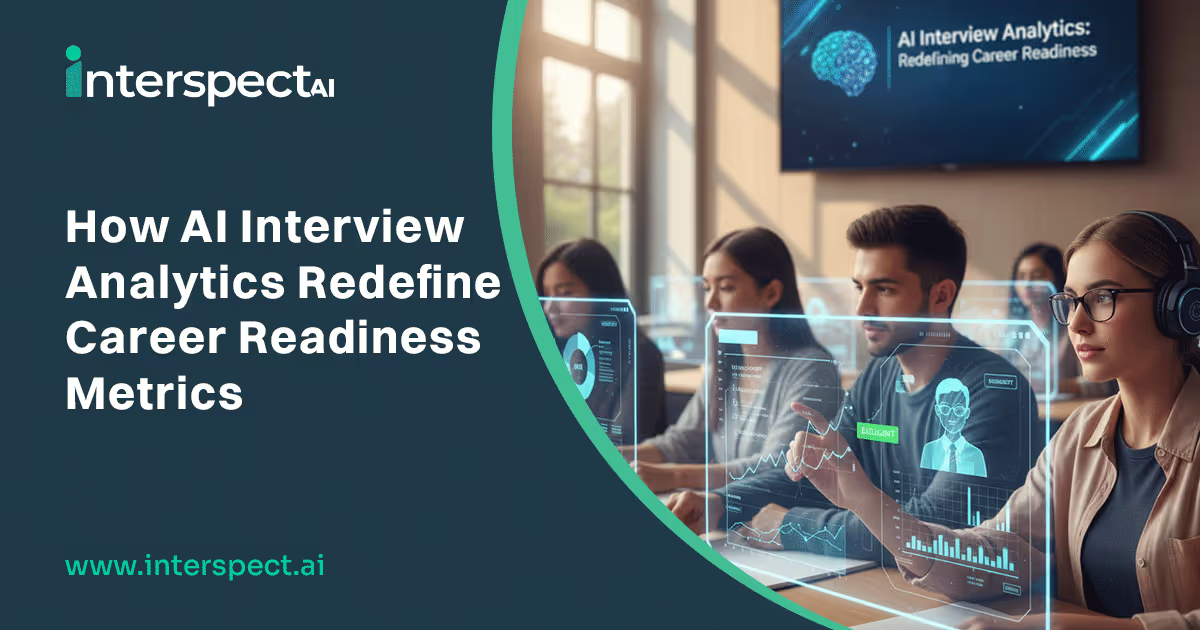
The success of a college education has traditionally been validated by lagging indicators, primarily placement rates gathered months after graduation. But in a labor market where algorithmic gatekeepers (Applicant Tracking Systems, or ATS) filter out up to 70% of résumés and recruiters spend an average of just 7 seconds reviewing the rest, this retrospective model just doesn't work anymore.
The future of workforce preparation is now being shaped by AI interview analytics. These platforms convert abstract professional competencies, defined by the National Association of Colleges and Employers (NACE) through its Career Readiness Competencies Framework, into objective, quantifiable data features.
The NACE framework outlines the essential skills and behaviors that prepare college graduates for successful entry into the workforce, including critical thinking, communication, teamwork, professionalism, and leadership. Traditionally, these competencies were assessed through subjective evaluation or self-reported surveys.
With the advent of AI-driven interview analytics, universities can now capture real-time, evidence-based data on how students demonstrate these skills during simulated or live interviews. This evolution gives career services teams not just outcome reports, but tangible proof of student preparedness, enabling them to identify and address skill gaps before graduates enter the job market.
I. The Obsolescence of Traditional Measurement
Traditional metrics fail because they rely on subjective language and lack scalability. A conventional résumé with general statements is incompatible with an ATS, which prioritizes precise, quantifiable metrics, such as "Increased revenue by 23%". The sheer volume of students mean that university career services ratios often reach 2,263 students per staff member. This volume constraint makes personalized, rapid human feedback structurally impossible.
The necessity of AI-driven assessment stems directly from this problem. To prepare students for a tech-driven hiring funnel, institutions must fight "fire with fire". The focus must shift from general guidance to producing candidates whose communication and professional documents are optimized to pass algorithmic scrutiny.
II. The Mechanism: From Abstract Skill to Data Feature
AI interview platforms use multimodal assessment. This means they integrate natural language processing (NLP), speech recognition, and machine learning (ML) to transform soft skills into objective employability metrics.
This system moves assessment away from what a candidate claims they can do towards what they demonstrably and measurably exhibit.
Platforms like SpectraSeek by InterspectAI perfectly embody this advanced approach. SpectraSeek's core technology is an LLM-powered decision engine engineered for high-precision, verifiable assessment. This system is unique because it uses multimodal data analysis, enabling the AI agent to "see, hear, reason, and speak" and deliver objective scores for both technical and crucial behavioral metrics. For university career services, this is a game-changer: they can use SpectraSeek to give students AI-powered mock interviews, offering instant feedback and quickly boosting communication skills for real-world opportunities.
AI interview analytics break down behavioral performance across two critical dimensions:
- Paralinguistic and Non-Verbal Metrics: AI systems analyze how a message is delivered, providing objective interview feedback on traits that have historically been considered subjective. Metrics include quantifying voice tone, pace, and prosody, as well as analyzing non-verbal cues and engagement levels. Significantly, the AI also minimizes the influence of negative signals such as filler words or prolonged pauses, ensuring the candidate stays focused on strong, positive articulation.
- Linguistic and Structural Coherence: The systems evaluate the content's organization, logic, and complexity. This includes measuring syntactic complexity (a positive predictor of hiring success) and using context-aware tips to help candidates instantly correct instances of rambling or freezing.
By standardizing these metrics, AI minimizes interviewer-led bias and provides a consistent, objective measure of communication and professionalism across all candidates.
III. Proving Readiness: Quantifying Institutional ROI
In higher education, AI analytics is the vital link that connects curriculum and service delivery directly to labor-market demand. This data helps institutions move beyond simply reporting placement rates to demonstrating the tangible effectiveness of their career training.
- Scaling Services: AI tools allow university career services to deliver fast, personalized interview feedback at scale. This optimized approach enables human advisors to transition from foundational tasks to high-leverage activities, such as strategic guidance. Tools like SpektraSeek by InterspectAI Google’s Interview Warmup or custom campus platforms provide 24/7 access to guidance and real-time transcription.
- Data-Driven Curriculum Refinement: Aggregate performance data from student practice interviews helps institutions identify pervasive skill and knowledge gaps across entire cohorts. This insight enables curriculum modification based directly on objective performance scores, shifting resources toward personalized, data-driven learning paths.
- Quantifying Institutional Value: By leveraging Career Intelligence Data, Labor Market Insights (LMI), and Outcome Data Visualization (ODV), university career services can show prospective students the direct, real-time connection between academic programs and meaningful careers. Correlating AI-derived competency scores with institutional metrics enables career centers to demonstrate ROI to university leadership, supporting enrollment and funding stability.
IV. Predictive Validity and Placement Success
The true impact of AI interview analytics is its superior predictive validity. The scores generated by these systems are robust predictors of long-term job fit, which fundamentally redefines the standard for Quality of Hire.
Studies have shown that applicants who interviewed using AI were:
This significant retention increase suggests AI metrics aren't just measuring interview readiness; they're predicting true placement success and long-term organizational stability. This predictive power comes from Explainable AI (XAI) models. They offer clear, interpretable insights into why a candidate is predicted to succeed, turning ethical compliance into a strategic advantage and building candidate trust.
Ultimately, AI interview analytics compel a necessary convergence of education and workforce demands by integrating objective, data-driven employability metrics into the preparation process. Institutions can ensure students are not just educated, but verifiably ready to thrive in the modern, algorithmic workplace.
The Future of Readiness is Data-Driven
Placement rates are only half the story. The real proof of career readiness lies in objective performance metrics. SpectraSeek is the platform that delivers this necessary data, quantifying the behavioral skills recruiters prioritize.
Ready to move beyond guesswork and start measuring true success?
Whether you're a job seeker aiming for mastery or a university striving to prove graduate success, discover how our agentic AI can transform your metrics.
Frequently Asked Questions
Q: How does AI interview analytics help universities prove ROI?
AI interview analytics provide objective competency scores (e.g., vocal tone, non-verbal cues) that demonstrate a student’s career readiness. By correlating these scores with baseline metrics like interview and employment rates, university career services can demonstrate their value and effectiveness to institutional leadership.
Q: What specific non-verbal metrics do these AI systems measure?
AI interview analytics platforms built on multimodal assessment quantify paralinguistic and nonverbal factors, including vocal tone, pacing, filler word rate, and engagement levels. This detailed interview feedback helps candidates refine subtle delivery skills that human reviewers often miss.
Q: How does AI assessment lead to better placement success?
Candidates assessed using AI are more likely to receive job offers and exhibit higher retention rates (up to 17% higher for 30+ days employment). This strong correlation suggests that the objective metrics measured by AI are highly predictive of long-term job fit and organizational stability, ensuring truer placement success.
Q: Is AI proficiency now a mandatory career readiness skill?
Yes. The shift to AI-driven hiring has created new roles like Prompt Engineer and AI Ethicist. Career readiness now includes foundational AI literacy, requiring students to develop advanced prompting techniques (like Chain-of-Thought) and an ethical understanding of AI systems to navigate the modern, technological workplace.
Subscribe to The InterspectAI Blog