%201.svg)

Why AI-Powered Practice Is Better Than Watching Interview Tutorials


In the digital age, we have been conditioned to believe that we can learn anything by watching a video. Whether it is baking sourdough or repairing drywall, YouTube is the go-to university for the modern learner. Naturally, this habit extends to career preparation. A quick search for interview tips yields millions of results featuring charismatic career coaches giving perfect answers to tough questions.
Students and job seekers binge these tutorials and nod along with the advice. They hear a model answer and think that it makes sense. They walk away feeling prepared. But this feeling is often a trap. Psychologists call it the illusion of competence. It is the mistaken belief that understanding a concept passively is the same as mastering it actively.
The reality of the interview room is starkly different. When the pressure is on, and a recruiter asks a complex behavioral question, the neural pathways required to formulate and articulate an answer simply have not been built. This is why AI practice is rapidly replacing passive consumption as the gold standard for interview preparation. It shifts the dynamic from watching to doing to bridge the massive gap between knowing what to say and actually being able to say it.
The Problem with Passive Consumption
To understand why video tutorials often fail to translate into performance, we must look at how we learn. Watching a video is a passive activity. The retention rate for this method is notoriously low because the brain is not required to generate information, only to receive it.
When you actively simulate an activity, your brain is forced to retrieve information, structure arguments, and articulate thoughts in real time. This active retrieval process strengthens neural connections to ensure that the skills are available when you need them under stress. AI practice tools leverage this principle by forcing you into the driver's seat. You cannot just nod along. You must speak, reason, and respond.
The Flight Simulator for Your Career
Consider how pilots are trained. They do not just watch videos of other people flying planes. They spend hundreds of hours in flight simulators, which are machines that replicate the pressure, the controls, and the unpredictability of the sky.
An interview is a high-stakes performance much like flying a plane or playing a sport. You can watch a professional tennis player serve a thousand times, but that does not mean you can step onto the court and hit an ace. You need muscle memory.
AI interview platforms act as the flight simulator for your career. They replicate the environment of the interview, including the unexpected questions and the need for concise storytelling. By practicing in this simulated environment, you expose yourself to the pressure of the situation in a safe and controlled setting. Over time, the brain desensitizes to the stress, which allows your Communication Confidence to take over. You stop panicking about the question and start focusing on the answer.
InterspectAI: Your Personal Sparring Partner
While generic tools might offer simple text prompts, InterspectAI has built SpectraSeek to be a high-fidelity training ground for serious candidates. It moves beyond the passive consumption of advice and immerses you in the active development of skill.
Here is how SpectraSeek transforms preparation from passive watching to active mastery:
- Validating the Narrative: You might think your story about leadership is compelling, but does it actually land? SpectraSeek listens to your spoken response and analyzes the content. It provides response insights that tell you if your answer was structured logically and if you effectively hit the key points required for the role.
- Checking for Substance: It is easy to use buzzwords, but do you have the substance to back them up? The platform evaluates your technical proficiency and experience areas. It ensures that you are not just sounding good but that your content demonstrates a deep understanding of your field.
- Measuring Genuineness: Watching tutorials often leads to robotic answers where candidates recite memorized scripts. SpectraSeek counters this by calculating an ‘Authenticity Score’. It encourages you to use personal and specific examples that align with your unique history rather than generic templates found online.
- Targeted Improvement: Instead of a vague feeling that you did okay, you get a concrete Skills Breakdown. You can see exactly which parts of your answer aligned with the job description via Role Alignment and where you missed the mark. This allows for surgical improvements that passive video watching can never provide.
Conclusion
There is a place for video tutorials. They are excellent for understanding the theory of interviewing. But theory does not get you hired. Execution does. In a competitive job market, the candidates who win are not the ones who have watched the most advice. They are the ones who have practiced the most execution.
By embracing AI practice, you move past the illusion of competence and build real and verifiable skills. You stop hoping you can answer the question and start knowing you can.
Stop watching and start performing. Turn your preparation into active mastery. Partner with InterspectAI today to bring the power of SpectraSeek to your students and ensure they are ready for the reality of the interview room.
FAQs
Why do I feel prepared after watching videos, but freeze in real interviews?
This is known as the illusion of competence. Watching a video is a passive process that requires recognition rather than recall. In a real interview, you must actively retrieve information and structure it under pressure. Without active practice, the neural pathways for doing the task have not been built, which leads to blanking out.
How does AI practice improve retention compared to studying notes?
AI practice utilizes active recall and simulation. By forcing you to verbalize your answers and respond to dynamic follow-up questions, AI tools ensure a much higher retention rate of key stories and skills compared to passive reading or watching.
Can SpectraSeek help me sound less rehearsed?
Yes. One of the main metrics SpectraSeek analyzes is the ‘Authenticity Score’. It encourages you to use specific and personal examples from your own experience areas. This helps you sound genuine and confident rather than robotic.
Is AI practice useful for technical roles?
Absolutely. For technical roles, articulating your thought process is just as important as the solution itself. SpectraSeek assesses your technical proficiency by analyzing how clearly you explain complex concepts and whether you use the correct terminology to ensure you can communicate your hard skills effectively.
You might also like


What does an interview really cost your business?
Most leaders calculate the obvious expenses, such as a recruiter's salary or the cost of a job ad. This misses the real story. The actual financial damage comes from the hidden costs buried deep in your hiring process. These are the subtle, corrosive expenses that drain your budget, slow your growth, and quietly sabotage your success.
It's the top engineer pulled from a critical project to sit in yet another first-round screening.
It's the brilliant candidate who walks away because your process was too slow.
And it’s the staggering expense of a bad hire, whose adverse effects on morale and productivity can linger for months.
These aren't just operational headaches; they are significant financial liabilities. Understanding this true hiring cost is the first step toward fixing a broken system.
The Compounding Cost of Wasted Hours
Opportunity cost is the single biggest budget killer in hiring.
Every hour your best people spend in interviews is an hour they aren't generating revenue or building your future.
Consider a senior engineer whose fully loaded cost to the company is $150 per hour.
If they spend just five hours a week on interviews, that’s $750 of high-value engineering time vaporized every week. Over the course of a year, that's $39,000 of lost productivity.
This "scheduling tax" extends across the organization.
The endless email chains to coordinate schedules, the last-minute cancellations, and the time spent writing up repetitive feedback create a constant administrative drag.
This is a direct hit to your bottom line.
Many teams are now turning to agentic AI interviews for the benefits they offer to recruiters and candidates, to reduce this scheduling burden altogether.
Furthermore, the cost of context-switching is immense. When a developer is pulled out of a state of deep work for an interview, it can take them over 20 minutes to regain focus. This constant disruption grinds innovation to a halt.
A delayed hire also means a delayed product launch, which directly translates to delayed revenue and loss of competitive edge.
Beyond the Clock: The High Price of Process Flaws
The financial drain of interview inefficiencies goes far beyond wasted time.
Your hiring process itself is likely leaking money due to inherent human limitations. Unconscious bias, for example, can cause even the best-intentioned interviewers to overlook incredible candidates who don't fit a preconceived mold.
Affinity bias might lead a manager to favor someone from their alma mater, while the halo effect might cause them to overvalue a candidate who is simply a polished speaker.
These process flaws aren't just unfair; they're incredibly expensive.
They lead directly to bad hires. The cost of a bad hire is not limited to lost productivity; it also includes the costs of re-hiring and retraining a replacement, as well as the negative impact on team morale. A single bad hire can poison a team's culture and derail important projects.
Beyond that, a slow or inconsistent process damages your employer brand. In today's market, candidate experience is paramount.
A talented individual who has a poor experience won't just walk away; they'll tell their network. This tarnishes your reputation and makes it more challenging and costly to attract top talent in the future.
The Human Factor: Why Great Interviewers Still Struggle
The problem isn't that your people are bad at interviewing.
The problem is that the traditional interview process is set up for failure. Even your most skilled interviewers are susceptible to systemic issues that lead to poor outcomes.
Interviewer fatigue is a significant factor. After four or five back-to-back interviews, no human can maintain the same level of focus, objectivity, and energy they had at the start of the day.
Decision quality inevitably degrades.
Moreover, most employees are thrown into interviews with little to no formal training. They are expected to be expert evaluators but are rarely given a consistent framework for success.
This leads to different interviewers assessing different attributes, making it impossible to compare candidates on an even playing field.
One manager might prioritize raw technical skills, while another looks for collaborative potential. Without a standardized rubric, your hiring process becomes a game of chance rather than a strategic function.
A Smarter Model: The AI Co-Pilot
This isn’t about replacing human connection. It’s about enhancing it with powerful conversational intelligence.
An AI agent, like the one offered by SpectraHire, acts as the perfect co-pilot for your hiring teams, handling the systematic, data-driven parts of the process so your people can focus on what they do best.
Imagine an AI interview that handles the entire initial screening phase.
The AI Agent consistently asks role-specific questions, assesses core skills against a clear rubric, and delivers an objective, data-driven report.
This frees up your human interviewers to focus on high-level evaluation, deep cultural fit, and building genuine relationships with a shortlist of top contenders.
The AI agent handles the repetitive, fatiguing tasks while your team makes the final, critical decisions. This model significantly reduces the actual hiring cost by enhancing your existing team's capabilities and making your process more reliable.
From Hidden Costs to Hard ROI: A Practical Guide
The AI ROI is both immediate and measurable.
Let's revisit our example. A key engineering role is open, and your team collectively spends 40 hours on initial screenings. At a blended rate of $120 per hour for your team, that’s $4,800 in opportunity cost that can be completely eliminated by an AI agent.
That's a hard-dollar saving on just one role.
You also drastically reduce your time-to-fill.
By automating the top of the funnel, you can move qualified candidates to the final stages in days, not weeks. This means your new hire starts contributing to your goals sooner, directly accelerating your business outcomes.
A platform like SpectraHire provides the tools to implement this co-pilot model. It allows companies to design and deploy intelligent, automated interview agents that handle the heavy lifting of screening, freeing up human teams to focus on strategic decision-making.
To implement this effectively, start small.
- Pilot an AI-powered screening process for one high-volume or critical role.
- Define your success metrics upfront—track time saved, cost-per-hire reduction, and the quality of candidates who make it to the final round.
- Involve your hiring managers in designing the interview template to ensure team fit.
You will quickly see how this co-pilot approach transforms your hiring from a costly, inefficient chore into a streamlined, strategic advantage.
Ready to cut interview costs without compromising on quality?
Try SpectraHire and let an AI co-pilot streamline your screening process—so your team can focus on hiring smarter and faster.
The annual placement season at universities has traditionally been a battle of logistics: scheduling interview rooms, printing resumes, and coordinating recruiter visits. Today, however, the battleground has shifted entirely. We are witnessing a fundamental transformation in how talent is assessed, moving from human-centric screening to AI-driven evaluation. For universities, this creates a new strategic imperative: to arm their students not just with technical knowledge, but with the specific skills to navigate an algorithmic hiring landscape.
Universities that integrate AI in career counseling early are finding themselves with a distinct competitive advantage. They aren't just placing more students; they are placing better-prepared students who understand the mechanics of the modern interview. Conversely, institutions relying solely on traditional, manual coaching methods risk sending their graduates into a digital gunfight with a knife.
The New Reality: Employers Are Already AI-First
The urgency for universities to adopt AI employability technology stems from a simple fact: the employers have already done it. Recent industry data reveals that 99% of hiring managers now use AI in some capacity during the hiring process, and 87% of large enterprises have implemented AI specifically for screening and interviewing candidates at scale.
This creates a mirror problem. If a student is being interviewed by an AI agent that analyzes paralinguistic cues like pace, tone, hesitation, and keyword alignment, but has only practiced with a human peer, they are fundamentally unprepared for the medium of assessment. Additionally, AI screening tools filter out 70-80% of unqualified candidates before a human recruiter even sees the resume. To win the placement war, universities must provide AI interview prep platforms that simulate this exact environment, allowing students to train like they fight.
Solving the Scale Crisis in Career Services
Beyond the technological mismatch, universities face a severe capacity crisis. The average ratio of students to career advisors can be as high as 500 to 1. This bottleneck makes personalized, high-quality coaching mathematically impossible for the majority of the student body.
This scarcity creates an equity gap. Students with strong professional networks or access to private coaching thrive, while first-generation students or those from underrepresented groups often struggle to master the intangibles of interviewing, such as confidence and storytelling.
By adopting student success tools driven by agentic AI, universities can democratize access to career coaching. An AI agent doesn't sleep, doesn't get coaching fatigue, and provides the same level of rigorous, structured feedback to even the 5,000th student as it does to the 1st. This allows human advisors to pivot from repetitive mock interviews to high-impact strategy sessions, effectively scaling their influence across the entire campus.
Data-Driven Campus Placement Strategy
The placement war is also an information war. Traditional career centers often fly blind, relying on anecdotal feedback from students post-interview to gauge preparedness. AI platforms change this dynamic by generating thick data on student performance before recruiters ever arrive on campus.
Universities using these platforms have access to dashboards that reveal systemic weaknesses. For example, if data shows that 40% of the engineering cohort scores low on communication clarity but high on technical accuracy, the career center can deploy targeted workshops to fix that specific gap. This shift from reactive to proactive intervention is what separates placement leaders from laggards.
InterspectAI: The Strategic Solution for Modern Campuses
While many tools claim to offer AI practice, InterspectAI stands apart by moving beyond simple text-based feedback. Through its dedicated student platform, SpectraSeek, InterspectAI brings the power of agentic AI to career preparation.
Unlike rigid chatbots, SpectraSeek’s agents are Vertical AI systems, purpose-built to understand the nuance of specific industries. Here is how InterspectAI serves as the ultimate campus placement strategy:
- Human-Like Simulation: SpectraSeek doesn't just ask static questions. Its agents can reason and listen, analyze the content of the answer, its authenticity and provide the overall candidate fit score and much more. This prepares students for the rigorous authenticity and competency checks used by enterprise hiring tools.
- Bias-Free Feedback: One of the greatest anxieties for students is unfair judgment. SpectraSeek ensures students receive objective feedback focused purely on competency and role alignment, building their confidence in a safe, judgement-free environment.
- Resume & Role Alignment: The platform helps students align their resumes with specific job descriptions, teaching them how to communicate their value in the language of the employer.
- Scalable Equity: SpectraSeek allows universities to offer 24/7 access to high-fidelity mock interviews for every single student, bridging the equity gap without requiring additional headcount.
By integrating SpectraSeek, universities are not just buying software; they are acquiring a digital faculty capable of coaching thousands of students simultaneously.
Conclusion
The placement war will not be won by the universities with the oldest alumni networks, but by those with the most adaptable infrastructure.
Adopting AI for student practice is the single most effective lever a university can pull to improve outcomes. It solves the scale problem, bridges the equity gap, and aligns student preparation with the reality of AI-driven hiring. The future of placement is agentic, and the institutions that embrace it today will define the standards of student success tomorrow.
Ready to transform your campus placement outcomes?
Equip your students with the world’s most advanced agentic AI interview coach. Partner with InterspectAI today to bring SpectraSeek to your university and ensure your students are ready for the future of work.
FAQs
Q1: How does AI in career counseling help with the advisor-to-student ratio problem?
A: AI acts as a force multiplier for career services. With advisor ratios often reaching 1:500, it is impossible for human staff to conduct mock interviews for every student. AI platforms like SpectraSeek handle the high-volume, repetitive task of practice interviews, allowing human advisors to focus on high-stakes guidance and emotional support, thus ensuring every student receives personalized attention.
Q2: Will practicing with AI actually help students pass real human interviews?
A: Yes, because modern hiring often starts with AI. Since 99% of hiring managers now use AI tools and up to 45% use AI interviewers for screening, students must learn to communicate effectively with algorithms. Furthermore, AI tools analyze human factors like confidence, tone, and structured thinking, which are critical regardless of whether the interviewer is a machine or a person.
Q3: Is the feedback provided by AI interview platforms objective?
A: AI platforms are designed to reduce the subjectivity inherent in human feedback. Tools like SpectraSeek use a standardized scoring rubric and non-profiling algorithms to evaluate candidates based on the content of their answers and role alignment, rather than unconscious biases related to appearance or background. This provides students with consistent and actionable data.
Q4: Can InterspectAI's platform help with resume preparation as well?
A: Absolutely. In addition to interview simulation, SpectraSeek provides detailed feedback on resumes to ensure they align with desired job descriptions. This holistic approach ensures that students are not only prepared to answer questions but also have the optimized materials needed to secure the interview in the first place.
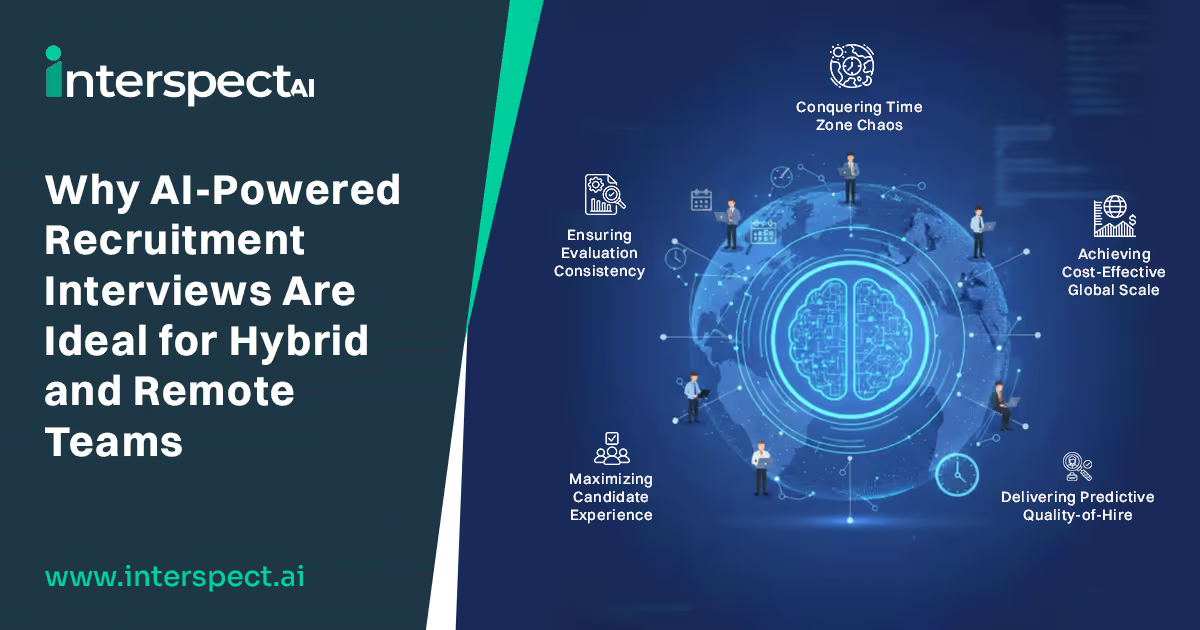
The modern shift to remote and hybrid work demands a new approach to talent acquisition. Traditional methods struggle with time zones, scheduling conflicts, and maintaining consistent evaluation standards across decentralized teams. AI-Powered Recruitment Interviews are the answer, providing the standardization, scalability, and objective data collection needed to hire high-quality talent anywhere in the world.
5 Ways AI Interviews Drive Remote Hiring Success
1. Conquering Time Zone Chaos (Boosting Time-to-Hire)
In traditional remote hiring, scheduling involves complex, manual coordination across continents, a bottleneck that significantly increases the Time-to-Hire (TTH). Automated candidate interviews solve this by offering true 24/7 access. This means a candidate in Tokyo can complete their screening at 2 AM their time, and the recruiter in London can review the objectively scored data during their standard workday. This asynchronous efficiency eliminates the delay caused by logistical friction, allowing hiring managers to move qualified candidates forward instantly and to secure global talent faster.
2. Ensuring Evaluation Consistency (Fostering Fairness)
Decentralized teams often struggle to maintain interview standards, where variations in interviewers' questions or biases can lead to unfair or inconsistent hiring decisions, harming the Bias Reduction Index. AI Candidate Evaluation Tools guarantee uniformity. Every candidate, regardless of their location or the time they interview, is subjected to the same standardized questions and scored against the same rubric. This removes the variable of human inconsistency, ensuring a consistently fair process that focuses purely on objective, job-relevant competencies like Role Alignment.
3. Maximizing Candidate Experience (Boosting CSAT)
For candidates, a drawn-out, fragmented remote hiring process is frustrating and can severely lower the Candidate Satisfaction Score (CSAT). AI-Powered Recruitment Interviews provide a seamless, reliable, and fast experience. The ability to complete the first screening immediately is a major convenience benefit. Furthermore, many AI systems provide candidates with personalized, actionable feedback (like a Skills Breakdown), which turns the interview into a valuable growth opportunity, fostering a positive view of the company even for those who are not hired.
4. Delivering Predictive Quality-of-Hire (QoH)
Traditional remote interviews can struggle to assess soft skills and behavioral fit accurately. AI transcends this by providing deep, objective behavioral analysis. By assessing communication patterns and consistency, AI makes data-driven predictions about a candidate's future performance and cultural fit, directly increasing your Quality-of-Hire (QoH). Metrics like the Overall Candidate Fit and Authenticity Score quantify fit with far greater precision than subjective human judgment, ensuring the remote hire is set up for long-term success in a distributed team environment.
5. Achieving Cost-Effective Global Scale (Lowering CPH)
Scaling a global remote recruiting effort using human recruiters is expensive due to increased labor hours for coordination and screening. By automating the most time-intensive tasks like screening, scheduling, and basic evaluation, AI-Powered Recruitment Interviews reduce the number of recruiter hours required per hire. This automation functions as a scalable infrastructure, enabling companies to expand their talent search globally without proportionally increasing their internal recruitment team size, resulting in a dramatic reduction in Cost-per-Hire (CPH).
SpectraHire: Quantifying Fit for Follow-Ups
To master candidate follow-up, recruiters need specific, granular data to make communication meaningful. SpectraHire is an agentic AI platform that provides this exact level of quantification, helping recruiters move beyond subjective impressions to objective, measurable metrics:
- Overall Candidate Fit: Provides a holistic score, evaluating an applicant's strengths, gaps, and next suggested steps. This ensures follow-up is relevant, whether the candidate is being advanced or pipelined.
- Role Alignment Score: Precisely checks how a candidate’s experience directly matches the Job Description requirements (critical for automated decision-making).
- Authenticity Score: Evaluates the genuineness in responses through the use of personal examples, ensuring honest candidate insight.
- Communication Skills/Confidence: Assesses clarity of explanations, including pacing, which are core indicators of effectiveness.
- Technical Proficiency: Assesses competency in technical interview rounds.
By leveraging these quantified insights, recruiters are armed with a much higher signal-to-noise ratio, ensuring automated follow-up is personalized and accurate, and that only the most qualified candidates move forward.
Conclusion
The "black hole" of recruitment is a choice, not a necessity. By deploying AI Agents to manage the entire spectrum of candidate follow-up—from instant acknowledgment to personalized feedback and future nurturing—companies demonstrate respect for every applicant. Recruiters leverage data provided by platforms like SpectraHire to quantify complex metrics such as Overall Candidate Fit and Authenticity Score. This investment proves that modern AI Candidate Evaluation Tools are not just an efficiency play; they are a strategic move to secure the highest quality talent faster, fairer, and cheaper than ever before, ensuring that even rejected applicants become advocates for the company.
Start hiring smarter. Request a SpectraHire demo today.
FAQs
How does AI for recruitment interviews ensure a fairer process?
AI ensures fairness by applying a standardized scoring rubric to every candidate, eliminating human unconscious biases. It focuses purely on objective metrics like Role Alignment to provide a transparent assessment based on required competencies.
Is Quality-of-Hire (QoH) measured solely by the AI tool?
No. AI improves the predictive aspect of QoH by analyzing communication and behavioral fit, providing metrics like the Overall Candidate Fit score, which strongly correlates with post-hire success. QoH is an organizational metric measured after the hire.
What is the main difference between an AI screening interview and an automated candidate interview?
AI screening is focused on early funnel filtering (e.g., basic qualification questions). An automated interview can be a more comprehensive assessment, including scenario-based questions to measure Technical Proficiency or providing a full Skills Breakdown report.
Can small and medium-sized businesses (SMBs) afford to use these AI recruitment tools?
Yes. The efficiency gains in Time-to-Hire and Cost-per-Hire often result in a rapid ROI, making the investment worthwhile for SMBs. Scalable AI for recruitment interview solutions is available for businesses of all sizes.
Subscribe to The InterspectAI Blog