%201.svg)


For decades, the success of a university career centre was measured by volume. How many appointments were booked? How many resumes were reviewed? How many students walked through the door? While these metrics track activity, they fail to measure impact. In an era where higher education is under increasing pressure to demonstrate Return on Investment (ROI), counting foot traffic is no longer enough. The modern career centre must evolve from a service provider into a strategic intelligence hub, utilising career services analytics to drive decision-making.
The reality is that most institutions are sitting on a vast, untapped reservoir of data. Every student interaction, every mock interview, and every resume critique contains valuable signals about employability data and workforce readiness. The challenge and the opportunity lies in capturing these signals and converting them into structured insights. By doing so, universities can move from reactive advising to a proactive, data-driven strategy, ensuring their training programs align perfectly with the evolving demands of the labour market.
Moving Beyond Vanity Metrics
The first step in turning career services into a data goldmine is distinguishing between vanity metrics (lagging indicators) and actionable insights (leading indicators). Traditional reports often focus on university career outcomes, who got hired and where. While critical for marketing, this data arrives too late to help the current cohort. It is autopsy data; it tells you what happened, not how to fix it while it is happening.
To truly influence student success, institutions need student performance tracking that occurs during the preparation phase. Instead of just knowing that a student attended a workshop, career leaders need to know if that student demonstrated improved competency in communication or critical thinking afterwards. This shift allows advisors to identify at-risk students months before graduation, deploying interventions when they can still make a difference.
The Black Box of Interview Preparation
The most significant data gap in career services typically lies in interview preparation. When a student practices with a peer or a mentor, the feedback is subjective and ephemeral. It disappears the moment the conversation ends. There is no record of whether the student struggled with eye contact, failed to use the STAR method, or lacked specific domain knowledge.
This lack of visibility creates a black box. Advisors know students are practicing, but they lack the granular data to understand why some succeed and others fail. Without this data, it is impossible to diagnose systemic weaknesses across a cohort. Are the engineering students struggling with technical questions, or are they failing to communicate their soft skills effectively? Without AI-driven insights, these questions remain matters of guesswork rather than evidence.
Turning Conversations into Structured Data Sets
This is where the integration of advanced technology becomes transformative. Modern AI platforms do not just simulate interviews; they digitise and analyse the interaction, turning the messy, unstructured nature of human conversation into clean, comparable data rows.
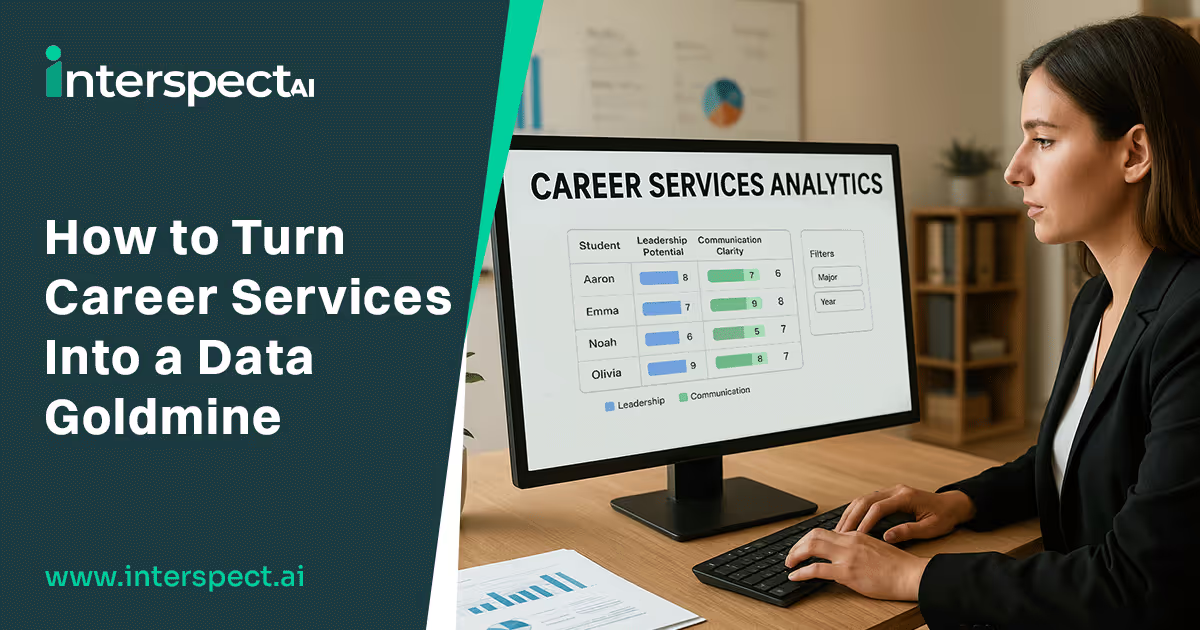
Imagine a dashboard that doesn't just list student names, but categorises their performance based on specific competencies like leadership potential, communication clarity, and authenticity. This level of career services analytics allows directors to slice the data by major, year, or demographic. If the data reveals that marketing majors are consistently scoring low on data fluency questions, the curriculum committee has the evidence needed to adjust the academic program. This feedback loop bridges the gap between the career centre and the classroom, making employability a campus-wide mandate.
InterspectAI: The Engine for Employability Intelligence
While many tools offer basic recording capabilities, InterspectAI is engineered to be the analytical backbone of the modern career centre. Through its SpectraSeek platform, InterspectAI transforms the subjective art of interviewing into objective science.
Here is how InterspectAI acts as the ultimate solution for data-driven career centres:
- Granular Skill Decomposition: Unlike generic tools that give a simple pass/fail, SpectraSeek breaks down performance into specific metrics. It analyses overall candidate fit, interview readiness, communication skills, and content relevance. This provides advisors with a Role Alignment Score, indicating exactly how well a student matches the specific requirements of their target industry.
- Structuring the Unstructured: The platform utilises InterspectAI’s proprietary Vertical AI Agents, which are fine-tuned for specific domains. This means the system can understand the nuance of a nursing answer versus a finance answer, extracting relevant data points and outputting them as structured files. This turns every practice session into a data point for longitudinal tracking.
- Bias-Free Benchmarking: One of the greatest challenges in assessing student readiness is human bias. SpectraSeek applies a standardised scoring rubric to every interaction. This creates a fair, consistent baseline, allowing universities to accurately compare the preparedness of different cohorts without the noise of subjective human grading.
- Scalable Insight Generation: Because the AI operates autonomously, it can generate data on thousands of students simultaneously. This volume of data allows career leaders to spot trends that would be invisible in manual, one-on-one advising models.
Closing the Loop with Employers
Ultimately, a data-driven career centre is a better partner to employers. Instead of sending out a general blast of resumes, a centre armed with analytics can curate talent pipelines with precision. They can say to a recruiter, Here is a list of students who have scored in the top tier for Python proficiency and communication adaptability.
This capability elevates the university's reputation from a simple talent pool to a strategic talent partner. By aligning internal metrics with external hiring standards, universities ensure their graduates are not just educated, but market-prepared before they ever leave campus.
Conclusion
The era of intuition-based career counselling is ending. To survive and thrive in a competitive educational landscape, career centers must treat student performance data as their most valuable asset. By leveraging tools that provide deep, actionable career services analytics, institutions can transform their operations from administrative support functions into strategic engines of student success.
The shift to data is not just about better charts; it is about better lives. It ensures every student receives the targeted support they need to launch their career with confidence.
Stop guessing and start measuring. Transform your career centre into a data powerhouse with SpectraSeek. Partner with InterspectAI today to unlock the deep insights needed to refine your training, impress employers, and drive superior placement outcomes.
FAQs
Q1: What is the difference between leading and lagging indicators in career services?
A: Lagging indicators measure past outcomes, such as graduation rates or placement statistics. Leading indicators predict future success, such as student engagement levels, practice interview scores, and skill acquisition rates. Career services analytics should focus on leading indicators to allow for proactive interventions before students graduate.
Q2: How can analytics help with curriculum development?
A: By aggregating data from student performance in mock interviews and assessments, career centres can identify systemic skill gaps across specific majors. For example, if data shows finance students consistently struggle with verbal communication, the university can introduce targeted workshops or adjust the curriculum to address this deficiency, ensuring better alignment with employer needs.
Q3: Does collecting this data compromise student privacy?
A: Not when using enterprise-grade platforms. Solutions like InterspectAI are built with strict compliance standards, including SOC2 Type 2 and GDPR. The goal is to aggregate data for strategic insights and personalised coaching, ensuring that employability data is used securely and ethically to benefit the student.
Q4: How does AI provide more objective data than human advisors?
A: Human advisors, despite their best intentions, are subject to unconscious biases and fatigue. An AI agent applies the same standardised scoring rubric to every student, regardless of the time of day or the student's background. This ensures that the student performance tracking is consistent, fair, and comparable across the entire student body.
You might also like

The modern job search has undergone a radical transformation. For decades, the primary connection between you and a job offer was a hiring professional, a recruiter or a hiring manager. Today, however, your first conversation is increasingly likely to be with an algorithm. Whether it is an automated online video interview or a screening tool analyzing your responses, AI is now a central player in the global hiring landscape.
For many job seekers, this shift feels intimidating. How do you build rapport with a machine? How do you ensure your soft skills translate through a lens of data? The good news is that passing an AI interview is not about "tricking" the system; it is about understanding the objective criteria these platforms use to define success. By leveraging the right AI interview prep and focusing on data-backed strategies, you can turn digital screening into your greatest competitive advantage.
Understanding the AI Hiring Logic
To excel in an AI-driven environment, you first need to understand what the technology is actually looking for. Unlike human recruiters, who may be influenced by unconscious bias or "gut feelings," AI platforms are built on the science of structured assessment.
When you participate in an automated video interview, the system is typically evaluating several core pillars through AI interview analytics:
Role Alignment: This measures how closely your verbalized skills and experiences match the specific requirements of the job description.
Response Structure: The AI looks for organized, logical flow in your answers, often rewarding frameworks like the STAR method.
Behavioral Fluency: This indicates your ability to retrieve and structure your knowledge clearly even under the pressure of a timed response.
Authenticity: Platforms check if you are sharing unique, personal stories or simply reciting generic, memorized scripts found online.
Platforms like SpectraSeek provide an ‘Interview Readiness Score’ that tells you exactly where you stand. By practicing with an AI mock interview platform, you aren't just rehearsing; you are validating your readiness against the same algorithms that will decide your future.
Strategy 1: Master the “Role Alignment” Algorithm
The most critical metric in any AI screening is Role Alignment. In a traditional interview, you might hope a recruiter "sees your potential." In an AI interview, you must provide the specific data to prove it.
The AI analyzes your response relevance and keyword integration. If the job description emphasizes "cross-functional leadership" or "technical proficiency," the AI is specifically listening for those themes.
Expert Tip: Use SpectraSeek to run a diagnostic on your current narrative. When you upload the Job Description to the platform, it compares your verbal responses against target requirements and your uploaded resume. If it gives a low alignment score, it is a clear indicator that you need to weave more specific experience areas into your answers before the real interview.
Strategy 2: Prioritize Authenticity Over Scripts
A common mistake job seekers make is trying to sound "perfect" by memorizing generic answers. However, modern automated video interview software is designed to detect and penalize rehearsed, robotic delivery.
Employers today value genuine connection and personal evidence. This is why InterspectAI developed the Authenticity Score. It rewards specific, personal storytelling over generic clichés. For example, instead of saying, "I am a problem solver," describe a specific instance where you identified a technical loophole or developed a new metric to track success.
The more specific the detail, the higher your authenticity score will be. This AI behavioral analytics approach helps you connect on a human level, even when the initial listener is a machine.
Strategy 3: Use "Stress Inoculation" to Build Confidence
Anxiety is one of the leading causes of interview failure for even the brightest candidates. You may have the perfect qualifications, but if the pressure of a recording causes you to stumble, the AI may interpret that as a lack of communication confidence.
Think of an AI interview coach as a tool for "stress inoculation". By replicating the pressure of a timed, recorded environment, these platforms desensitize you to the digital interview format.
The goal is to achieve high Interview Readiness, a state where you can maintain clarity and resilience across multiple simulated sessions. When you enter the real high-stakes environment, your brain treats it like a familiar dress rehearsal rather than a threat.
Strategy 4: Structure and Technical Proficiency
For both technical and behavioral roles, structure is king. Frameworks like the STAR method (Situation, Task, Action, Result) or CAR (Context, Action, Result) ensure your stories are easy for the AI to extract and categorize.
Furthermore, if you are applying for a technical role, do not assume the AI won't catch errors. Advanced platforms like SpectraSeek rigorously check for Technical Proficiency, wherein it checks the areas of your response wherein you talk about your experience with technical tools.
Why Data-Driven Coaching is the Future
For years, interview preparation was a game of guesswork involving qualitative feedback like "you seemed a bit nervous." While well-intentioned, that feedback has zero predictive value for modern hiring.
By moving to an automated feedback system, you gain actionable analytics. You can see detailed skills breakdown and identify exactly where your "blind spots" are before you risk a real application. This turns the mystery of hiring into a manageable data problem you can solve.
Conclusion: Don't Guess, Know
The era of "hoping for the best" is over. With SpectraSeek, you can uncover your gaps, refine your narrative, and enter the job market not just with hope, but with proof of your potential.
Equip yourself with the predictive power of InterspectAI. Visit SpectraSeek today to transform your career center experience into a data-driven launchpad for your success.
FAQs
Can an AI simulator really match the complexity of a human interviewer?
While no AI can perfectly replicate a human, advanced platforms use agentic AI to mimic the reasoning and adaptability of a recruiter. They can ask follow-up questions based on your specific answers.
How does a high score on an interview platform translate to a job offer?
A high score indicates you have mastered the content structure, clarity, and relevance that employers prioritize. Since many companies use similar criteria or AI tools to evaluate candidates, demonstrating high readiness in a simulation strongly correlates with having a great chance of passing the real screening process.
Does the AI check if I am providing generic answers?
Yes. Platforms like SpectraSeek generate an Authenticity Score. They analyze your responses to see if you are using specific, personal details, which indicates authenticity, or if you are reciting generic, memorized scripts found online.
For many university students, the interview process feels like a black box. They submit an application, show up for a conversation, and then wait for a judgment that often comes without explanation. This lack of transparency breeds anxiety. Students often wonder if they talked too much, if their stories made sense, or if they truly sounded like themselves.
The introduction of AI interview coaching into career centers is changing this experience. While the technology is often sold on its efficiency, its profound impact lies in psychology. When students practice with an intelligent agent, they are not just rehearsing lines. They are engaging in a deep form of self-assessment. They hold up a digital mirror that reflects not just what they said, but how they came across. This objective feedback loop helps students dismantle self-limiting habits and discover a level of confidence-building that traditional practice rarely unlocks.
Uncovering Blind Spots in Communication
Most students have never heard themselves speak in a professional setting. They may believe they are being concise, while in reality, they are burying the lead under minutes of context. Or they may think they are being humble when they are actually failing to claim ownership of their achievements.
AI tools act as impartial observers. They provide immediate response insights that highlight these blind spots without judgment. A student might learn that they overuse tentative language when describing their technical skills, which undermines their technical proficiency. Or they might discover that their answers lack structure, leading to a low score in communication skills.
This realization is the first step in student development. It shifts the focus from "what does the recruiter want to hear?" to "how am I actually communicating?" By seeing a breakdown of their response structure, students learn to organize their thoughts logically. They realize that clarity is a skill they can control, not a trait they are born with.
The Psychological Safety to Fail
Fear of judgment is the primary barrier to effective practice. In a mock interview with a career counselor or a peer, students often stick to safe, rehearsed scripts because they do not want to look foolish. This prevents them from experimenting with new stories or bolder ways of presenting themselves.
An AI agent removes the social stakes. It does not judge, get bored, or form an opinion based on appearance. This creates a psychological safety net where students are free to fail. They can try answering a difficult behavioral question five different ways to see which one yields the highest interview readiness score.
Through this iterative process, students learn resilience. They discover that a bad answer is not a character flaw but simply a data point to be improved. This freedom allows them to find their authentic voice. They learn that they sound most confident not when they are reciting a perfect script, but when they are speaking naturally about experience areas they genuinely care about.
Aligning Personal Story with Professional Expectations
One of the hardest lessons for students is understanding how their unique background fits into a rigid job description. They often struggle to translate academic or extracurricular experiences into the language of the workplace.
Advanced AI platforms help students bridge this gap by analyzing role alignment. A student might think their experience running a university club is irrelevant to a corporate analyst role. However, the AI can highlight how that experience demonstrates leadership and budget management, aligning directly with the job requirements.
This teaches students to value their own history. They learn to view their diverse experiences as assets rather than footnotes. By seeing a concrete skills breakdown, they understand that they are more qualified than they realized. This shift in perspective is transformative. It turns the interview from a plea for employment into a negotiation of value.
InterspectAI: A Partner in Self-Discovery
While many tools provide simple transcripts, InterspectAI is designed to foster deep behavioral insight. Through SpectraSeek, the platform offers a sophisticated environment where students can explore their professional identity.
Here is how InterspectAI supports this journey of self-discovery:
- Measuring the Real You: SpectraSeek calculates an ‘Authenticity Score’ for every interaction. It flags generic, rehearsed answers and rewards genuine, specific storytelling. This teaches students that vulnerability and specificity are strengths, not weaknesses.
- Holistic Feedback: Instead of just correcting grammar, the platform evaluates ‘Overall Candidate Fit’. It looks at the synthesis of skills, experience, and delivery. This helps students understand the big picture of how employers perceive them.
- Targeted Skill Development: The system breaks down performance into granular metrics like ‘Technical Proficiency’ and ‘Communication Confidence’. A student can see exactly where they excel and where they need work, turning the vague goal of "getting better" into a manageable checklist of improvements.
- Safe Repetition: Students can practice unlimited times with domain-specific agents. This allows them to master the vocabulary of their field and build the muscle memory required to speak with authority.
Conclusion
The ultimate goal of AI in career services is not to create robotic interviewees, but to empower human ones. By providing a private, objective space for practice, these tools allow students to confront their insecurities and recognize their strengths.
When a student walks into a real interview, they should not be hoping for the right questions. They should be confident in their ability to give the right answers because they have already proven it to themselves.
Help your students find their voice. Give them the tool that turns practice into self-belief. Partner with InterspectAI today to bring SpectraSeek to your campus and empower the next generation of confident professionals.
FAQs
Q1: How does AI help students who are anxious about interviewing?
A: AI provides a safe, judgment-free environment for confidence building. By allowing students to practice repeatedly without the fear of embarrassment, it desensitizes them to the pressure of answering questions. This familiarity reduces anxiety and allows their true personality to shine through during real interviews.
Q2: Can AI really measure if a student is being authentic?
A: Yes. Advanced platforms like SpectraSeek use an ‘Authenticity Score’. This metric analyzes whether a student is using specific, personal examples and "I" statements, or if they are relying on generic clichés. This feedback encourages students to share their unique stories rather than rehearsed scripts.
Q3: What makes AI feedback different from peer feedback?
A: AI feedback is objective and data-driven. While a peer might say "that sounded good," an AI tool provides specific response Insights and a skills Breakdown. It highlights exactly which parts of the answer demonstrated competence and which parts were vague, ensuring students focus on measurable improvements.
Q4: Does practicing with AI help with technical interviews?
A: Absolutely. AI agents can be trained on specific industry knowledge. They assess technical proficiency by checking if the student used the correct terminology and logic for their field. This ensures that students are not just good communicators, but also competent subject matter experts.
When candidates walk into an interview, there’s so much more going on beyond just their words. Their tone, pauses, enthusiasm, and even subtle moments of hesitation paint a picture that resumes can’t capture alone. Yet, traditional interviews often miss these priceless signals because hiring teams rely on scattered notes or memory, which can be pretty unreliable.
What if you could replay each conversation exactly as it happened? To really dive into how someone tackled a tricky question, spot authentic excitement, or catch early signs of stress before it becomes a problem? Better still, what if this insight were delivered consistently and without bias, every single time?
This is precisely what SpectraHire offers — a completely agent-led interview experience powered by AI, equipped with detailed transcripts and deep sentiment analysis.
Why Traditional Interviews Sometimes Fall Short
Most hiring teams do their best, but let’s face it: relying on human memory and notes means important details inevitably fall through the cracks. Interview notes vary from one person to another; details can get muddled after multiple rounds, and unconscious bias can creep in without anyone realizing it. Plus, without a clear record, it’s tough to back up hiring decisions or ensure fairness.
This uncertainty keeps recruiters and hiring managers up at night, unsure if they caught the whole story behind a candidate’s potential.
Meet SpectraHire: The Platform Orchestrating Intelligent Interviews
SpectraHire isn’t your average recruitment tool. It's an Agentic AI-driven Interview Platform designed to revolutionize the interview process. It deploys specialized AI agents that lead entire conversations, from greeting to goodbye. These intelligent agents ask tailored questions, follow up based on candidate responses, and adapt in real-time, much like a human interviewer, but without the limitations of fatigue, unconscious bias, or missed notes.
Every word the candidate says is recorded and transcribed instantly, creating a searchable and accurate transcript that your team can revisit. But SpectraHire goes a step further—its underlying AI constantly analyzes how things are said, picking up on tone, confidence, hesitation, and problem-solving style. These insights provide your team with a fuller, more objective picture than any written notes could offer, ensuring consistent and fair evaluations driven by agentic capabilities.
Why Detailed Transcripts Matter
Imagine being able to:
- Search for a candidate’s exact answer to a critical question anytime
- Share transcripts easily with other decision-makers
- Compare candidates based on their actual words, not just impressions or notes
Having a verbatim record brings clarity, trust, and accountability. It replaces guesswork with facts, making debrief meetings more productive and hiring decisions more informed.
Beyond Words: Understanding Sentiment and Reasoning
SpectraHire analyzes not just what candidates say, but how they say it. This helps answer questions like:
- Did the candidate stay calm and confident, or did stress show through?
- How creative or logical was their approach to solving problems?
- Were they genuinely motivated, or just giving rehearsed answers?
This nuanced understanding is challenging for humans to capture consistently during live interviews, but AI can do it in real-time, every time.
What Makes SpectraHire Stand Out?
Here’s a quick look at what SpectraHire brings to the table:
- Fully Autonomous Interviews: The AI agent handles the entire conversation on its own.
- Accurate, Searchable Transcripts: Your team gets verbatim records that can be reviewed anytime.
- In-Depth Sentiment & Reasoning Analysis: Tone, hesitation, confidence, and logical flow are all measured automatically.
- Customizable Interview Templates: Tailor the interview flow and questions to the specific role.
- Flexible Scheduling for Candidates: Interviews can be conducted at convenient times within a specified time window.
- Intuitive Dashboards: Recruiters can review detailed reports and assess candidates all in one place.
- Seamless Integration: Works smoothly with your existing Applicant Tracking System (ATS).
- Data Security & Compliance: Your candidate data is secure, meeting industry standards such as GDPR and SOC 2.
If you want to explore SpectraHire’s full capabilities, check out the official page.
How This Helps Recruiters and Hiring Managers
For busy hiring teams, SpectraHire offers:
- Scalability: Whether it’s 10 or 1,000 candidates, interviews remain consistent and manageable.
- Fairness: AI-driven analysis eliminates human biases, leveling the playing field.
- Speed: Automated interviewing and insights enable teams to shortlist candidates faster.
- Better Decisions: Rich transcripts and sentiment data empower smarter, evidence-backed choices.
- Improved Candidate Experience: Clear, transparent interactions make candidates feel respected and valued.
What SpectraHire Is Designed to Deliver
As an innovative AI-driven interview platform, SpectraHire is built to address the core challenges that hiring teams face every day. The platform's capabilities are designed to help organizations achieve:
- More Informed Hiring Decisions through deeper candidate insights that go beyond surface-level assessments.
- Reduced Interview Bias by standardizing the evaluation process and removing subjective human inconsistencies.
- Faster Time-to-Hire without compromising the thoroughness of candidate evaluation.
- Better Role-Candidate Alignment by analyzing communication patterns, reasoning abilities, and cultural fit indicators more comprehensively.
Hiring is about more than ticking boxes—it’s about truly understanding people and potential. With SpectraHire, you gain a partner that helps you conduct interviews that are fair, comprehensive, and deeply insightful.
By combining autonomous AI interviewing with precise transcripts and sentiment analysis, SpectraHire transforms hiring from guesswork into a science, all while saving your recruiting team time and effort.
Discover how SpectraHire can revolutionize your hiring process today by visiting our website.
Subscribe to The InterspectAI Blog