%201.svg)

How AI Mock Interviews Actually Work: A Technical Deep Dive


Have you considered what happens behind the scenes when an AI interviews you? Is it only searching for keywords, or does it analyze your micro-expressions? For many candidates, the experience seems unclear; you interact with a screen and receive a score in return.
In today's job market, understanding these mechanisms is valuable. By exploring the technology, you can move from guessing what the system expects to strategically enhancing your performance.
Here is the technical breakdown of how AI mock interviews work, from the initial pixel to the final score.
The Tech Stack: The Brain Behind the Bot
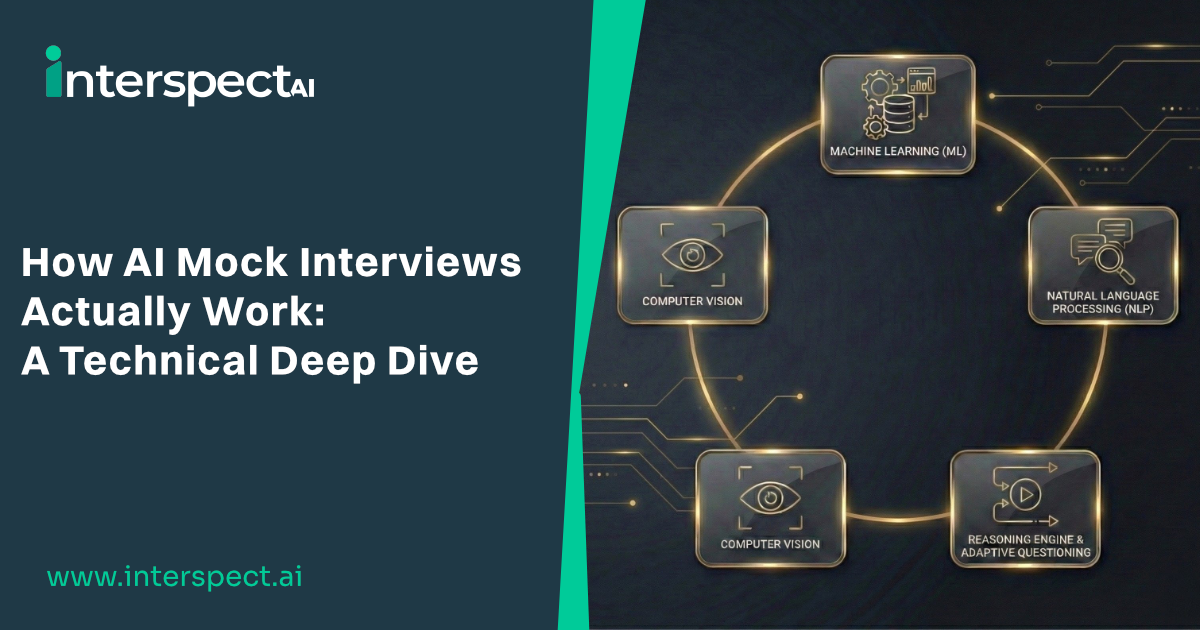
A robust AI interview scoring system isn't just one piece of software; it is a stack of three distinct technologies working in harmony:
- Natural Language Processing (NLP) converts human speech into meaningful text for analysis.
- Machine Learning (ML) compares your answers to a dataset of interviews to identify competence patterns.
- Computer Vision analyzes video inputs to assess your engagement and non-verbal cues during interviews.
How the AI "Listens": From Audio to Analytics
When you speak, the AI doesn't "hear" you the way a human does. It processes your audio in two critical stages.
First, an Automatic Speech Recognition (ASR) engine converts your speech to text. Clarity is key. If you mumble, the transcription fails, giving poor data to the NLP engine.
Once transcribed, the AI system uses sentiment analysis and semantic processing. It analyzes your intent, not just keywords.
- Entity Extraction: It identifies specific tools (e.g., "Tableau," "Python") and maps them to the skills required.
- Structural Analysis: It looks for logic markers like "Because" or "Therefore" that signal you are providing evidence.
How the AI "Sees": The Visual Metrics
While not all platforms use video analysis, many corporate machine learning interview coaching tools and screening systems do. This is often the most controversial and misunderstood part of the tech stack.
The computer vision algorithms are typically tracking:
- Eye Tracking: Is your gaze focused on the camera/screen, or is it darting to the side? Consistent darting can trigger "script reading" flags.
- Facial Analysis: The system maps key facial points to detect engagement. It isn't reading your "soul"; it is checking for openness and attentiveness versus boredom or distraction.
- Posture Analysis: Are you centered in the frame? Poor framing or slouching can impact professionalism scores.
How the AI "Thinks": Reasoning vs. Rules
Old chatbots followed simple rules (e.g., "If X, say Y"). Modern agentic AI uses reasoning engines.
This is the "generative" part. The AI holds a "system prompt" that defines its persona (for example, a Senior Product Manager). It evaluates your answer against that logic.
If you give a vague answer, the reasoning engine detects the information gap and formulates a specific follow-up question. This adaptive questioning is what makes the simulation feel real. It is not following a script; it is reacting to the quality of your input.
(Curious about the difference between bots and agents? Read our guide on What is Agentic AI.)
The Scoring Methodology: Benchmarking Success
The system turns your performance into a score by evaluating your responses as a whole, rather than just tallying points. It measures how well your answers align with the specific competencies and expectations defined for the job role.
Modern AI interview platforms move beyond standard checklists. These systems evaluate your responses directly against the Job Description, verifying that your specific skills and experiences match what the role actually requires. Role Alignment: It compares your verbal responses directly with the job description to determine whether you possess the required core competencies.
- Technical Proficiency: The system rigorously checks the accuracy of your explanations. If you are explaining a complex concept, it verifies that your terminology and logic align with industry standards.
In addition to these primary scoring areas, the algorithms also assess factors like your Authenticity and Communication Confidence. The goal is to measure your overall Interview Readiness by assessing whether you can succeed in a realistic, live conversation.
Privacy and Ethics: The Safety Layer
With all this data analysis, privacy is a valid concern. Legitimate platforms operate under strict compliance frameworks like FERPA (for education) and GDPR.
Generally, the video and audio data are processed to extract metrics, which are then often discarded or encrypted, leaving only the anonymized data points. The goal of ethical AI is to evaluate professional competency, not personal identity. Reputable platforms are transparent about what is stored and ensure that bias-mitigation protocols are in place to treat all accents and backgrounds fairly.
How This Prepares You for Real Interviews
Understanding the technical details of this technology removes ambiguity and anxiety. When you know the AI values logical connectors, you can focus on clear communication. Being aware of eye tracking encourages you to maintain natural engagement.
By practicing against a system that uses the same tech stack as the employers, you are stress-testing your skills in the exact environment you will face on game day.
Ready to see the data behind your interview performance? Visit us at InterspectAI to start your technical training today.
TL;DR
The AI interview ecosystem relies on a sophisticated "Tech Stack" that combines Natural Language Processing (NLP) to interpret speech, Machine Learning to identify competency patterns, and Computer Vision to track visual engagement. Beyond simply hearing words, the system analyzes the deeper meaning and structure of your responses to verify you are using the right terminology, while simultaneously using visual algorithms to monitor eye contact and posture for signs of script-reading. This process is driven by advanced Agentic AI reasoning engines that ask adaptive follow-up questions to mimic a human recruiter, ultimately generating a holistic score based on Role Alignment and Technical Proficiency rather than random metrics.
FAQs
Can the AI understand accents?
Yes. Modern NLP engines are trained on massive, diverse datasets to understand a wide variety of global accents. However, clear enunciation always helps the speech-to-text engine provide the most accurate transcription of your skills.
Does the AI know if I am lying?
It doesn't use a polygraph, but it detects inconsistency. If you claim to be an expert in a specific skill but fail to use the correct technical terminology associated with that skill, the reasoning engine will flag the discrepancy as low "Role Alignment."
Why do I need to look at the camera if the AI listens to text?
Because many real-world hiring platforms (like HireVue) combine text analysis with visual analysis. Practicing eye contact ensures you don't get flagged for low engagement or "reading off-screen" behaviors during the actual job screening.
Is my data shared with employers?
On a practice platform like SpectraSeek, your data is private to you (and your career center, if applicable). It is a safe sandbox to fail and learn. We do not sell student performance data to recruiters.
You might also like

For decades, the university career center has functioned primarily as a document consultancy. Students visited to have their resumes proofread, their cover letters edited, and perhaps to browse a physical or digital job board. Success was often measured by the number of appointments booked or the number of resumes approved. This transactional model worked when the hiring process was manual and linear. However, we have entered a new epoch. With the rapid integration of AI in university career services, the old playbook is not just outdated; it is becoming a liability.
The modern labor market is algorithmic. Employers are using sophisticated tools to screen candidates based on skills, competency, and potential match. In this environment, a perfectly formatted resume is merely the price of admission, not the ticket to a job. To deliver real value, modern career offices must undergo a radical transformation. They must evolve from administrative support hubs into high-tech readiness accelerators, leveraging employability innovation to prepare students for a world where they will be interviewed, assessed, and managed by AI agents.
From Document Perfection to Skill Verification
The first step in this reinvention is a philosophical shift. Career centers must stop obsessing over the artifacts of hiring (resumes) and start obsessing over the substance of hiring (skills). Employers today are less interested in where a student went to school and more interested in what they can actually do.
An AI readiness platform allows career offices to pivot toward skill verification. Instead of spending 30 minutes correcting grammar on a CV, advisors can use that time to review data on a student's technical proficiency and communication confidence. By shifting the focus to verified skills, career centers align themselves with the "skills-first" hiring trends dominating the corporate world. This ensures that when a student lists "leadership" on their resume, they have the response insights and behavioral examples to back it up in an interview.
Scaling the "Human" Element
A common misconception is that adopting AI means removing the human touch. In reality, the opposite is true. The current advisor-to-student ratio at most institutions makes deep, personalized guidance impossible for the majority of the student body. Advisors are trapped in a cycle of repetitive, low-level tasks.
Reinventing the career service model involves offloading these repetitive tasks to intelligent agents. When an AI tool handles the initial mock interviews and resume scans, human advisors are liberated to do what they do best: mentor. They can focus on complex career mapping, emotional support, and networking strategies. This structure creates a tiered service model where every student gets unlimited digital practice, and high-stakes conversations happen with human experts. This is the only viable path to student outcomes improvement at scale.
InterspectAI: The Infrastructure for Modern Career Centers
To execute this vision, universities need more than just a chatbot; they need a robust infrastructure designed for deep assessment. InterspectAI provides this foundation through SpectraSeek, a platform that functions as a 24/7 career readiness engine.
Here is how InterspectAI serves as the cornerstone of a reinvented career office:
- Objective Readiness Metrics: Unlike human feedback, which can be subjective, SpectraSeek provides standardized data. It evaluates interview readiness by analyzing the structure and content of a student's spoken answers. It determines if a student is actually answering the question asked or merely rambling.
- Authenticity as a Metric: In an era of ChatGPT-written cover letters, employers crave genuineness. SpectraSeek calculates an ‘Authenticity Score’. It detects whether a student is using specific, personal examples or relying on generic platitudes. This forces students to dig deeper into their own experience areas.
- Precision Role Matching: The platform assesses role alignment by comparing a student's verbal responses against the specific competency requirements of a job description. It identifies gaps in technical proficiency and provides skills breakdown, allowing the student to address them before the real interview.
- Feedback that Sticks: Students receive immediate response insights on many key metrics including their communication confidence. They learn to articulate their value proposition clearly and concisely, ensuring they are prepared for both human and AI screeners.
The Career Center as a Data Hub
The final pillar of reinvention is data. A modern career office should function like a business intelligence unit. By aggregating the performance data from thousands of AI practice sessions, directors can see the pulse of the university's talent pipeline in real-time.
If the data shows that 60% of business students are scoring low on ‘Overall Candidate Fit’ for finance roles due to a lack of specific technical examples, the career center can immediately intervene. They can launch targeted workshops or collaborate with faculty to bridge that gap. This moves the department from reactive advising to a proactive, data-driven strategy.
Conclusion
The university career center stands at a crossroad. It can cling to the models of the past and watch its relevance fade, or it can embrace the tools of the future and become the most vital department on campus. By adopting AI not just as a tool, but as a strategic partner, institutions can ensure their graduates are not just educated, but truly ready for the modern workforce.
The era of the "resume review shop" is over. The era of the "career readiness accelerator" has begun.
Build the career center of the future. Equip your institution with the technology that drives real results. Partner with InterspectAI today to integrate SpectraSeek and transform your student outcomes through the power of agentic AI.
FAQs
Q1: Why is "employability innovation" necessary for career centers now?
A: The hiring landscape has shifted dramatically with the widespread adoption of AI by employers. Traditional methods like manual resume reviews are no longer sufficient to prepare students for algorithmic screening and skills-based assessments. Innovation is required to align university preparation with these new corporate realities.
Q2: How does an AI readiness platform improve student outcomes?
A: An AI platform provides unlimited, consistent practice that human staff cannot match in volume. By allowing students to practice interviewing anytime and receive immediate feedback on interview readiness and skills, they build competency faster and enter the job market with greater confidence and preparation.
Q3: Does InterspectAI replace the need for human career counselors?
A: No. It augments them. By handling the high-volume, repetitive work of initial practice and assessment, InterspectAI frees up human advisors to focus on high-value mentorship, strategy, and complex problem-solving, effectively allowing them to serve more students with higher quality interactions.
Q4: What data can career centers gain from using AI tools?
A: Beyond simple attendance metrics, AI tools provide deep analytics on ‘Overall Candidate Fit’, ‘Role Alignment’, and ‘Communication Skills’ and much more, across the student body. This allows career center leaders to identify systemic skill gaps in specific majors and adjust their programming to address them proactively.
AI agents today are far more than simple conversational systems. They seamlessly blend multiple layers of memory, including working memory for immediate dialogue context, episodic memory for recalling past interactions and preferences, and knowledge-based memory for structured domain facts, with strategic reasoning and specialized cognitive skills.
By orchestrating external tools such as APIs, databases, and execution environments, these agents perform complex tasks autonomously, from data analysis and report generation to workflow automation and real-time decision-making.
This sophisticated cognitive architecture enables AI agents to understand nuanced user intent, adapt to evolving contexts, and deliver intelligent, personalized assistance across diverse industries.
To appreciate how these components come together, we first examine the core research that underpins modern agentic systems and then explore each cognitive layer in detail.
Foundational Research on Agentic Cognitive Architectures
For a deep dive into the underpinnings of these advanced AI systems, refer to Dr. Fouad Bousetouane’s seminal paper on agentic cognitive architectures. His work lays out the theoretical framework that informs today’s layered memory designs, strategic reasoning methods, and modular skill integrations, forming the blueprint for truly autonomous, context-aware agents.
1. Memory: Foundation of Contextual Intelligence
Building on this research foundation, AI agents rely on three complementary memory layers to maintain context and learn over time:
Working memory holds immediate context and recent interactions, ensuring coherent multi-turn dialogues without losing sight of objectives. Episodic memory captures past events, such as user preferences, task outcomes, and conversational nuances, enabling personalization and the detection of patterns. The knowledge base memory stores structured domain facts, rules, and ontologies, grounding responses in verified information and thereby reducing hallucinations. Together, these layers allow agents to recall relevant details and adapt their behavior based on accumulated experience.
2. Reasoning: From Steps to Strategy
With context firmly in place, agents apply advanced reasoning techniques to achieve strategic decision-making:
Chain-of-thought prompts guide stepwise analysis for complex tasks, such as intricate calculations or nuanced ethical deliberations. Tree-of-Thoughts explores multiple reasoning paths in parallel, improving solution quality under uncertainty. Monte Carlo Tree Search–based planning enables the anticipation of future states and the evaluation of alternative action sequences. Reflective learning mechanisms would allow agents to review their outcomes, self-correct, and refine their strategies over time. These methods combine to help AI agents decompose goals, forecast consequences, and select optimal courses of action.
3. Cognitive Skills: Domain Expertise Modules
To deliver precise, industry-grade performance, AI agents incorporate purpose-built Cognitive Skills Modules:
In healthcare, modules integrate clinical protocols and regulatory guidelines to ensure patient-centric interactions. In finance, risk assessment frameworks and market data analysis are applied to support trading, compliance, and advisory tasks. By isolating domain expertise into modular components, agents can perform specialized functions, such as document review, compliance checks, and predictive modeling, with precision and consistency, seamlessly switching between general reasoning and domain-specific workflows.
4. Tools: Bridging Models and the Real World
While memory and reasoning power the agent’s mind, tool integration extends its reach into practical operations:
Dynamic tool selection frameworks discover and invoke the appropriate APIs, such as databases, web services, or internal enterprise systems, based on the task context. Execution environments run code or workflows to handle data transformation, report generation, or system updates autonomously. This tight coupling between cognitive reasoning and external execution transforms AI agents into end-to-end automatons capable of fetching real-time data, triggering business processes, and managing multi-step operations without human intervention.
5. Orchestration: Coordinating Cognitive Components
Bringing all these elements together is a central orchestrator that pipelines each stage into a coherent workflow:
- Intent detection classifies user goals.
- Memory retrieval accesses relevant context.
- Reasoning strategy selects the optimal inference method.
- Skill invocation routes tasks to specialized modules.
- Tool execution triggers external actions.
- Result integration synthesizes the user's outputs.
- A continuous learning loop logs outcomes for refinement.
This orchestration layer ensures reliable, goal-driven performance, graceful error recovery, and seamless transitions between cognitive processes and external tools.
Pioneering Agentic Intelligence
At InterspectAI, we've been at the forefront of developing these sophisticated cognitive architectures through our work on conversational intelligence platforms. Our research, led by Dr. Fouad Bousetouane, whose recent paper on agentic systems has become a foundational reference in the field, has pioneered the integration of Cognitive Skills Modules with advanced memory systems and reasoning capabilities. Through our platform, Spectra, we've demonstrated how these cognitive components can work together to create AI agents that truly understand context, learn from interactions, and operate autonomously across diverse domains. Our practical implementations have revealed crucial insights into orchestrating memory, reasoning, skills, and tools to achieve reliable, intelligent behavior in real-world applications.
The Future of Autonomous Intelligence
The architecture of modern AI agents reveals a sophisticated integration of cognitive components that work together to create genuinely intelligent behavior. By understanding how memory systems maintain context, reasoning mechanisms enable strategic thinking, cognitive skills provide domain expertise, and tools extend capabilities into action, we gain insight into how AI agents can transcend simple pattern matching to become autonomous collaborators.
As this technology continues evolving, the organizations that understand these underlying cognitive architectures will be best positioned to harness the transformative potential of agentic AI systems. The mind of an AI agent is no longer a black box; it's a sophisticated cognitive architecture designed for autonomous intelligence, continuous learning, and meaningful collaboration with human partners.
FAQs
1. How do AI agents maintain context across long conversations?
AI agents employ layered memory systems, including working memory for immediate context, episodic memory for storing conversation history, and a knowledge base memory for domain-specific facts. This architecture enables persistent context awareness and personalized interactions based on accumulated experience.
2. What makes Cognitive Skills Modules different from general AI capabilities?
Cognitive Skills Modules embed domain-specific knowledge, regulatory requirements, and industry-specific reasoning patterns. Unlike generic AI, they understand specialized workflows, compliance frameworks, and expert-level decision-making processes tailored to specific sectors, such as healthcare or finance.
3. How do AI agents decide which tools to use for specific tasks?
Modern agents employ dynamic tool selection frameworks that evaluate available options based on current task requirements, context, and success patterns. They can discover new tools, assess capabilities, and orchestrate complex workflows across multiple systems autonomously.
4. What role does reasoning play in AI agent decision-making?
AI agents employ multiple reasoning strategies, including a chain-of-thought approach for step-by-step analysis, a tree-of-thoughts method for exploring alternatives, and reflective learning for continuous improvement. This enables strategic planning, complex problem-solving, and autonomous adaptation based on outcomes and feedback.

The year 2026 marks a strategic inflection point in talent acquisition. Organizations face a critical skills gap and intense global competition for specialized roles. Compounding this challenge, the continued retirement of the Baby Boomer generation is accelerating, creating a significant void of institutional knowledge and available workers that must be filled quickly.
In this high-stakes environment, speed and accuracy are non-negotiable. Top candidates are available for a limited time, making slow internal processes synonymous with competitive failure. The strategic mandate is clear: AI-powered recruiting is the only way to transform HR from a reactive, administrative function into a proactive, predictive strategic partner.
Here are the definitive competitive advantages organizations can expect to gain by integrating AI-driven recruiting platforms by 2026.
1. The New ROI: Radical Speed and Operational Scale
The most immediate competitive gain from AI is the radical improvement in hiring velocity, which protects revenue lost due to role vacancies.
I. Accelerated Time-to-Hire (TTH): AI-powered, end-to-end recruitment pipelines typically reduce the overall Time-to-Hire by 40–60%. This is achieved by automating the most time-consuming administrative tasks, resulting in direct cost-per-hire reductions of 30–40%.
II. Unprecedented Velocity: AI systems drastically cut the Time-to-Interview (TTI)—the time elapsed between identifying a candidate and scheduling their first interview—from approximately 21 days to under 7 days. This rapid, 24/7 engagement reduces application drop-off by up to 30%.
III. Administrative Freedom: The most advanced systems, leveraging agentic AI, can reduce manual administrative work (like screening, scheduling, and data entry) by an average of 45%. This frees recruiters to handle higher requisition volumes and focus on strategic human connections.
2. Strategic Quality, Objectivity, and Skills-First Hiring
While speed is necessary, the strategic advantage lies in the quality and ethical consistency of the resulting hires.
I. Skills-First Priority: By 2026, skills-first hiring focusing on verifiable credentials, certifications, and portfolios over degrees would be the default. AI is the only infrastructure capable of matching candidates based on granular, real-time skill validation at scale, expanding the addressable talent pool.
II. Predictive Assessment: AI-driven platforms shift decision-making from subjective instinct to data-driven prediction. These tools leverage predictive analytics to combine historical data with new hire performance, accurately estimating which candidates are most likely to achieve long-term retention and success. Teams using structured, AI-supported interviews report 24–30% higher assessment consistency.
III. Bias Reduction as a Business Imperative: Ethical AI is a powerful strategic advantage, not just a compliance checkbox. By standardizing evaluation criteria and using Non-profiling algorithms, AI ensures candidates are evaluated on objective criteria relevant to the job. This objective approach directly contributes to a more diverse workforce, with one multinational firm reporting a 20% increase in the representation of underrepresented minorities within one year of implementation.
Introducing Spectra: Your Agentic AI Recruiting Partner
The Spectra by InterspectAI is engineered to deliver this next-generation competitive edge through agentic AI.
Spectra is built to "hear, see, reason, and speak," providing human-like, hyper-personalized interactions at enterprise scale. Its core recruitment solution, SpectraHire, automates the entire end-to-end workflow—from screening and scheduling to candidate nurturing—within a single platform.
Key differentiators for Spectra include:
- Unbiased Assessment: The platform uses non-profiling algorithms to eliminate unconscious bias, providing objective, evidence-based metrics, such as skill-match scores and behavioral insights.
- Structured Data: The platform captures full video interviews and instantly generates automated scores. Crucially, it extracts all interview data into a structured format (JSON) for seamless integration with business intelligence tools.
- Compliance Moat: Designed for highly regulated industries, the platform attests to compliance with SOC 2 Type 2, GDPR, CCPA, and HIPAA.
The Evolution of the Recruiter: Strategic Talent Advisor
The integration of AI ultimately augments, rather than replaces, the human recruiter. Agentic AI takes over the transactional workflows, allowing recruiters to shift their focus from administrative drudgery to the uniquely human, high-impact work that drives true competitive success.
The recruiter's new role is that of a Strategic Talent Advisor, focusing on building deep relationships, negotiating complex offers, and providing consultative guidance to C-suite leaders on workforce planning and long-term talent strategy. The most competitive organizations in 2026 will be those that master this symbiotic human-AI partnership.
Ready to Transform Your Interview Workflows?
The future of assessment is autonomous, objective, and integrated. Stop relying on static forms and basic automation for high-stakes decisions.
Request a Demo of the Spectra today to see how seamless, scalable AI-driven interviews can fuel growth and provide clear, quantifiable insights across hiring, market research, and compliance.
Frequently Asked Questions (FAQs)
Q: How much does AI typically reduce the time it takes to hire?
AI-powered recruiting platforms typically reduce the overall time-to-hire (TTH) by 40–60%. Furthermore, AI systems can shorten time-to-interview (TTI) from approximately 21 days to under 7 days, significantly reducing candidate drop-off.
Q: Will AI replace the role of the human recruiter by 2026?
No, AI will not replace recruiters, but it will fundamentally change their role. AI excels at automating repetitive, data-intensive tasks (e.g., scheduling and screening), freeing recruiters to focus on strategic, high-value activities that require human judgment, such as relationship building and consultative advice.
Q: How does AI ensure fairness and reduce bias in the hiring process?
Ethical AI platforms use Non-profiling algorithms to standardize evaluation criteria, focusing strictly on objective, job-relevant skills and behavioral answers rather than subjective or demographic data. This ensures consistency (up to 30% higher assessment consistency ) and makes all decisions auditable.
Q: What is the benefit of integrating AI with ATS and HRIS platforms?
Integrating AI with Applicant Tracking Systems (ATS) and Human Resource Information Systems (HRIS) creates a unified view of the talent lifecycle. This eliminates manual data entry errors, accelerates the onboarding process, and provides superior analytics that link external hiring data to internal performance and succession planning.
Subscribe to The InterspectAI Blog