%201.svg)

Can AI Job Interview Simulators Predict Hiring Outcomes?


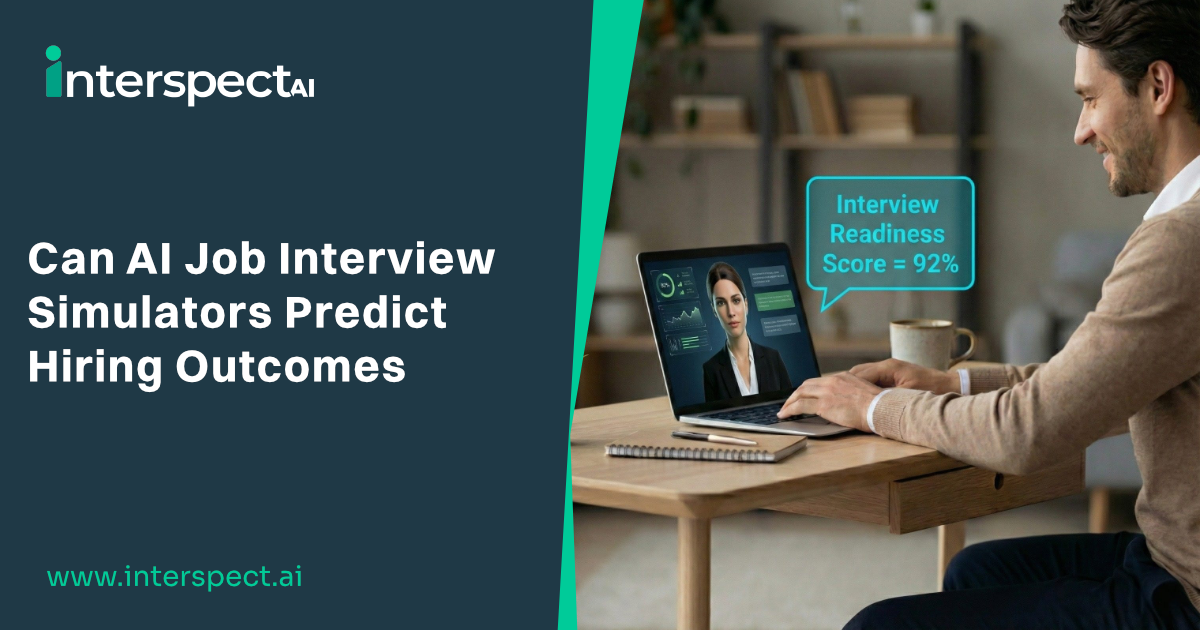
For years, interview preparation was a game of guesswork. A student would practice with a friend or a career counselor and receive feedback like "you did great" or "you seemed a bit nervous." While well-intentioned, this qualitative feedback offered zero predictive value. It could not tell a candidate if they would actually pass the rigorous screening of a Goldman Sachs or an interview at Google.
Today, the emergence of the advanced interview platform is changing this dynamic. By moving from subjective opinion to objective data, AI simulators are beginning to answer the golden question: Can a machine predict if you will get hired?
The answer is increasingly pointing to yes. The correlation between performance in a high-fidelity AI simulation and success in a real interview is not accidental. It is rooted in the fact that the technology used to train candidates is now remarkably similar to the technology used to assess them. When a student aces a simulation on a sophisticated platform, they are not just practicing; they are validating their readiness against the same algorithms that will decide their future.
The Science of Structured Assessment
The primary reason human mock interviews fail to predict outcomes is variability. One counselor might focus on enthusiasm while another focuses on technical content. Real-world hiring, however, is moving toward "structured interviewing"—a method where every candidate is asked the same questions and graded on the same rubric.
AI simulators enforce this structure. They evaluate candidates on consistent pillars such as technical proficiency and communication confidence. Research in industrial-organizational psychology has long established that structured assessments are far stronger predictors of job performance than unstructured chats. By practicing in an environment that mimics this rigidity, candidates are effectively taking a "pre-test" for the actual interview. If they score high on role alignment in the simulation, it is a statistically significant indicator that they possess the core competencies the employer is looking for.
Stress Inoculation as a Success Metric
One of the biggest variables in hiring is anxiety. A candidate might know the answers but fail to articulate them under pressure. This performance gap is often why bright students fail interviews.
AI platforms function as stress inoculators. By replicating the pressure of a timed, recorded response, they desensitize the candidate to the environment of a digital interview. High performance in a simulator indicates more than just knowledge; it suggests the ability to retrieve and structure that knowledge under stress. This "behavioral fluency" is a leading indicator of hiring success. Candidates who can maintain a high ‘Interview Readiness’ score across multiple simulated sessions demonstrate a resilience that directly translates to the high-stakes environment of a real interview.
Matching the Employer's Algorithms
The strongest argument for predictive validity is technological alignment. Many Fortune 500 companies now use AI to screen candidates in the first round. These systems analyze response relevance, keyword integration, and logical flow.
When a student practices on a platform like SpectraSeek, they are essentially running a diagnostic against these same criteria. If the simulator flags a low authenticity score because the candidate is using generic clichés, it is highly probable that the employer's AI will flag the same issue. Conversely, if the simulator validates that a response effectively highlights specific experience areas and skills, the candidate can enter the real process with data-backed confidence. The simulation provides a "scorecard" that mirrors the one used by recruiters, turning the mystery of hiring into a manageable data problem.
InterspectAI: Bridging Practice and Placement
While basic tools offer generic feedback, InterspectAI designs its SpectraSeek platform to be a predictive engine. It goes beyond simple transcription to analyze the deeper markers of employability.
Here is how SpectraSeek correlates practice with placement:
- Job Description Mapping: The platform analyzes a candidate's verbal responses against the specific requirements of a target job description. A high role alignment score in SpectraSeek is a strong predictor that a human recruiter will see the candidate as a good fit.
- Competency Validation: Unlike a peer who might nod along, the AI rigorously checks for technical proficiency. If a computer science student explains an algorithm incorrectly, the AI catches it. This ensures that a "pass" in the simulator means the candidate actually knows their stuff.
- Authenticity Detection: Employers value genuine responses over rehearsed scripts. SpectraSeek's authenticity score predicts how well a candidate will connect on a human level by rewarding specific, personal storytelling over generic answers.
- Actionable Analytics: The platform provides a detailed Skills Breakdown, allowing students to see exactly where they stand before they risk a real application. This turns the simulator into a gatekeeper of quality, ensuring students only interview when they are truly ready.
Conclusion
The era of "hoping for the best" is over. With the right interview platform, candidates can know their standing before they ever walk into the room. AI simulators have evolved from simple practice tools into predictive instruments that correlate preparation with success.
By treating the simulation as a dress rehearsal with a tough critic, students can uncover their blind spots, refine their narrative, and enter the job market not just with hope, but with proof of their potential.
Don't guess. Know. Equip your students with the predictive power of SpectraSeek. Partner with InterspectAI today to transform your career center into a data-driven launchpad for student success.
FAQs
Can an AI simulator really match the complexity of a human interviewer?
While no AI can perfectly replicate a human, advanced platforms use agentic AI to mimic the reasoning and adaptability of a recruiter. They can ask follow-up questions based on your specific answers and evaluate complex metrics like Role Alignment and Technical Proficiency, providing a highly realistic and predictive simulation.
How does a high score on an interview platform translate to a job offer?
A high score indicates that you have mastered the content structure, clarity, and relevance that employers prioritize. Since many companies use similar criteria (or even AI tools) to evaluate candidates, demonstrating high interview readiness in a simulation strongly correlates with passing the real screening process.
Does the AI check if I am providing generic answers?
Yes. Platforms like SpectraSeek generate an ‘Authenticity Score’. They analyze your responses to see if you are using specific, personal details, which indicates authenticity, or if you are reciting generic, memorized scripts found online. Authenticity is a key predictor of hiring success.
Is this technology only useful for technical roles?
No. While it is excellent for checking technical proficiency, it is equally powerful for behavioral assessments. The AI evaluates communication confidence and how well you structure your stories (e.g., using the STAR method), which are critical skills for roles in sales, management, and healthcare.
You might also like


Think about all the critical interviews your company conducts in a week. Screening calls with candidates, in-depth user research sessions, customer feedback interviews, and candid exit interviews with departing employees.
Each one is a goldmine of information.
A critical insight from a frustrated user, a brilliant product idea from a new hire, or a recurring complaint that signals a market shift.
Now, where do all those insights go?
If you’re like most companies, they disappear. They’re trapped in scattered notes, siloed in department-specific software, or lost entirely the moment the interview ends.
Your company's collective intelligence is unstructured, unsearchable, and untapped. It's dark data.
It’s time to stop treating interviews as fleeting moments and start treating them as your most valuable data asset with Spectra.
From Unstructured Voice to Searchable Data
For years, the first step in conversational intelligence was transcription. Turning voice into text was a giant leap forward, but it's no longer enough.
A folder full of transcripts is a slightly more organized version of the original problem. You still can't query it at scale.
You can't ask: "Show me every time a user mentioned a competitor in an interview this quarter."
The real breakthrough comes when you structure the context within the interview. This is where Spectra's AI agents come in.
AI agents don't just hear words; they understand the meaning behind them. They perform advanced voice data structuring during every interview, automatically tagging conversations with rich metadata:
- Entities: People, products, companies, and locations mentioned.
- Topics: Key themes discussed, like "pricing," "onboarding," or "customer support."
- Sentiment & Tone: The emotional undertone of the conversation—is the customer happy, frustrated, hesitant?
- Events: Key moments, like action items, decisions, or follow-ups.
With structured data like this, a 30-minute interview becomes a structured, queryable data object. In addition to being used by the business teams, the data can also be used to train the model and agents further, improving their capabilities and leading to a continuously improving experience.
Building Your Single Source of Truth: The Spectra Knowledge Graph
When you consistently capture and review conversations using Spectra, you're not just documenting interviews—you’re creating a rich repository of insights that can power smarter decisions across your organization.
Think of it as the first step toward building your own Interview Knowledge Graph: a connected, searchable ecosystem of qualitative data.
Each conversation recorded through Spectra becomes a data point, tied to topics, people, and sentiment. Once exported, this structured data can be fed into your existing BI tools, data warehouses, or CRM systems to create a dynamic knowledge base.
How Businesses Use Their Knowledge Graph with Spectra
By integrating Spectra’s outputs into their analytics workflows, organizations can surface cross-functional insights that were previously buried in transcripts.
- For Product Teams: Analyze user feedback to track feature mentions and sentiment trends across time.
- For HR & Talent: Investigate patterns in exit interviews or performance conversations by asking, “What themes are common among top-performing employees who left voluntarily?”
- For Market Researchers: Run large-scale customer interviews with Spectra, then use your tools to group insights and identify emerging themes—faster and at scale.
- For Sales Teams: Identify sales enablement opportunities by reviewing instances where key objections came up and tracking changes in rep confidence.
Best of all, this structured data isn't locked away. With Spectra's data extraction capabilities, it can be easily exported as a configurable JSON file and piped directly into your BI tools, data warehouses, or CRM, integrating the qualitative "why" with your quantitative "what."
Your First Steps to Building an Interview Hub
The idea of building a comprehensive knowledge graph can feel daunting, but it doesn’t have to be.
Here’s a practical way to begin.
- Start with One High-Value Interview Type: Select one area where insights are consistently lost. Is it user research interviews? Candidate screening calls? Start there. This focus enables you to demonstrate value quickly in a controlled environment.
- Define Your Key Questions: Before conducting the first interview with Spectra, ask your team: "What are the 3-5 critical insights we need to track?" These could be competitor mentions for a product team or reasons for leaving for an HR team. This defines the initial structure of your data.
- Pilot with a Single Team: Empower one team to be your champion. Let them use Spectra to build their mini-knowledge hub. As they start sharing powerful, data-backed insights they couldn't access before, other departments will naturally want to follow suit.
Building an interview hub is an iterative process. Start small, show value, and scale from there.
From Interviews to Intelligence
Building an interview hub transforms isolated conversations into your company's most valuable, searchable asset.
By structuring interview data with AI agents, you move from simply listening to actively learning. Every conversation makes your organization smarter, shaping product roadmaps with direct user feedback and informing talent strategies with real-time sentiment.
The most innovative companies don't just listen—they learn. Are you ready to unlock the data hidden in your conversations?

AI agents aren’t just powering products or automating workflows - they’re showing up in hiring rooms.
Companies across industries are now using AI agent-led video interviews to scale hiring, simplify evaluations, and reduce bias.
And for jobseekers, that means learning to succeed in a new kind of interview - one where you’re interacting with an AI-powered agent instead of a traditional recruiter.
This shift doesn’t make interviews harder. It just makes preparation a bit more important.
In this blog, we break down -
- What exactly an AI agent-led interview looks like
- Why this format is gaining traction
- How jobseekers like you can adapt and thrive
- And how tools like SpectraSeek can help you prep, perform, and stand out
So, what is an AI agent-led interview?
An AI agent-led interview is a structured video interview where an AI agent with conversational intelligence conducts the session.
Unlike traditional or one-way interviews,
- You’re interacting with a dynamic AI that asks role-specific questions
- You may be assessed across communication clarity, delivery, relevance, and confidence
- There’s no live human present, but the experience is far from static - AI agents can follow up, reframe, or shift tone
These interviews are often used in early screening rounds to evaluate multiple candidates quickly and consistently.
Why are companies using AI agents for interviews?
This shift is driven by both efficiency and equity.
AI agents bring several key advantages to the hiring process:
1. Standardized evaluation
Every candidate gets asked questions based around the same template, reducing unconscious bias and subjectivity in initial screenings.
2. Easily scalable
For high-volume hiring, AI-driven interviews allow recruiters to assess hundreds of candidates in parallel - without burning out.
3. Skill-first focus
AI agents can focus on what is said (and how), rather than being influenced by resumes or first impressions.
4. Data-driven insights
Interview recordings can be analyzed for key traits like communication skills, domain knowledge, and cultural fit - often with a scoring rubric to assist human recruiters.
What makes AI agent-led interviews different for candidates?
Let’s be clear - this is not a downgrade from human interviews. It’s just different. And different means you need a new kind of readiness.
Here’s how AI agent-driven interviews stand out,
1. No social cues to guide you
In a human interview, you can read the room. You get nods, smiles, shifts in tone. With an AI agent, those cues are limited or absent - which means your delivery needs to be clear, confident, and intentional from the start.
2. You’re speaking to logic, not empathy
Human interviewers might reward charm or storytelling. AI agents are more focused on structure, substance, and clarity.
You’re not there to impress - you’re there to communicate your value, clearly and effectively.
3. You're evaluated holistically
AI agents assess multiple dimensions:
- Clarity of speech
- Conciseness of response
- Keyword alignment with job requirements
- Nonverbal cues like eye contact and posture (yes, the camera sees it too)
Preparation isn’t just about what you say, it’s about how you show up.
4. You need to be tech-comfortable
From camera setup to mic clarity and speaking to a screen, this format can feel new at first. The more you practice it, the more second-nature it becomes.
How SpectraSeek helps you practice for AI-led interviews, and nail them
You can’t prepare for a new kind of interview with old methods.
SpectraSeek is an AI agent-powered mock interview tool built specifically to help you prepare for agentic AI-led video interviews. It mirrors the actual interview format - and gives you real feedback, fast.
Here’s how it adds value at every stage of your prep:
1. Practice with a real AI agent
SpectraSeek simulates AI agent-led interviews - so you’re not just reading questions off a list. You’re responding to an intelligent, interactive agent that replicates the real experience.
You’ll,
- Speak your answers out loud
- Engage with follow-ups and different question types
- Practice maintaining presence on camera
- Build familiarity with how structured AI interviews flow
No awkward coaching calls. No judgment. Just realistic, high-relevance practice.
2. Upload your resume and role to get tailored prep
Generic mock questions can only get you so far.
With SpectraSeek, you can,
- Upload your resume
- Paste in a real job description
- Get interview questions customized to the role you’re targeting
That means you’re not just rehearsing blindly or vaguely; you’re rehearsing with purpose.
3. Receive instant, actionable feedback
After each session, SpectraSeek gives you detailed performance insights:
- Did your speech have clarity?
- Was your answer structured and relevant to the question?
- And more...
This kind of feedback is nearly impossible to get from traditional mock interviews, and it’s what makes SpectraSeek truly powerful.
4. Track your improvement over time
SpectraSeek saves your sessions and monitors your progress.
You’ll be able to,
- See how your confidence improves
- Identify recurring habits (like saying “uhm” too much)
- Know when you’re ready to take on the real interview
You’re not preparing blindly; you’re building skills with a measurable outcome.
This matters because AI agent driven interviews are the future, and early adopters win
AI agents aren’t a passing phase. They’re becoming the new standard for screening, and they’re only going to get more advanced and widely used.
Candidates who understand how to communicate effectively with AI agents have an edge - not just in getting hired, but in understanding how the hiring world is evolving.
With SpectraSeek, you’re gaining an advantage in a new hiring format.

You walk into an interview room, heart racing, palms slightly damp. You answer the first question about handling challenges, but inside you wonder: Did I convey the right qualities? Meanwhile, the recruiter is silently evaluating traits far beyond technical skills—qualities like adaptability, emotional intelligence, and resilience.
Today’s interviews resemble complex puzzles. Candidates who rely on outdated strategies often find themselves unprepared for the real demands of the process. Fortunately, modern interview prep platforms have unlocked the recruiter’s mindset, turning uncertainty into a clear path for success.
The Traits Recruiters Prioritize
Recruiters no longer focus solely on your résumé. They look for indicators of adaptability—how you pivot when priorities shift. Emotional intelligence matters just as much: can you forge productive relationships and navigate conflict? Then there’s resilience—the ability to rebound when projects go off course. These traits signal that you’ll thrive in dynamic work environments.
Demonstrating these qualities requires more than a quick “yes, I have it.” Recruiters expect concrete examples woven into compelling stories. Candidates who master this narrative approach stand out because their responses feel authentic and relevant.
Reading Between the Questions
When a recruiter asks, “Tell me about a time you faced a setback,” they’re probing your problem-solving process, stress management, and learning mindset. A query like “Where do you see yourself in five years?” uncovers strategic thinking and ambition. Understanding the hidden intent behind each question helps you respond with precision and confidence.
Candidates who tune into these underlying goals can shape their answers to showcase the exact skills recruiters seek. This insight transforms interviews from scripted exchanges into engaging conversations.
Why Traditional Prep Comes Up Short
Memorizing answers or practicing with a friend often falls short. Real interviews evolve based on your responses, featuring unpredictable follow-up questions and shifts in tone. Traditional methods rarely address these dynamics.
Additionally, subtle communication skills—eye contact, confident tone, active listening—play a pivotal role in making a strong impression. Many candidates overlook these nonverbal cues, despite their significance.
Without clear feedback on why certain answers succeed, candidates often repeat ineffective habits. Preparation becomes a matter of guesswork rather than a strategic exercise.
SpectraSeek: AI-Driven Interview Mastery
SpectraSeek bridges the gap between traditional prep and real-world demands. This AI-powered platform recreates dynamic, recruiter-style conversations and provides tailored guidance to help you stand out.
SpectraSeek customizes practice based on your industry and role. Whether you’re targeting a fast-paced tech startup or a structured financial institution, the question bank adapts to spotlight the competencies recruiters in your field value most.
Key Features of SpectraSeek
- Dynamic Interview Simulation: Experience realistic, conversational sessions with AI-driven follow-up questions.
- Industry-Specific Prompts: Practice with scenarios aligned to your desired roles—tech, healthcare, finance, and more.
- Detailed Feedback Reports: Get clear insights on how your responses demonstrate leadership, teamwork, and resilience.
- Structured Storytelling Framework: Master the situation–action–result method to deliver concise, impactful answers.
- Delivery Coaching: Improve tone, pacing, and filler word usage, and strengthen your active listening skills.
- Adaptive Difficulty Levels: Advance through multi-part scenarios, rapid-fire questions, and panel interview simulations.
- Progress Tracking Dashboard: Monitor your improvement with visual metrics on response quality and confidence.
How SpectraSeek Resolves Common Challenges
SpectraSeek eliminates uncertainty by replicating the fluid nature of real interviews. You receive precise feedback on both content and delivery, so each practice session sharpens your performance.
Industry-specific scenarios focus your preparation on the most relevant skills. The storytelling framework teaches you to transform broad experiences into targeted examples. Delivery coaching refines your nonverbal communication, ensuring your presence supports your message.
Through repeated, varied simulations, you develop genuine confidence. You learn to think on your feet, adapt to unexpected questions, and communicate with clarity.
Building Long-Term Interview Skills
Effective interview preparation builds more than quick fixes—it cultivates enduring communication and interpersonal abilities. Clear articulation, compelling storytelling, and thoughtful responses translate to stronger performances in meetings, presentations, and everyday collaboration.
As you refine these skills, you’ll notice a shift in mindset. Interviews become opportunities to showcase your authentic strengths rather than sources of anxiety.
Asking Better Questions
Understanding recruiter priorities also improves your questioning skills. When you ask informed, strategic questions about role expectations, team dynamics, or company goals, you demonstrate curiosity and alignment with organizational needs. This two-way conversation further distinguishes you as a thoughtful candidate.
Your Next Step Toward Interview Success
The interviewing landscape will continue to evolve, but one truth remains: preparation that mirrors real conversations leads to confidence and success. If you’re ready to decode recruiter expectations and elevate your performance, SpectraSeek offers the tailored practice you need.
Discover how SpectraSeek can transform your interview experience and help you step into every conversation with certainty and poise.
Start mastering your next interview with SpectraSeek today and unlock the confidence to succeed.
FAQs
- What makes AI-driven practice different from traditional mock interviews?
AI-driven platforms adapt in real time to your answers, simulate follow-up questions, and offer detailed feedback on content and delivery rather than relying on static question lists. - How do industry-specific scenarios enhance interview prep?
By aligning prompts to the nuances and expectations of your field—whether tech, healthcare, finance, or another sector—industry-specific scenarios ensure your practice focuses on the traits recruiters value most in your target role. - What kind of feedback can I expect from AI coaching platforms?
You’ll receive insights on storytelling effectiveness, demonstration of key traits like leadership and resilience, and tips on tone, pacing, filler word usage, and active listening.
Can AI-powered practice build long-term communication skills?Yes. Repeated, realistic simulations help develop behavioral fluency—clear articulation, compelling narratives, and thoughtful engagement—that benefit interviews and every professional interaction.
Subscribe to The InterspectAI Blog