%201.svg)

Why Conversational AI Interviews Are Ideal for Soft-Skill Assessments


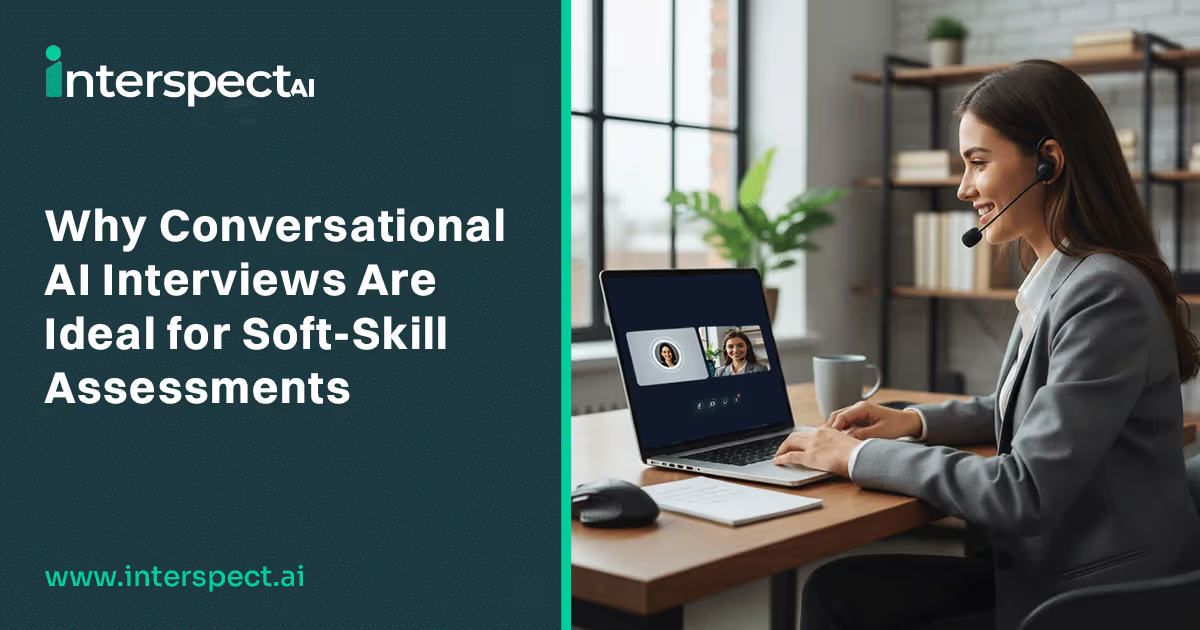
Since every recruiting team receives hundreds (sometimes thousands) of applications for a single role, sifting through them all manually is a nightmare.
Resumes blur together. First-impression bias creeps in. And subtle soft skills like empathy, communication style, and nuance often end up being relied on gut instinct. That’s why more companies are implementing conversational AI for interviews.
Conversational AI platforms can interview dozens or hundreds of candidates at the same time, ask each thoughtful, fair questions, evaluate soft skills consistently, and do all of that without human fatigue or bias. That’s not sci-fi. It’s real. And increasingly, it’s changing how companies assess talent.
If you care about hiring for soft skills - communication, adaptability, critical thinking, empathy - conversational AI interviews might just be the smartest choice you make. Here’s why.
Why you should implement conversational AI in soft-skill screening
Consistency + scalability = fairness & coverage
One of the biggest downsides of traditional human-led interviews is inconsistency. Different interviewers, moods, times of day, unconscious biases - all introduce variability.
With conversational AI for interviews, every candidate receives the same baseline evaluation framework: consistent scoring criteria, objective assessment logic, and standardized question types appropriate to their role.
What’s more? It can reduce hiring process costs and screen-time significantly, while improving recruiter efficiency. Because the AI can handle thousands of applicants around the clock, scalability becomes easy.
Data-driven soft-skill assessment
Soft skills often seem “hard to quantify,” but modern AI makes it possible. Through natural language processing (NLP), scenario-based prompts, and structured evaluation rubrics, conversational AI can evaluate communication clarity, situational reasoning, behavioral responses, and more.
One research angle suggests something interesting: chatbot-based assessment tools, when built using strong psychometric principles, can reliably capture personality or behavioral traits - and those scores can even modestly predict things like peer-rated performance or how well students adjust.
For recruiters, that means soft skills are no longer vague “gut-feel” checks but measurable qualities, allowing for objective comparison and better hiring decisions.
Speed and efficiency without sacrificing quality
Time-to-hire matters because slow hiring can mean losing great candidates. With conversational AI, companies have reported major reductions in cycle time.
It’s not just recruiters who win here. Candidates get quicker updates, making the process feel far more transparent as they'll receive the feedback quicker and know where they stand in the recruitment process.
Reduced human bias
Because every candidate is treated with the same rubric, conversational AI reduces variability caused by different interviewer styles, moods, or unconscious bias.
For companies striving for diversity and fair hiring practices, that matters - especially when hiring for roles where soft skills and attitude matter more than past pedigree or background.
Know the limitations of conversational AI in soft-skill screening
If the AI is trained on data with existing biases - certain speech patterns, communication styles, cultural norms - it may disadvantage people outside those norms. So, AI-driven evaluations can systematically score people differently depending on linguistic style or cultural background.
Many experts agree that conversational AI works best as the first filter - not the final decision. Use it to shortlist based on objective soft skills and then follow-up with human-led interviews to judge team fit, emotional resonance, potential, and cultural alignment.
For whom conversational AI interviews work best
Conversational AI for interviews brings the most value when:
- You’re hiring at scale and you’ve lots of applicants.
- Soft skills, behavioral traits, communication, and consistency matter.
- You need a fair, standardized baseline across diverse candidates.
- You want faster hiring and lower cost per screening.
- You plan to follow up with humans for final hiring decisions (hybrid model).
If you’re recruiting for roles like customer support, sales, entry-level hiring, large volume campus hiring, conversational AI shines. For senior leadership, roles requiring high cultural fit or emotional intelligence, it’s best treated as an assist.
FAQs on conversational AI interviews & soft-skill assessment
What exactly is “conversational AI for interviews”?
It refers to AI-powered systems (chatbots or video/voice-enabled agents) that conduct interviews with candidates, asking questions, recording responses (text/audio/video), and evaluating those responses using NLP, predefined scoring rubrics, sometimes psychometric models.
Can AI really assess soft skills fairly and accurately?
It can, to a degree. AI can evaluate communication clarity, coherence, reasoning, situational responses. Studies show that chatbot-based assessments produce scores with acceptable reliability and can even predict certain outcomes better than purely self-reported or unstructured methods. However, soft-skill judgment remains imperfect, especially for emotional nuance, cultural context, or interpersonal “chemistry.”
Will using conversational AI make my hiring biased?
Not necessarily, if designed and trained carefully. Standardized questions and scoring reduce subjective interviewer bias. But beware: if training data are skewed (e.g. overrepresentation of certain accents, cultural contexts), AI can inherit those biases. Experts recommend transparency, fairness auditing, regular validation of models.
Should we rely only on AI interviews for hiring?
No. The best practice today is a hybrid model. Use conversational AI for initial screening - to filter candidates efficiently and fairly. Then, use human-led interviews (or assessments) to evaluate softer, human-centric aspects: team fit, cultural alignment, emotional intelligence, potential, nuanced behavior.
What kind of jobs are best suited for AI-led soft skill assessment?
Roles with high volume and predictable soft-skill requirements or entry level hiring - e.g. customer service, call-center support, sales (entry or mid-level), campus hiring, roles that require basic communication, adaptability, clarity. For creative roles, leadership positions, or jobs demanding high emotional intelligence, human judgment remains irreplaceable.
Conversational AI for interviews won’t replace human judgment
But used smartly, it can turn the soft-skill assessment process from messy, subjective gut-checks into objective, scalable, and fair evaluations.
For companies looking to hire at scale, conversational AI offers real value. Combined with human oversight for final decisions, it paves the way for hiring that’s faster, fairer, and smarter.
Interested to see how a conversational AI screening platform would look like in your hiring process? Check out SpectraHire!
You might also like

AI video interviews are no longer a novelty. Especially in tech-forward job markets like the U.S., they’re becoming a standard part of the hiring funnel.
So, learning to navigate this format can seriously boost your chances, especially if you're a student applying for internships, a recent grad going for your first job, or a professional exploring your next move.
But far too many jobseekers trip up, not because they lack skill, but because they’re unaware of what hiring teams are really looking for in these AI-scored evaluations.
If you're already practicing on platforms like SpectraSeek, an AI-powered video interview prep tool built for students and jobseekers, you’re one step ahead.
Now, let’s make sure you're not unknowingly sabotaging your chances, and avoid these all-too-common mistakes.

1. Treating it like a Zoom call
Mistake - Showing up casually like it's a video chat with friends; rambling responses, hoodie on, and zero prep.
Why it matters - Unlike live interviews, these responses are timed, recorded, and often analyzed by algorithms first. There's no back-and-forth or second chances.
Fix - Prep like it’s a real interview. Set up your space, dress the part (at least from the waist up), and rehearse your answers ahead of time using tools like SpectraSeek to build confidence.
✅ Tip - Professional attire isn’t just for show. It improves how you feel, and how you perform on camera.
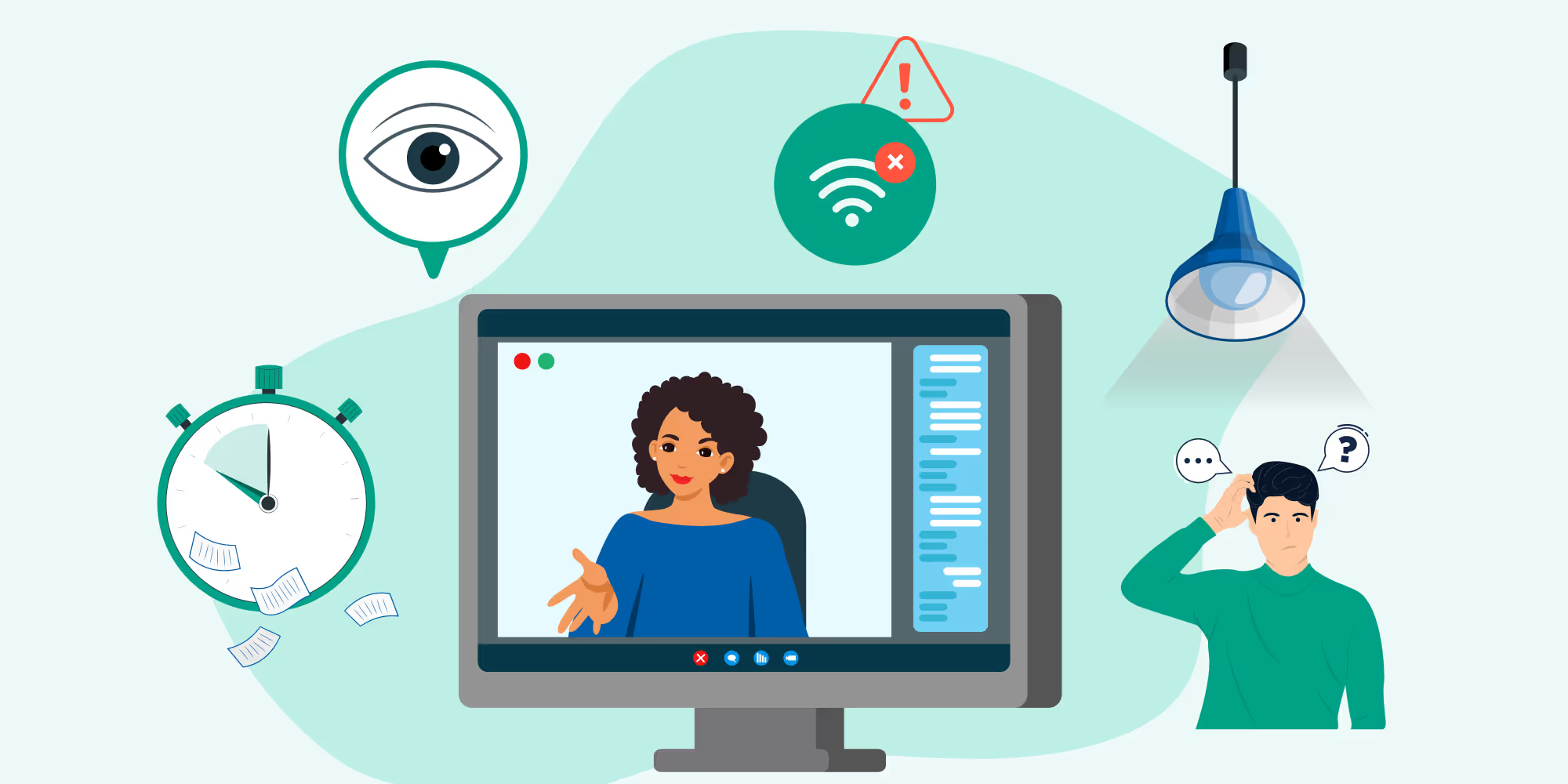
2. Ignoring the timer
Mistake - Speaking too briefly or rambling on because you didn’t keep an eye on the clock.
Why it matters - Going over time may cut off your best points. Ending too early may make you seem underprepared.
Fix - Most platforms give you 1–3 minutes per question. Use the STAR method (Situation, Task, Action, Result) to organize your answers, and rehearse them so they fit comfortably within the time limit.
3. Looking at yourself instead of the camera
Mistake - Constantly checking your own image while talking, instead of looking into the camera.
Why it matters - Eye contact matters – yes, even in a pre-recorded setting. Looking into the lens gives the feeling of connection and confidence.
Fix - Put a tiny sticker or post-it near the camera lens to remind yourself where to look. It’s a small tweak that makes a big difference.
4. Poor lighting and background setup
Mistake - Recording in a dark room, with cluttered bookshelves or laundry piles in the background.
Why it matters - Visual distractions can affect how professional, and how focused, you appear, even subconsciously.
Fix - Face a window for natural light or use a lamp with soft lighting. Keep your background simple and tidy. You don’t need a designer setup - just a clean, quiet space.
💡 According to Harvard Business Review, visual distractions can subconsciously bias how recruiters rate your professionalism.
5. Skipping practice sessions
Mistake - Thinking you'll "just wing it" when the time comes.
Why it matters - The pressure of a timed, AI video interview can catch you off guard - even if you're usually a great speaker.
Fix - Simulate the real thing. Platforms like SpectraSeek allow you to practice under realistic conditions, giving you feedback on timing, clarity, and delivery, so you’re not winging it on the big day.
6. Reading off a script
Mistake - Delivering answers like you're reading from a teleprompter - eyes shifting, voice monotone, energy flat.
Why it matters - Recruiters and AI alike can pick up on unnatural delivery. It comes off as stiff or rehearsed, not authentic.
Fix - Ditch the full script. Use bullet points or keywords to guide you instead. Speak naturally, like you’re talking to someone, and focus on clarity, not perfection.
7. Not answering the actual question
Mistake - Giving a great answer - just not to the question that was asked.
Why it matters - Though you might get away with it if you’re talking face to face with a recruiter, AI doesn’t care much for charisma. Off-topic responses signal poor listening or lack of attention to detail, which can cost you.
Fix - Read the question carefully. If it's about teamwork, don’t talk about a solo win. Use a structured approach like STAR to stay focused and relevant.
8. Skipping the tech check
Mistake - Waiting until the last minute to test your mic, camera, or browser - only to hit a glitch mid-recording.
Why it matters - Tech issues can disrupt your flow and make your answers hard to hear or see.
Fix - Run a full tech check. Use headphones, close background apps, and check your video quality. Practice using automated video interview platforms or try recording in an incognito window to test your setup.
9. Neglecting body language
Mistake - Slouching, fidgeting, or showing zero facial expression throughout the answer.
Why it matters - Nonverbal cues play a big role in how confident and engaged you appear, even in a solo video.
Fix - Sit upright, smile (naturally), and use hand gestures to emphasize key points (without overdoing it). Even AI models evaluate body language markers in their scoring systems.
10. Ending without a closing impact
Mistake - Wrapping up an answer with a shrug or a mumbled, “Yeah, that’s about it…”
Why it matters - A weak finish can dull the impact of an otherwise great answer. Ending strong leaves a lasting impression.
Fix - Sum up your answer with one strong closing sentence, then pause and smile. No need to overthink it - just make it clear and confident.
It's not just what you say, it's how you say it
AI-powered video interviews can feel weird at first. You're talking to a screen, alone, with no interviewer nodding along.
But these AI interviews are becoming a staple in hiring pipelines, because they’re efficient, consistent, and fair when done right.
The good news? With tools like SpectraSeek, you can practice in a low-pressure environment, get instant feedback, and sharpen your delivery so that when the real interview hits, you’re more than ready.

Think about all the critical interviews your company conducts in a week. Screening calls with candidates, in-depth user research sessions, customer feedback interviews, and candid exit interviews with departing employees.
Each one is a goldmine of information.
A critical insight from a frustrated user, a brilliant product idea from a new hire, or a recurring complaint that signals a market shift.
Now, where do all those insights go?
If you’re like most companies, they disappear. They’re trapped in scattered notes, siloed in department-specific software, or lost entirely the moment the interview ends.
Your company's collective intelligence is unstructured, unsearchable, and untapped. It's dark data.
It’s time to stop treating interviews as fleeting moments and start treating them as your most valuable data asset with Spectra.
From Unstructured Voice to Searchable Data
For years, the first step in conversational intelligence was transcription. Turning voice into text was a giant leap forward, but it's no longer enough.
A folder full of transcripts is a slightly more organized version of the original problem. You still can't query it at scale.
You can't ask: "Show me every time a user mentioned a competitor in an interview this quarter."
The real breakthrough comes when you structure the context within the interview. This is where Spectra's AI agents come in.
AI agents don't just hear words; they understand the meaning behind them. They perform advanced voice data structuring during every interview, automatically tagging conversations with rich metadata:
- Entities: People, products, companies, and locations mentioned.
- Topics: Key themes discussed, like "pricing," "onboarding," or "customer support."
- Sentiment & Tone: The emotional undertone of the conversation—is the customer happy, frustrated, hesitant?
- Events: Key moments, like action items, decisions, or follow-ups.
With structured data like this, a 30-minute interview becomes a structured, queryable data object. In addition to being used by the business teams, the data can also be used to train the model and agents further, improving their capabilities and leading to a continuously improving experience.
Building Your Single Source of Truth: The Spectra Knowledge Graph
When you consistently capture and review conversations using Spectra, you're not just documenting interviews—you’re creating a rich repository of insights that can power smarter decisions across your organization.
Think of it as the first step toward building your own Interview Knowledge Graph: a connected, searchable ecosystem of qualitative data.
Each conversation recorded through Spectra becomes a data point, tied to topics, people, and sentiment. Once exported, this structured data can be fed into your existing BI tools, data warehouses, or CRM systems to create a dynamic knowledge base.
How Businesses Use Their Knowledge Graph with Spectra
By integrating Spectra’s outputs into their analytics workflows, organizations can surface cross-functional insights that were previously buried in transcripts.
- For Product Teams: Analyze user feedback to track feature mentions and sentiment trends across time.
- For HR & Talent: Investigate patterns in exit interviews or performance conversations by asking, “What themes are common among top-performing employees who left voluntarily?”
- For Market Researchers: Run large-scale customer interviews with Spectra, then use your tools to group insights and identify emerging themes—faster and at scale.
- For Sales Teams: Identify sales enablement opportunities by reviewing instances where key objections came up and tracking changes in rep confidence.
Best of all, this structured data isn't locked away. With Spectra's data extraction capabilities, it can be easily exported as a configurable JSON file and piped directly into your BI tools, data warehouses, or CRM, integrating the qualitative "why" with your quantitative "what."
Your First Steps to Building an Interview Hub
The idea of building a comprehensive knowledge graph can feel daunting, but it doesn’t have to be.
Here’s a practical way to begin.
- Start with One High-Value Interview Type: Select one area where insights are consistently lost. Is it user research interviews? Candidate screening calls? Start there. This focus enables you to demonstrate value quickly in a controlled environment.
- Define Your Key Questions: Before conducting the first interview with Spectra, ask your team: "What are the 3-5 critical insights we need to track?" These could be competitor mentions for a product team or reasons for leaving for an HR team. This defines the initial structure of your data.
- Pilot with a Single Team: Empower one team to be your champion. Let them use Spectra to build their mini-knowledge hub. As they start sharing powerful, data-backed insights they couldn't access before, other departments will naturally want to follow suit.
Building an interview hub is an iterative process. Start small, show value, and scale from there.
From Interviews to Intelligence
Building an interview hub transforms isolated conversations into your company's most valuable, searchable asset.
By structuring interview data with AI agents, you move from simply listening to actively learning. Every conversation makes your organization smarter, shaping product roadmaps with direct user feedback and informing talent strategies with real-time sentiment.
The most innovative companies don't just listen—they learn. Are you ready to unlock the data hidden in your conversations?
AI interview software has exploded in adoption. Everyone claims to automate hiring, reduce bias, improve candidate experience, and “revolutionize recruitment.”
But if you’ve evaluated even three tools, you already know the truth that most AI interview platforms look identical on the surface.
Same features. Same dashboards. Same promises.
So how do you actually compare them beyond the glossy feature lists?
And more importantly, how do you choose a platform that measurably improves hiring operations rather than becoming another unused subscription?
What Does an AI Interview Software Actually Do?
AI interview software isn’t confined to chatbots asking questions. At its core, it applies artificial intelligence to multiple talent-acquisition steps, including:
- Resume screening and candidate matching
- Automated interview scheduling
- Structured AI-driven interviews
- Confidence and skills assessments
- Predictive analytics to forecast candidate success
According to market data, the interview software market was valued around USD 1.158 billion in 2024 and is expected to grow at a Compound Annual Growth Rate (CAGR) of around 10.6% from 2025 to 2035 signalling strong adoption across industries.
In practice, tools like HireVue, Paradox (Olivia), SpectraHire and Pymetrics are already used by brands to sift, screen, and even interview at scale.
The Market Growth Explains Why Most Vendors Look the Same
AI-based hiring systems are exploding in demand, as academic implementation shows how AI-based interviews can drastically reduce manual workload and processing time by automating question delivery and answer evaluation.
But because recruitment AI is booming, vendors are racing to release the same features just to remain competitive.
Which means your job isn’t to compare features. It’s to compare outcomes.
To do that, you need a deeper framework.
Why “Features” Aren’t Enough
Many vendors list features like “AI scoring,” “video interviews,” and “dashboard analytics.”
But that’s just the surface. Here’s how to compare meaningfully:
A. Accuracy & Analytics
Ask:
- How reliable are predictive insights?
- What metrics power candidate evaluations?
- Can you audit model decisions for fairness?
Because while systems can boast accuracy, only detailed analytics show why candidates were ranked a certain way.
B. Bias Mitigation
AI can reduce human bias, yet research shows AI models can also inadvertently encode bias if left unchecked. So the real question isn’t whether bias exists - it’s how the system identifies, measures, and actively reduces it.
C. Human + AI Collaboration
AI should augment, not replace, human judgment. Tools that allow recruiters to steer outcomes, not just follow them, win in real-world hiring.
D. Candidate Experience
Most teams underestimate this. Candidate satisfaction ties directly to employer brand - and bad AI experiences can hurt both. Tools with transparent AI involvement and clear candidate feedback mechanisms stand out.
E. Integration With Hiring Workflows
Many academic models highlight the importance of smooth data flow:
- Interview results must automatically become structured datasets for HR systems
- Recruiters should not manually transfer scoring data
If a tool forces your team to do manual exports, CSV juggling, or duplicate entries, the “automation” is pointless.
Better tools feel like they were built for recruiters and not for engineers.
Where SpectraHire Stands Out
Now let’s connect the research to the real world. Most AI interview tools fail because they,
- Use static question banks
- Cannot scale reliably
- Don’t provide transparent scoring
- Do not reduce recruiter workload meaningfully
- Are built as “AI demos” rather than hiring systems
SpectraHire, on the other hand, is built the way the research recommends.
SpectraHire vs. Traditional Hiring
The Comparison Checklist (Use This Before Choosing Any Tool)
Here is your definitive, practical checklist.
Accuracy & Data Quality
- Is the model trained on diverse datasets?
- Is the accuracy benchmark publicly documented?
Bias Mitigation
- Are there fairness tests?
- Does the vendor disclose model reasoning?
Scalability
- Can it handle your volume?
- Is the architecture cloud-native?
Candidate Experience
- Are interviews adaptive or scripted?
- Is feedback generated automatically?
Workflow Integration
- Do results flow directly into your ATS?
- Is the system modular?
Vendor Transparency
- Do they share how scoring works?
- Are audit logs available?
If a platform checks all these boxes, it’s worth your time.
Frequently Asked Questions (FAQ)
Q1: What is AI interview software?
AI interview software uses artificial intelligence to automate and enhance stages of hiring - from resume screening to interview execution - by analyzing candidate data, structuring assessments, and generating actionable insights.
Q2: How does AI improve hiring efficiency?
AI automates repetitive tasks, accelerates candidate screening, shortens time-to-hire, and provides analytics that help teams decide faster and with more insight.
Q3: Are AI interviews fairer than traditional ones?
They can be fairer by standardizing questions and scoring, but fairness depends on model design and ongoing bias mitigation.
Q4: Can candidates trust AI hiring tools?
Trust varies. Some job-seekers remain skeptical about AI fairness. Thoughtful implementation with transparency improves candidate comfort.
Q5: Why not just build my own?
AI hiring systems require significant model training, data privacy safeguards, bias audits, and workflow automation; so, building from scratch is expensive and time-consuming.
Q6: Why choose SpectraHire?
SpectraHire is built end-to-end for modern teams, combining fast, data-backed screening with structured interviews and analytics, helping you hire better and faster.
Q7: Does AI interview software really improve hiring efficiency?
Yes. Traditional interviews don’t scale well as each candidate requires live time, coordination, and manual review. AI interview software improves hiring efficiency because it automates the most time-consuming parts of the process. Instead of recruiters manually scheduling, conducting, and reviewing early-stage interviews, candidates can be assessed simultaneously, at scale. Interviews are structured, responses are automatically organized, and evaluations are consistent, cutting down back-and-forth, rework, and subjective guesswork.
Subscribe to The InterspectAI Blog