%201.svg)

Why the Best Candidates Fail AI Interviews—and What Career Services Can Do About It


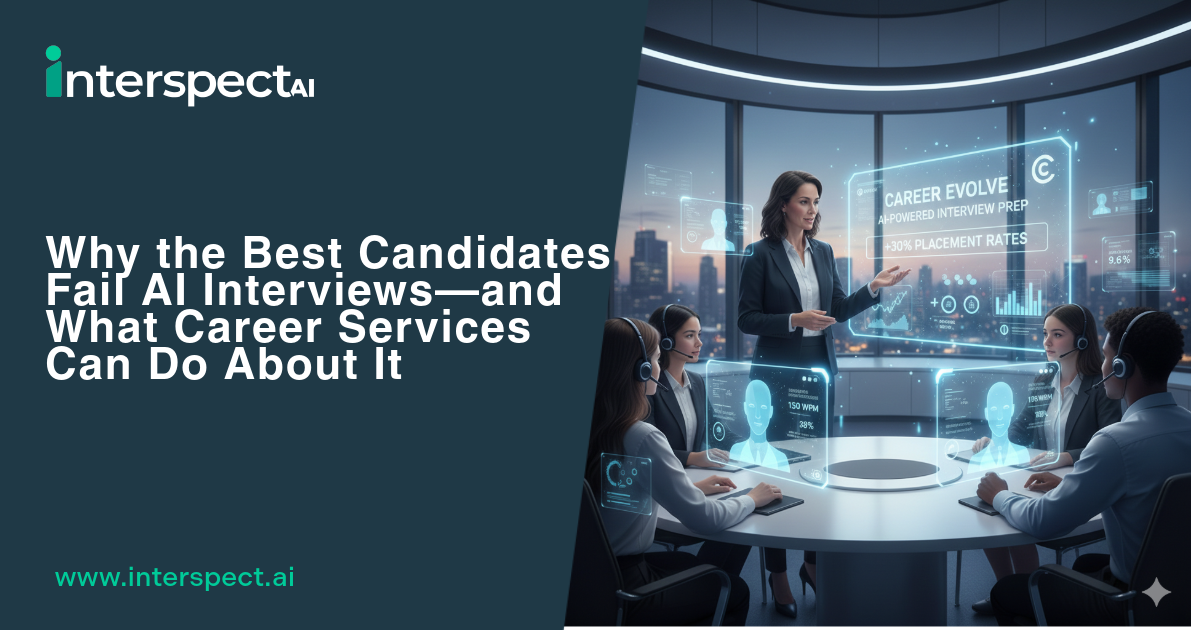
Every spring, career services offices celebrate their strongest cohorts. Students with stellar GPAs, polished resumes, and impressive internships head into recruiting season with confidence. And every spring, a troubling pattern repeats: some of the most talented graduates stumble at the interview stage, not because they lack knowledge, but because they never learned to perform under the conditions modern employers now use.
The problem is not aptitude. It is preparation misalignment.
In recent years, hiring processes at mid- to large employers have shifted dramatically. According to surveys conducted in 2025, more than 60 percent of companies with more than 500 employees now use some form of AI-assisted interviewing in their first-round screening. These systems evaluate candidates on dimensions that traditional mock interviews rarely address: speech pacing, response structure, filler word frequency, facial engagement, and the coherence of answers under adaptive follow-up questioning.
Students trained through conventional career center workshops—where a counselor conducts a 20-minute behavioral interview once or twice a semester—are practicing for a format that increasingly does not exist. The gap is not one of intelligence. It is one of exposure.
Consider what a typical AI video interview measures. The candidate sits in front of a camera and responds to questions delivered by an automated system. There is no conversational warmth, no encouraging nod from a human interviewer. The system logs speaking pace in words per minute, counts filler words, tracks eye contact as a percentage of total response time, and evaluates answer relevance against a rubric. Students who have never encountered this format often underperform, not because their answers are weak, but because their delivery patterns trigger low scores on metrics they did not know existed.
This creates a paradox for universities. Their strongest students may be the ones most affected, because high-achievers often rely on interpersonal rapport to shine in interviews. When that rapport is removed—replaced by an algorithm—their advantage disappears.
The solution is not to abandon human career advising. It is to augment it.
Universities that have introduced AI-powered interview practice platforms report significant improvements. When students can rehearse against an adaptive AI interviewer that mirrors the systems employers actually use, they learn to calibrate their delivery to algorithmic evaluation. They discover their unconscious habits—the verbal tics, the tendency to ramble, the nervous glance away from the camera—and they correct them before those habits cost them an offer.
The data supports this approach. Institutions that integrated AI practice tools into their career readiness programs in 2024 and 2025 saw measurable gains. Placement rates at pilot universities rose between 20 and 35 percent within a single academic year. Student satisfaction with career services increased because counselors, freed from repetitive mock-interview sessions, could devote more time to high-value activities such as salary negotiation coaching, industry-specific strategy, and networking guidance.
For career services directors weighing this shift, the calculus is straightforward. The cost of an AI interview platform is a fraction of a single counselor’s salary. The return—measured in placement outcomes, student satisfaction, alumni engagement, and institutional reputation—compounds over time.
The question is no longer whether AI interview preparation belongs in higher education. It is whether your institution will adopt it proactively or reactively—and how many graduating classes will pass through underprepared before the change is made.
Career services teams that act now position their universities as leaders in student outcomes. Those that wait will find themselves explaining why their placement rates lag behind peer institutions that moved faster.
The best candidates deserve preparation that matches the reality they face. AI-driven hiring is that reality. It is time career services caught up.
You might also like


Gut instinct, paper resumes, and back-to-back interviews... that's what hiring used to be all about.
Today? It’s increasingly about conversations; that too smart, data-rich, and AI-powered ones.
AI agents powered by conversational AI are changing how we screen, engage, and assess talent at scale, and with surprising empathy.
What is conversational AI in hiring?
Conversational AI refers to intelligent systems that can hold two-way conversations with humans - through text, voice, or video. In hiring, these systems aren’t just answering FAQs or scheduling interviews. They’re conducting interviews, screening candidates, and collecting insights in real time.
They are intelligent recruiting agents.
But instead of replacing human recruiters, they free them up to build relationships with the most promising candidates before competitors do, and make informed hiring decisions.
Why it’s gaining serious ground
The hiring process is more complex than ever. Here’s why conversational AI is stepping in.
1. It scales what humans can’t
Recruiters spend an average of 7 seconds scanning each resume.
That’s not a process - it’s a scramble.
Conversational AI can instantly engage 100s of applicants in parallel, screen for role-specific criteria, and score candidates fairly; no bias, no burnout.
2. It saves time (a lot of it)
Pre-screening calls, email coordination, no-shows—it all adds up.
One study found that companies using conversational AI in the early stages of hiring reduced time-to-hire by up to 30%.
That’s not just faster - it’s better candidate experience too.
3. It improves candidate engagement
Old hiring funnels are passive. Apply, wait, hope.
With conversational AI candidates get instant responses, can ask questions, and feel seen early in the process - without waiting on a recruiter’s calendar.
And more engagement = higher quality hires.
What conversational AI is not
Let’s clear up a misconception - It’s not a robot replacing your team.
Conversational AI doesn’t make final decisions. It doesn’t judge nuance like a seasoned recruiter can. And it definitely doesn’t eliminate the human touch.
What it does do is tee up the right conversations by giving hiring teams better signals, faster.
Real-world use cases in hiring
Conversational AI isn't just a concept anymore as it's already powering smarter hiring workflows across industries. Here's how.
AI-driven interviews
Instead of endless phone screens, AI interview agents now conduct structured, role-specific interviews at scale. Intelligent agents adapt their tone and questions, creating a more natural and insightful experience for candidates without needing a human on the other end.
Resume screening + scoring
AI doesn’t just filter resumes based on keywords, it screens applicants through conversation, then scores them based on relevant competencies. This ensures alignment with the role beyond just what’s on paper.
Interview insights + analytics
Beyond recording responses, AI interview agents generate actionable analytics: how clearly a candidate communicates, how confidently they speak, and how relevant their examples are.
AI-powered feedback
Candidates receive automated, structured feedback post-interview. It's clear, constructive, and rooted in actual performance, not vague impressions. This not only boosts candidate experience but encourages future applications.
ATS integration
Conversational AI isn’t another disconnected tool. AI interview agents like SpectraHire integrate smoothly with your ATS, ensuring candidate data, transcripts, and scores flow into your system of record, with zero manual effort.
Interview transcripts + recordings
Every conversation is transcribed and stored with a video recording, giving hiring teams a chance to review responses together, evaluate soft skills, and reduce bias in decision-making.
Customizable interview templates
Whether you're hiring for a developer, a designer, or a customer support role, AI interview agents let teams build templates tailored to competencies that matter. No starting from scratch every time.
One platform doing all of the listed use cases well is SpectraHire, which allows companies to deploy smart AI interview agents that feel surprisingly human.
These agents conduct structured conversations that assess skills, extract insights, and keep the hiring funnel moving without overwhelming recruiters.
Interested in adding conversational AI to your hiring workflow?
SpectraHire makes it easy to scale interviews, reduce time-to-hire, and gain insight without losing the human touch.
It’s not automation for automation’s sake.
It’s better hiring, powered by better conversations.
Predicting customer needs is no longer just a nice-to-have capability—it’s becoming essential for businesses to stay competitive. AI agents are now capable of analyzing vast amounts of data, learning from customer behaviors, and forecasting future needs with remarkable accuracy. By anticipating what customers want before they express it, companies gain a critical edge in delivering timely, personalized experiences.
Understanding the Predictive Power of AI Agents
AI agents draw on a variety of data sources like transaction histories, web browsing activity, customer support interactions, and even social media chatter to establish detailed behavioral profiles. Unlike static analysis, these agents learn continuously, adapting to new patterns and context changes. For instance, a sudden drop in engagement or a negative sentiment in customer messages can serve as early warning signs that something needs attention.
Natural language processing (NLP) enables AI agents to interpret the tone and sentiment of conversations, discerning frustration, excitement, or willingness to buy. When combined with predictive analytics, this allows businesses to tailor offerings that not only meet current needs but anticipate future desires.
Practical Applications Driving Business Value
In retail, AI agents forecast demand shifts and optimize inventory, preventing stockouts and overstock while tailoring promotions to individual preferences. Telecommunications companies use predictive AI to identify customers likely to churn and engage them preemptively with personalized retention offers. Financial institutions leverage AI-driven behavior analysis to recommend relevant products or detect fraud early. Even healthcare providers predict patient requirements to schedule timely care and reduce complications.
These real-world applications demonstrate how prediction enhances operational efficiency, drives revenue growth, and strengthens customer satisfaction.
The Role of Spectra in Predictive Customer Needs
InterspectAI’s Spectra platform exemplifies how sophisticated AI agents deliver predictive insights from conversational data. Designed to listen, understand, and reason like humans, Spectra captures rich nuances from customer interactions through natural conversations. It converts this complex data into instant, structured insights that inform predictive models and actionable strategies.
What sets Spectra apart is its commitment to unbiased, secure, and scalable intelligence. Through non-profiling algorithms, it reduces bias, ensuring fair evaluations, while adhering to strict compliance standards such as GDPR and HIPAA. Its plug-and-play architecture allows seamless integration with existing systems, enabling businesses across sectors to harness predictive AI quickly and effectively.
Key Benefits of Predictive AI Agents Using Spectra
- Conversational experience with human-like, personalized interactions during automated video interviews.
- Instant insights with automated interview scores and actionable analytics.
- Bias-mitigated predictions that promote fairness and compliance.
- Seamless integration into existing workflows allowing fast deployment and scaling.
Balancing Automation and Human Expertise
While AI agents handle massive data analysis and early-stage prediction, human judgment remains crucial. The best outcomes occur when AI predictions guide human decisions rather than replace them. Empathy, ethical considerations, and strategic thinking ensure that predicted insights lead to positive experiences rather than automated mistakes.
Looking Ahead: The Future of AI in Customer Prediction
Predictive AI agents are evolving toward greater emotional intelligence and integration with multimodal data—including voice, text, and video. This fusion will enable even more contextual and timely predictions, empowering businesses to anticipate and exceed customer expectations more effectively than ever before.
Take the Next Step with Spectra
Unlock the full potential of your interview data and anticipate needs before they arise with InterspectAI’s Spectra platform. Experience how advanced conversational AI agents, capable of data extraction and instant insights, can transform interview workflows into predictive insights that drive smarter hiring decisions, reduce bias, and enhance overall efficiency.
Request a demo today and discover how Spectra can empower your business to deliver truly proactive, personalized customer experiences that set you apart.
FAQs
1. How do AI agents predict what customers need?
By continuously analyzing diverse data sources and identifying behavioral and emotional patterns that indicate intent or dissatisfaction.
2. How does prediction improve customer relationships?
Proactive, personalized outreach based on AI insights fosters trust, satisfaction, and loyalty.
3. What challenges come with predictive AI agents?
Maintaining data privacy, mitigating algorithmic bias, ensuring data quality, and integrating human oversight are vital.

Conversational intelligence (CI) is slowly, but surely, changing how businesses communicate, and its influence will only grow in the coming years.
Let’s explore some use cases and future trends for conversational intelligence in business.
If you want an introduction to conversational intelligence, read our blog post here.
Customer support and experience automation
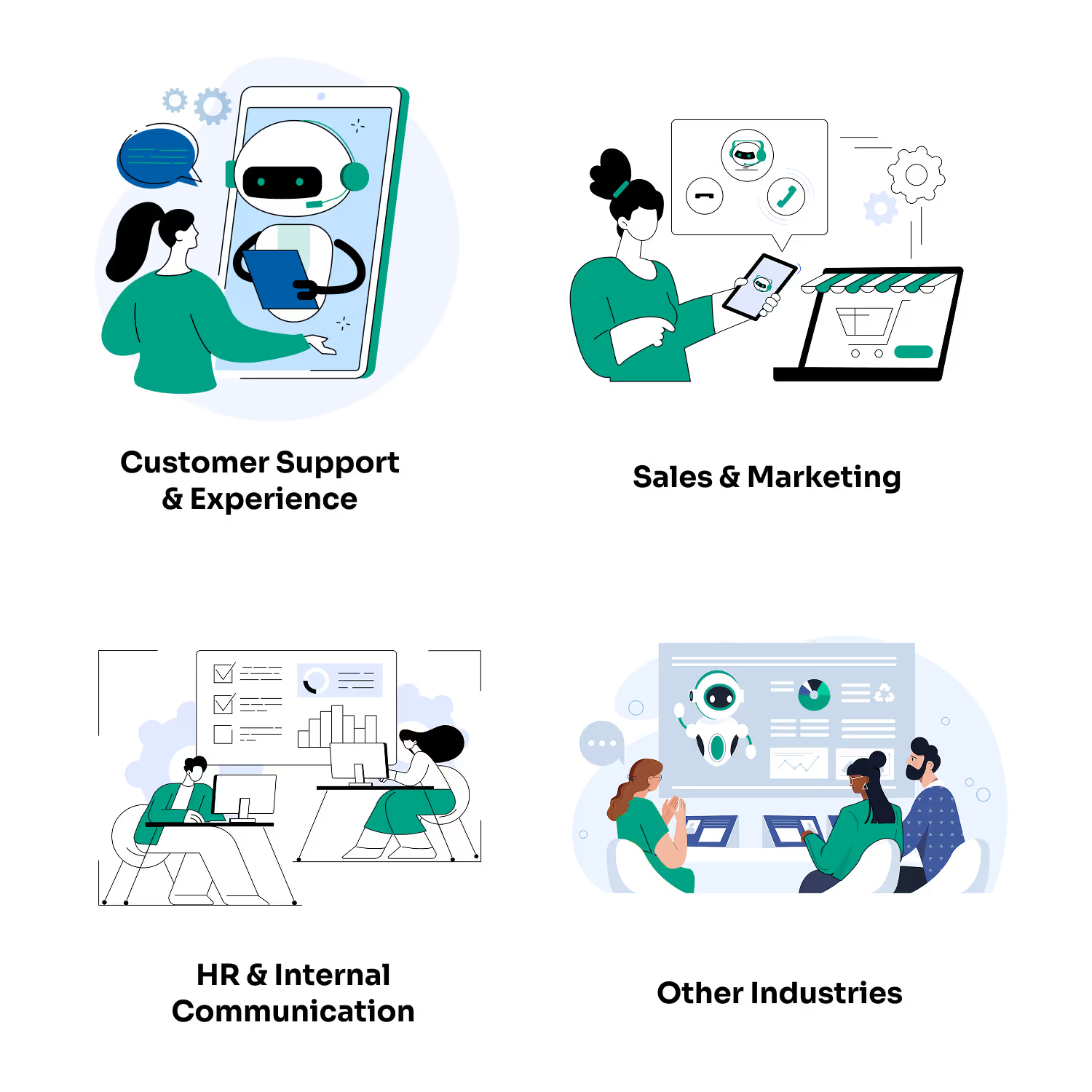
The most common use case for CI is customer service chats (on websites, apps, and messaging platforms). Here, conversational intelligence acts as a virtual customer assistant, resolving issues or answering questions. The future of business communication in this arena is leaning toward omnichannel, AI-assisted support. Already, 51% of consumers say they prefer interacting with bots for immediate service needs, which indicates a growing comfort with AI-driven help as long as it’s effective.
We also see AI digital agents bridging channels. For instance, a customer might start with a chatbot on a website and later get a follow-up from the same AI via WhatsApp or voice call, creating a seamless support journey.
Customer experience automation through conversational intelligence can cut costs and boost customer happiness by providing instant, accurate responses anytime, anywhere.
Sales and revenue generation
Sales teams are leveraging conversational intelligence in multiple ways. First, AI chatbots can engage website visitors in real time, qualifying leads, answering product questions, and even demoing products conversationally. This can improve lead capture and conversion rates by engaging prospects instantly rather than waiting for a sales rep’s availability.
Second, and perhaps more game-changing, is the use of conversation intelligence platforms to analyze sales calls and meetings. Imagine a meeting assistant with conversational intelligence that joins your Zoom sales call: It transcribes the meeting, analyzes the dialogue, and later provides you with a summary along with insights like “Customer reacted positively when pricing was discussed” or “Competitor X was mentioned twice.”
These insights help sales managers coach their teams and refine strategy. They also help reps themselves – some advanced systems can even coach in real time, nudging a rep if they’re doing too much talking or if they haven’t mentioned a key product feature yet.
According to industry trends, sales AI enablement tools like these are becoming standard; a recent report noted that 80% of sales reps say AI makes it easier to get the insights needed to close deals.
Marketing and personalization
Conversational intelligence is also making waves in marketing. AI chat agents on websites or social media can personalize product recommendations by analyzing what customers have browsed or purchased in previous sessions or visits. They can upsell or cross-sell with a conversational touch (“I see you bought a laptop - do you need a case for it?”).
Furthermore, conversational intelligence can be used for interactive marketing campaigns. For example, a beauty brand might have an AI chatbot that quizzes users and gives personalized skincare advice, creating an engaging experience that also drives product discovery.
These intelligent conversation software solutions blur the line between service and marketing, providing value to the customer while steering them through the marketing funnel.
Beyond marketing, AI-powered agents built on conversational intelligence are also transforming how enterprises approach market research and insights - especially in market research.
We expect to see more and more companies adopting this tech and conversational intelligence becoming a staple in the business communication trends of 2025 and beyond.
Internal communications and HR
Aside from using AI agents for hiring, enterprises are also applying conversational intelligence internally. HR chatbots (a type of conversational AI agent) can answer employees’ questions about benefits, company policy, or IT issues on Slack or other internal channels.
This improves employee experience by giving instant answers and freeing HR staff from repetitive queries. Meeting assistants (like Zoom’s AI assistant or Microsoft Teams’ Copilot) can live-transcribe meetings, highlight action items, and draft follow-up emails.
These AI meeting notes and insights mean employees don’t have to worry about scribbling notes and can focus on the discussion. The AI ensures nothing is lost, and everyone gets a summary after the meeting.
Different industries are customizing conversational intelligence to their needs.
There are countless benefits in adopting this tech, especially for enterprises. In healthcare, AI chatbots handle patient triage (“symptom checkers”) or help schedule appointments, improving accessibility.
Reports show that 58% of telemedicine platforms now use conversational interfaces to facilitate doctor-patient interactions. In finance, AI assistants help with account information and advise on basic financial questions.
In education, AI tutors or campus chatbots guide students. These specialized agents show that conversational intelligence isn’t one-size-fits-all – it can be trained on domain-specific knowledge (medical terms, financial regulations, etc.) to become an expert virtual assistant.
The trend points to more conversational intelligence platforms tailored for specific sectors (e.g., legal AI assistants, real-estate AI chatbots, etc.), which will further drive adoption because they can be deployed faster with industry context built in.
Can you think of a department in your company that could benefit from adopting conversational intelligence? If so, contact us!
Subscribe to The InterspectAI Blog