%201.svg)

How to Compare AI Interview Software Beyond Features (2026)


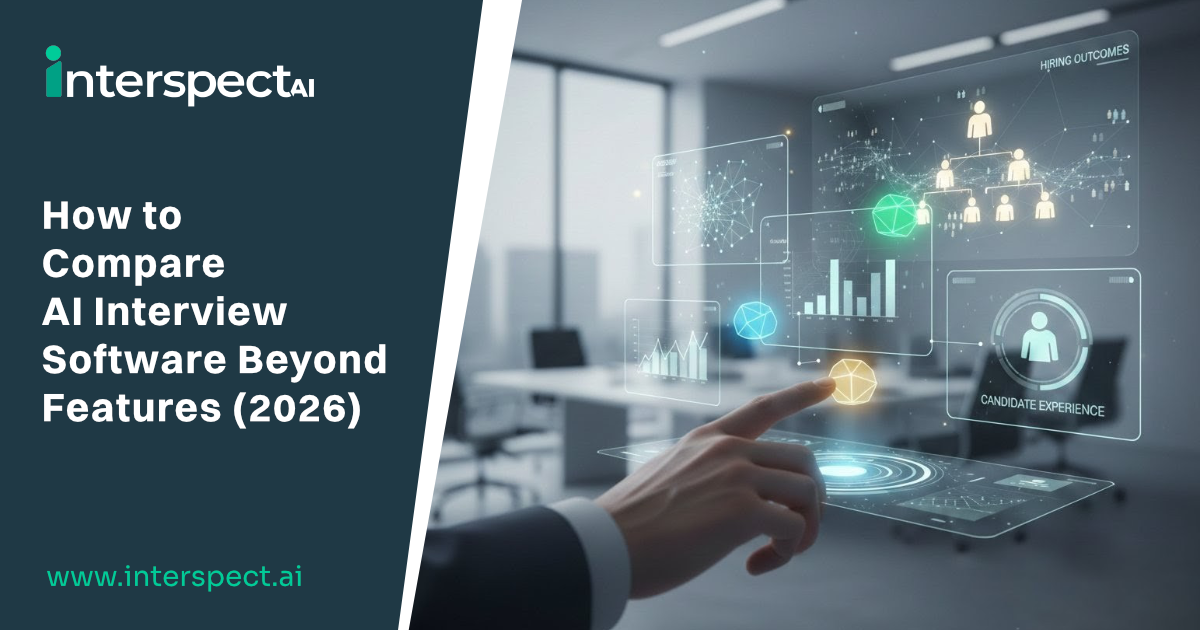
AI interview software has exploded in adoption. Everyone claims to automate hiring, reduce bias, improve candidate experience, and “revolutionize recruitment.”
But if you’ve evaluated even three tools, you already know the truth that most AI interview platforms look identical on the surface.
Same features. Same dashboards. Same promises.
So how do you actually compare them beyond the glossy feature lists?
And more importantly, how do you choose a platform that measurably improves hiring operations rather than becoming another unused subscription?
What Does an AI Interview Software Actually Do?
AI interview software isn’t confined to chatbots asking questions. At its core, it applies artificial intelligence to multiple talent-acquisition steps, including:
- Resume screening and candidate matching
- Automated interview scheduling
- Structured AI-driven interviews
- Confidence and skills assessments
- Predictive analytics to forecast candidate success
According to market data, the interview software market was valued around USD 1.158 billion in 2024 and is expected to grow at a Compound Annual Growth Rate (CAGR) of around 10.6% from 2025 to 2035 signalling strong adoption across industries.
In practice, tools like HireVue, Paradox (Olivia), SpectraHire and Pymetrics are already used by brands to sift, screen, and even interview at scale.
The Market Growth Explains Why Most Vendors Look the Same
AI-based hiring systems are exploding in demand, as academic implementation shows how AI-based interviews can drastically reduce manual workload and processing time by automating question delivery and answer evaluation.
But because recruitment AI is booming, vendors are racing to release the same features just to remain competitive.
Which means your job isn’t to compare features. It’s to compare outcomes.
To do that, you need a deeper framework.
Why “Features” Aren’t Enough
Many vendors list features like “AI scoring,” “video interviews,” and “dashboard analytics.”
But that’s just the surface. Here’s how to compare meaningfully:
A. Accuracy & Analytics
Ask:
- How reliable are predictive insights?
- What metrics power candidate evaluations?
- Can you audit model decisions for fairness?
Because while systems can boast accuracy, only detailed analytics show why candidates were ranked a certain way.
B. Bias Mitigation
AI can reduce human bias, yet research shows AI models can also inadvertently encode bias if left unchecked. So the real question isn’t whether bias exists - it’s how the system identifies, measures, and actively reduces it.
C. Human + AI Collaboration
AI should augment, not replace, human judgment. Tools that allow recruiters to steer outcomes, not just follow them, win in real-world hiring.
D. Candidate Experience
Most teams underestimate this. Candidate satisfaction ties directly to employer brand - and bad AI experiences can hurt both. Tools with transparent AI involvement and clear candidate feedback mechanisms stand out.
E. Integration With Hiring Workflows
Many academic models highlight the importance of smooth data flow:
- Interview results must automatically become structured datasets for HR systems
- Recruiters should not manually transfer scoring data
If a tool forces your team to do manual exports, CSV juggling, or duplicate entries, the “automation” is pointless.
Better tools feel like they were built for recruiters and not for engineers.
Where SpectraHire Stands Out
Now let’s connect the research to the real world. Most AI interview tools fail because they,
- Use static question banks
- Cannot scale reliably
- Don’t provide transparent scoring
- Do not reduce recruiter workload meaningfully
- Are built as “AI demos” rather than hiring systems
SpectraHire, on the other hand, is built the way the research recommends.
SpectraHire vs. Traditional Hiring
The Comparison Checklist (Use This Before Choosing Any Tool)
Here is your definitive, practical checklist.
Accuracy & Data Quality
- Is the model trained on diverse datasets?
- Is the accuracy benchmark publicly documented?
Bias Mitigation
- Are there fairness tests?
- Does the vendor disclose model reasoning?
Scalability
- Can it handle your volume?
- Is the architecture cloud-native?
Candidate Experience
- Are interviews adaptive or scripted?
- Is feedback generated automatically?
Workflow Integration
- Do results flow directly into your ATS?
- Is the system modular?
Vendor Transparency
- Do they share how scoring works?
- Are audit logs available?
If a platform checks all these boxes, it’s worth your time.
Frequently Asked Questions (FAQ)
Q1: What is AI interview software?
AI interview software uses artificial intelligence to automate and enhance stages of hiring - from resume screening to interview execution - by analyzing candidate data, structuring assessments, and generating actionable insights.
Q2: How does AI improve hiring efficiency?
AI automates repetitive tasks, accelerates candidate screening, shortens time-to-hire, and provides analytics that help teams decide faster and with more insight.
Q3: Are AI interviews fairer than traditional ones?
They can be fairer by standardizing questions and scoring, but fairness depends on model design and ongoing bias mitigation.
Q4: Can candidates trust AI hiring tools?
Trust varies. Some job-seekers remain skeptical about AI fairness. Thoughtful implementation with transparency improves candidate comfort.
Q5: Why not just build my own?
AI hiring systems require significant model training, data privacy safeguards, bias audits, and workflow automation; so, building from scratch is expensive and time-consuming.
Q6: Why choose SpectraHire?
SpectraHire is built end-to-end for modern teams, combining fast, data-backed screening with structured interviews and analytics, helping you hire better and faster.
Q7: Does AI interview software really improve hiring efficiency?
Yes. Traditional interviews don’t scale well as each candidate requires live time, coordination, and manual review. AI interview software improves hiring efficiency because it automates the most time-consuming parts of the process. Instead of recruiters manually scheduling, conducting, and reviewing early-stage interviews, candidates can be assessed simultaneously, at scale. Interviews are structured, responses are automatically organized, and evaluations are consistent, cutting down back-and-forth, rework, and subjective guesswork.
You might also like

Why are more and more companies investing in conversational intelligence? The benefits extend beyond having nicer conversations – they directly impact business performance and the bottom line.
🔖 What is Conversational Intelligence (CI)? Everything You Need to Know
Here are some key benefits enterprises see when implementing conversational intelligence effectively.
Deeper customer understanding and engagement
Conversational intelligence lets you truly understand your customers' needs, feelings, and motivations in a way traditional analytics can't. By analyzing actual customer interactions, businesses gain rich insights into customer sentiment and intent – a window into what customers truly care about.
This leads to more meaningful, personalized interactions. When customers feel heard and understood, they naturally become more loyal. Using conversational intelligence to tailor your responses and offerings to what customers reveal in conversation will result in stronger relationships and customer loyalty.
In short, conversational intelligence helps companies speak with customers rather than just to them, resulting in higher satisfaction and engagement.
Improved team collaboration and communication
Conversational intelligence isn't just about customers – it also improves how employees communicate with each other. When an organization emphasizes conversational intelligence, it trains teams to listen better and share knowledge openly. Misunderstandings decrease, and productivity increases.
For example, sales and support teams might start sharing call insights with each other, creating a feedback loop that benefits everyone. Leaders who practice conversational intelligence foster a culture where ideas and concerns can be voiced constructively. The benefit is a more cohesive, collaborative workforce. Everyone "gets on the same page" faster because key learnings from conversations (with customers or internally) are surfaced and distributed, not locked in individual heads.
Data-driven decision making
In the era of big data, conversations are a rich data source many companies have previously overlooked. Conversational intelligence tools uncover hidden themes and sentiments within thousands of conversations, enabling smarter, evidence-based decisions across the business.
Leaders can rely on trends and insights from real dialogues instead of guessing what features to build next or which marketing message will resonate. For instance, if conversational analysis shows customers consistently expressing a need for faster delivery, a retailer's management can decide to invest in logistics improvements. If employees repeatedly voice a specific concern in town halls, HR can address it before it becomes a bigger issue.
So, by tapping into conversation data, companies reduce the guesswork in strategic planning – they base choices on what people are saying. Conversational intelligence turns the art of decision-making into more of a science.
Higher sales conversion and marketing effectiveness
When sales and marketing teams leverage conversational intelligence, they can significantly boost their effectiveness. As noted earlier, salespeople with conversation insights can tailor their pitches to each prospect's real interests or objections, leading to more closed deals.
It's like having a cheat sheet on what the customer needs to hear. Marketing teams, on the other hand, use conversational intelligence to refine their targeting and messaging – they learn which product benefits customers spontaneously talk about most, or what language customers use, and then mirror that in campaigns.
The benefit is better conversion rates and ROI on campaigns, because messaging hits closer to the mark. Companies have found that by addressing the pain points surfaced through conversational intelligence, they can craft offers and content that resonate more deeply, driving engagement and sales.
Enhanced customer service & loyalty
Companies often see faster resolution times and improved service quality by implementing conversational intelligence in customer support. Agents equipped with real-time insights can resolve issues faster, personalize interactions, and make customers feel truly heard.
This level of attentiveness breeds loyalty.
Conversational intelligence can also proactively alert a business to brewing customer issues (for example, detecting a spike in negative sentiment around a product glitch), allowing them to fix problems before more customers are affected. This proactive approach prevents churn. Essentially, CI helps convert customer feedback (which used to be hidden in call logs or chat transcripts) into immediate action to improve service.
Over time, consistent improvement in service experience becomes a competitive differentiator. Customers stick with companies that understand them and respond quickly to their needs - exactly what conversational intelligence enables.
Competitive advantage
In a crowded market, knowledge is power. Conversational intelligence gives companies an edge by revealing not just what customers think of them but also insights about competitors.
For instance, conversational intelligence tools might catch that many customers mention a competitor's name on calls, asking how your product compares. Or, based on prospects' statements, sales call analysis might reveal why deals are lost to a competitor.
These insights help a business adapt its strategy. Moreover, identifying emerging trends or shifts in customer preferences early on (through keywords and sentiment analysis) means you can act on new opportunities faster than others. Businesses prioritizing conversational intelligence can differentiate themselves by delivering superior customer experiences and building stronger stakeholder connections.
Over time, that translates to a significant competitive advantage – they are essentially "learning" from every conversation and continuously getting better, while competitors who don't use conversational intelligence remain in the dark.
Operational efficiency and compliance
Conversational intelligence also has a very practical benefit: it makes operations more efficient and ensures conversations meet certain standards.
Traditionally, managers would randomly sample a few calls for quality assurance or compliance, like finding a needle in a haystack. Conversational intelligence tools automate this by analyzing all interactions and flagging the important ones.
This means issues like an agent not following a compliance script or a customer threatening to cancel can be caught and addressed immediately. Some companies use conversational intelligence dashboards to monitor compliance in contact centers, where the AI listens for required disclaimers or potential legal risks in calls.
This reduces risk and saves countless hours of manual call monitoring. Additionally, by spotting patterns (say, one process generating too many calls), conversational intelligence can inform process improvements that reduce workload. In short, conversational intelligence helps teams work smarter, not harder, focusing their energy where it matters most.
Conversational Intelligence is becoming a must-have for enterprises.
It simultaneously touches on revenue, cost, customer satisfaction, and employee engagement. When conversations are intelligently analyzed and harnessed, they stop being fleeting moments and become long-term value.
Companies effectively learn from every conversation, continuously refining their business like an organism that adapts and evolves from feedback.
Interested in exploring Conversational Intelligence tools for your company? Connect with us.
That moment when you blank out during an interview—when your mind goes empty and all you can manage is an awkward "um" followed by painful silence—is every job seeker's nightmare. The question hangs in the air, the interviewer waits expectantly, and your confidence crumbles with each passing second.
What if those dreaded moments could become your greatest strengths? What if instead of stumbling through responses, you could deliver thoughtful, well-structured answers that showcase your expertise?
AI interview practice is transforming how candidates prepare, turning nervous energy into polished performance and awkward pauses into opportunities to shine.
The Anatomy of Interview Anxiety
Most people experience interview stress, but for many, it goes beyond typical nerves. The fear of judgment, combined with high stakes, creates a perfect storm for anxiety.
Mental blanks happen when stress overwhelms cognitive function. Your prepared answers vanish, leaving you grasping for words while precious seconds tick by.
Filler word overload emerges as your brain tries to fill the silence while searching for the correct response. "Um," "like," and "you know" become crutches that make you sound unprepared.
Racing thoughts make it difficult to organize coherent responses. You know what you want to say, but it comes out jumbled or incomplete.
How AI Interview Practice Rewires Your Response Patterns
Traditional interview prep often involves memorizing answers or practicing with friends who may not ask tough questions. AI interview practice takes a different approach by creating realistic, pressure-filled scenarios that help you develop genuine confidence.
SpectraSeek exemplifies this new generation of interview preparation tools. It uses AI agents to conduct human-like practice interviews, providing instant feedback on both content and delivery.
Instead of just telling you what to say, these platforms help you understand how to think through challenging questions. The AI adapts to your responses, asks follow-up questions, and creates the kind of dynamic conversation you'll face in real interviews.
From Panic to Poise: The Science of Confidence Building
Repeated exposure to interview scenarios in a safe environment creates what psychologists call "systematic desensitization". Each practice session chips away at anxiety while building muscle memory for confident responses.
Real-time feedback helps you recognize and correct problematic patterns immediately. When you use filler words, speak too quickly, or lose focus, AI coaching can point it out so you can adjust.
Performance tracking shows measurable improvement over time. Seeing concrete evidence of progress—fewer "ums," better pacing, more structured answers—builds genuine confidence that carries into real interviews.
The STAR Method: Your Framework for Flawless Responses
One of the most significant advantages of AI practice platforms is their ability to teach structured answering techniques. The STAR method (Situation, Task, Action, Result) provides a reliable framework for behavioral questions:
- Situation: Set the context with relevant background
- Task: Explain your specific responsibility or challenge
- Action: Detail the steps you took to address the situation
- Result: Share the positive outcome and lessons learned
AI interviewers can guide you through each component, ensuring your stories are complete, compelling, and concise. This structure eliminates rambling and gives you a roadmap to follow even when nerves strike.
Advanced AI Capabilities
Modern AI interview platforms offer sophisticated features that go far beyond simple question-and-answer sessions:
Industry-specific scenarios prepare you for role-relevant challenges. Whether you're interviewing for tech, healthcare, finance, or creative positions, AI can generate appropriate questions and evaluate your responses accordingly.
Video analysis examines not just what you say, but how you say it. AI can track eye contact, posture, gestures, and facial expressions, providing insights into your non-verbal communication.
Adaptive difficulty adjusts question complexity based on your performance. As you improve, the AI presents more challenging scenarios to keep pushing your skills forward.
The SpectraSeek Advantage
SpectraSeek stands out by offering comprehensive interview preparation that mirrors real-world scenarios:
- Role-specific AI agents that understand industry nuances and ask relevant questions
- Instant, actionable feedback on both content quality and delivery style
- Progress tracking to monitor improvement across multiple practice sessions
- Flexible access allowing practice anytime, anywhere, without scheduling constraints
This combination creates a practice environment that's both challenging and supportive, building confidence through competence.
The Future of Interview Confidence
AI interview practice represents a fundamental shift in how we prepare for career opportunities. Instead of hoping for the best or relying on outdated preparation methods, candidates now have access to sophisticated, personalized coaching that adapts to their specific needs.
The awkward pauses, stumbling responses, and nervous energy that once derailed promising interviews can now be transformed into moments of clarity, confidence, and connection. With consistent practice and AI guidance, every candidate can develop the poise needed to showcase their true potential.
Ready to transform your interview performance?
Experience the power of AI-driven practice with SpectraSeek.
Quick Answers to Common Questions
- How often should I practice with AI interview tools?
Daily 15-20 minute sessions are most effective for building confidence without overwhelming yourself.
- Can AI interview practice help with technical questions?
Yes, advanced platforms offer industry-specific scenarios, including technical assessments and role-specific problem-solving.
- How long does it take to see improvement?
Most users notice reduced anxiety and better answer structure within 3-5 practice sessions.
Let's face it: the first-round job interview has always been a source of stress and frustration. The myth is that candidates want a high-touch human process, but in reality, they're tired of slow, inconsistent, and often biased human screenings. The data is clear: when given a choice, modern applicants are opting for the structured efficiency of AI Screening Interviews. They aren't rejecting human recruiters; they are demanding a better, faster, and fairer Candidate Experience.
Three Key Themes Driving Candidate Preference for AI
1. Autonomy and Access (It's About Their Schedule)
For a candidate juggling their current job, fitting a first-round screening into a narrow 9-to-5 window feels impossible. The primary appeal of AI lies in handing control of the process back to the person applying.
The Candidate Advantage:
- 24/7 Availability: Automated candidate interviews solve the scheduling crisis completely. The applicant gets to choose the exact time, day, and location for the screening, offering ultimate convenience and eliminating stressful email tag.
- Speed and Respect: The agonizing wait after an interview is gone. Since the AI scores the interview automatically, companies can now commit to delivering status updates and feedback within hours, not weeks. This demonstrates real respect for the candidate's time.
2. Objectivity and Trust (It's About Being Fairly Heard)
Candidates know that human screeners often fall prey to unconscious biases, maybe they didn't like the color of your shirt, or they didn't appreciate your speaking style. Job seekers are tired of feeling judged on anything other than their qualifications.
The Candidate Advantage:
- Standardized Fairness: AI ensures radical consistency. Every applicant answers the same questions and is scored using the same objective logic. This consistency provides procedural fairness, dramatically improving the candidate’s trust in the process and their perception of the Bias Reduction Index.
- Focus on Competency: The structured assessment from AI Screening Interviews eliminates ambiguity. Candidates know exactly what is expected of them, allowing them to focus on demonstrating their measurable skills rather than navigating inconsistent questions.
3. Value and Preparation (It's About Gaining Insight)
Getting a generic "we moved forward with other candidates" email is the worst. Modern job seekers view the application process as a two-way street and expect to gain something of value, even if they aren't hired.
The Candidate Advantage:
- Actionable Feedback: This is where advanced AI Candidate Evaluation Tools shine. By analyzing responses, relevance, and pacing, these platforms provide personalized feedback on strengths and gaps. This transforms the screening from a stressful passive audition into a valuable coaching session, improving the candidate's Interview Readiness.
- Data-Driven Transparency: Candidates value clear, quantified insights into their performance, which they can use to prepare better for later human rounds or future opportunities.
SpectraHire: A Candidate-First Experience
Candidates increasingly prefer systems like SpectraHire because the platform is designed to provide value and transparency to the recruiter, which can ultimately provide benefits to the applicant as well. The system’s automated feedback mechanisms turn a nerve-wracking interview into a data-driven process. Recruiters gain a better Quality-of-Hire (QoH) because candidates are better prepared and more engaged, while candidates benefit from objective metrics delivered by the system, should the recruiter choose to share the insights with them. These metrics include:
- Overall Candidate Fit: Provides the applicant with a clear understanding of their strengths, gaps, and next suggested steps for improvement.
- Authenticity Score: The system ensures the candidate knows that genuine, personal examples are recognized and valued over rehearsed scripts.
- Communication Skills/Confidence: Offers measurable insights into their clarity of explanations and pacing, which are key takeaways for any future interview.
- Technical Proficiency: Gives them a standardized score on hard skills, confirming their ability to pass the role's technical requirements.
By empowering candidates with these objective data points, SpectraHire fundamentally improves the hiring funnel for both parties, making the recruiting team the destination for top, prepared talent.
How SpectraSeek Helps Candidates Prepare for Interviews?
The transparency and feedback that candidates value can also be accessed during their preparation phase. SpectraSeek provides a comprehensive mock interview platform that helps candidates develop strong interviewing skills before they face a real recruiter. Candidates simply upload their resume and target job description, then engage with questions tailored to their field and experience level. The platform helps candidates develop strong interviewing skills that translate across all interview formats be it AI-based screenings, phone interviews, or in-person conversations with hiring managers.
SpectraSeek's value lies in its immediate, actionable feedback mechanism. Following each practice interview session, candidates receive detailed scoring on response alignment with role requirements, communication gaps, and overall answer quality. This level of targeted coaching is now accessible on-demand, enabling candidates to practice according to their own schedules via platforms like SpectraSeek.
Conclusion
The future of hiring is collaborative, with AI Screening Interviews playing a dominant role in the early stages. Candidates overwhelmingly choose these platforms for the procedural fairness, speed, and objective data they offer—benefits that traditional human screening simply cannot match at scale. SpectraHire proves that a highly automated process can still be a highly human and valuable experience. Embracing SpectraHire is the smartest way for companies to attract and retain talent by delivering the transparent, efficient experience modern job seekers demand while securing the highest quality hire.
Subscribe to The InterspectAI Blog