%201.svg)

Difference Between AI Screening and AI Interviews Explained


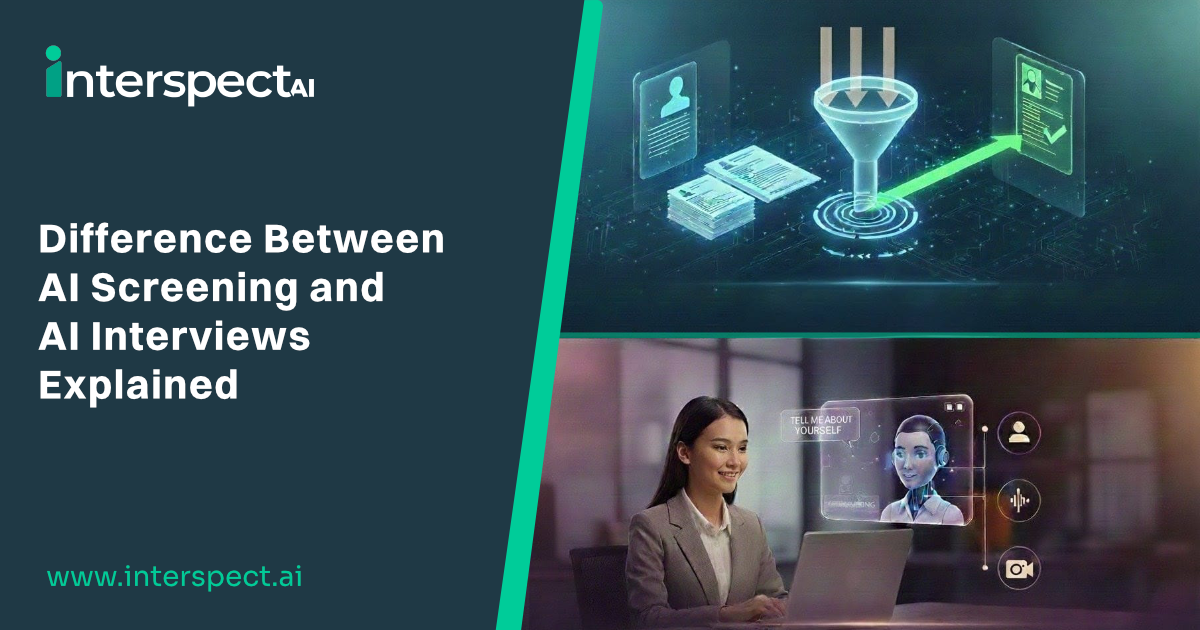
If you have applied for a job recently, you have likely encountered some form of automation. Maybe your resume was parsed instantly, or perhaps you were asked to record a video introduction. The term "AI Hiring" is thrown around constantly, creating a cloud of confusion for students and professionals alike. Is a robot reading your resume? Is a computer analyzing your facial micro-expressions?
The reality is nuanced. Not all AI in the hiring process is the same. There is a fundamental difference between AI Screening and AI Interviews. Understanding this distinction is not just academic trivia; it is the key to tailoring your preparation strategy.
While one is designed to efficiently identify the best matches, the other is designed to evaluate your potential. Here is the genuine breakdown of the difference, and how tools like SpectraSeek help you master both.
Part 1: AI Screening (The Digital Gatekeeper)
AI Screening is the first line of defense for employers. Its primary goal is efficiency. When a company receives 10,000 applications for a single role, no human team can read them all. They use resume screening, video screening software, and Applicant Tracking Systems (ATS) to manage the volume.
How It Works
Screening tools are "exclusionary" by design. They are programmed to reduce the candidate pool from thousands to a manageable few. They typically look for:
- Keyword Matches: Does your resume contain specific software names or certifications mentioned in the job description?
- Basic Constraints: Are you legally authorized to work? Are you located in the right time zone?
- Simple Video Prompts: In an automated online video interview at the screening stage, you might answer generic questions like "Tell us about yourself."
The Logic
The logic here is simple. You either meet the minimum criteria, or you are filtered out. These systems rarely analyze "soft skills" or "potential." They are checking for compliance and basic relevance.
Part 2: AI Interviews (The Intelligent Evaluator)
AI Interviews occur later in the funnel. This is where the technology shifts from "filtering" to "assessing." This is often referred to in the industry as an AI structured interview.
How It Works
Unlike screening, which looks for keywords, AI interviewing looks for competencies. Advanced platforms use what is known as "agentic AI" to mimic the reasoning of a recruiter. They are not just checking if you said a word; they are analyzing how you said it.
- Depth of Response: Did you explain the "how" and "why" of your project, or just the "what"?
- Soft Skills Assessment: The AI evaluates communication confidence, clarity, and structure.
- Behavioral Fluency: Can you retrieve and structure knowledge under stress?
The Logic
The goal here is predictive. Research has established that structured assessments are far stronger predictors of job performance than unstructured chats. The AI is scoring you on a rubric, evaluating your Role Alignment and Technical Proficiency against a high standard.
The Critical Gap: Why Candidates Fail
The confusion between these two stages causes candidates to fail.
- The Error: You treat an AI Interview like a Screening. You stuff your answers with keywords but fail to tell a coherent story.
- The Result: The AI marks you as having low Authenticity because you sound like a robot reciting a dictionary.
Conversely, some candidates treat a screening like an Interview, providing long-winded, philosophical answers when the system just needed a clear "Yes, I have 3 years of Python experience."
To succeed, you need to bridge the employability skills gap by understanding exactly which metrics are being measured.
How SpectraSeek Bridges the Divide
This is where SpectraSeek distinguishes itself. It is not just a practice tool; it is a talent intelligence platform that helps you navigate both the screening and interviewing logic. It prepares you for the rigorous "structured interviewing" methods that real-world hiring is moving toward.
Mastering the Screen with "Job Description Mapping"
To pass the screening gatekeeper, you need relevance. SpectraSeek features Job Description Mapping, where the platform analyzes your resume and verbal responses against the specific requirements of a target job description.
- The Benefit: It acts like a sophisticated screen. If your narrative is missing the core terminology required for the role, the system flags it. This ensures you don't get filtered out early for missing the "obvious" stuff.
Mastering the Interview with "Authenticity and Insight"
To pass the interview stage, you need connection. Employers value genuine responses over rehearsed scripts. SpectraSeek generates an Authenticity Score, predicting how well you will connect on a human level by rewarding specific, personal storytelling.
- The Benefit: It prevents you from sounding "generic." If you are using clichés, the platform warns you, ensuring your soft skills employability is high enough to impress a hiring manager (human or machine).
The "Black Box" of Soft Skills
The biggest difference between simple screening and complex interviewing is the analysis of soft skills. In a screen, soft skills are invisible. In an AI interview, they are quantified.
Through AI driven analytics, SpectraSeek breaks down your performance into actionable categories:
- Communication Skills/Confidence: Are you speaking clearly or is your delivery shaky?
- Response Insights: Is your answer structured logically?
- Interview Readiness: Are you prepared with specific examples?
This data-driven coaching moves you away from the vague feedback of "you did well" and gives you the specific metrics needed to improve.
Conclusion: Preparation for the Modern Age
The days of treating all digital interactions the same are over. AI Screening requires precision and relevance; AI Interviews require depth and authenticity.
Understanding this difference allows you to stop fighting the system and start leveraging it. By using an AI mock interview platform that mirrors these distinct logics, you can ensure you are not just "filling out a form" but actually demonstrating your potential.
SpectraSeek provides the interview readiness metrics you need to navigate both gates. Whether it is ensuring your keywords match or validating that your stories are authentic, the platform turns the anxiety of the unknown into the confidence of the known.
Don't get filtered out. Get hired. Visit InterspectAI to assess your readiness today.
FAQs
Is AI screening the same as an ATS?
They are related but different. An ATS (Applicant Tracking System) is used to manage the entire hiring pipeline, from posting jobs to tracking candidates, while also parsing resume text to organize and filter applications. AI screening often refers to video screening software or chatbots that interact with candidates early in the process to verify basic qualifications before a human reviews the file.
Can SpectraSeek help me with the screening stage?
Yes. The Job Description Mapping feature is excellent for screening prep. It ensures your resume and verbal responses align with the specific keywords and requirements of the job description, which is exactly what screening algorithms look for.
Why does the "Authenticity Score" matter for AI interviews?
Advanced AI interviews are designed to detect generic, memorized answers. The Authenticity Score helps you identify if your responses sound too scripted. High authenticity correlates with better hiring outcomes because it signals to the employer (and their AI) that you are being genuine and specific.
Does an AI interview replace a human recruiter entirely? Not usually. The AI interview acts as a high-fidelity filter. It predicts hiring success by validating skills and fit. If you pass the AI interview, you typically move on to subsequent rounds with human decision-makers, but you enter that room with data-backed validation of your skills.
You might also like

AI interviews score things human interviewers miss. But is your current interview style helping you stand out, or are you unknowingly hurting your score?
In a traditional interview, you rely on your knowledge of the subject and your ability to read the room. You build rapport and adjust your delivery based on the interviewer’s reactions. But in an automated video interview, the rules of engagement are rewritten. There is no recruiter to nod encouragingly while you find your thoughts. There is only a lens, a timer, and an algorithm measuring thousands of data points per minute. For many candidates, this shift is jarring. You might be the most qualified person for the job, but if you trigger specific algorithmic red flags, your application could be rejected before a human ever sees it.
The good news? These red flags are fixable. Here are the 7 clear signs that you are not yet ready for the camera, and the AI video interview tips you need to turn your performance around.
Sign #1: You Are Using Too Many Filler Words
We all do it. In casual conversation, words like "um," "uh," "like," and "you know" act as glue while our brains construct the next sentence. To a human ear, they are often filtered out as background noise.
To an AI, however, they are data. A high frequency of filler words can impact your Communication Skills/Confidence score. The algorithm may interpret excessive hesitation not just as a speech habit, but as a lack of certainty in your own experience. If you are saying "um" every three words, the machine calculates that you are struggling to retrieve information.
How to Fix It: The solution is not to silence yourself, but to embrace the pause. In video interview practice, train yourself to stop speaking when you need to think. A silent pause projects confidence and thoughtfulness. A vocalized pause ("ummmm") projects anxiety. Record yourself answering a standard question and count the fillers. Your goal is to reduce them by 50% in your next attempt.
Sign #2: Your Eye Contact Is Inconsistent
It feels unnatural to stare at a black dot on your laptop bezel. Our instinct is to look at ourselves on the screen or to look down at our notes.
In a virtual interview practice scenario, looking away frequently can be flagged as "low engagement" or even dishonesty. Some advanced proctoring AI might even flag erratic eye movement as a sign that you are reading from a script or looking up answers on a different monitor.
How to Fix It: Treat the camera lens as the interviewer's eye. Place a small sticky note with a smiley face right next to the camera to draw your gaze. During your preparatory sessions, practice delivering your entire answer while maintaining visual lock with that sticky note. It feels intense at first, but on the other side of the recording, it looks like deep, focused engagement.
Sign #3: You Ramble Without Structure
In a human conversation, you can wander a bit. A recruiter might interrupt you to guide you back to the point. An AI will not save you. It will simply let you run out the clock.
If your answer lacks a clear beginning, middle, and end, the AI may struggle to categorize your competencies. It searches for specific markers of a story (Situation, Task, Action, Result). If you ramble, your score drops because the system cannot identify the "Action" you actually took.
How to Fix It: Practice using a framework (say STAR) for structuring your answer:
- Situation: Briefly set the context (10% of time).
- Task: Define the challenge (10% of time).
- Action: Detail what YOU did (60% of time).
- Result: Quantify the outcome (20% of time). Use signposting language like "The action I took was..." or "As a result..."
This will help the AI parse your answers better.
Sign #4: You Haven't Practiced Speaking Out Loud
Reading your notes is not the same as speaking them. Many candidates prepare by writing bullet points but never actually vocalize them until the interview starts.
This leads to "cognitive traffic jams." You know what you want to say, but your mouth stumbles over the phrasing because you haven't built the fluency to articulate it. You might freeze up or restart your sentences, which eats into your time limit.
How to Fix It: Use an AI mock interview platform like SpectraSeek to get "reps" in. You need to bridge the gap between your brain and your voice. Speak your answers out loud until the phrasing feels muscular and automatic. This is the core of automated video interview preparation, moving from theory to execution.
Sign #5: Your Environment Is Distracting
You might think the pile of laundry behind you doesn't matter, or that the shadow casting over your face is "moody." The AI disagrees.
Poor lighting and background noise interfere with the AI's ability to analyze your facial expressions and voice clarity. If the audio is muddy, the speech-to-text transcription (which the AI actually analyzes) will be full of errors. If the transcription is wrong, your keyword matches will be wrong, and your score will plummet.
How to Fix It: Control your variables.
- Light: Face a window or a lamp. Never have the light source behind you.
- Sound: Use a headset with a microphone rather than your laptop's built-in mic to eliminate echo.
- Background: A plain wall is better than a messy room. Eliminate visual noise so the AI focuses solely on you.
Sign #6: You Pause Too Long Before Answering
When the question appears, the clock starts. Taking 30 seconds to gather your thoughts before speaking might be acceptable in a relaxed human chat, but in a timed AI environment, it eats up valuable seconds and can be interpreted as a lack of readiness.
Long silences at the start of a recording can also mess with the pacing analysis. It signals that you do not have the information readily available.
How to Fix It: Develop "buffer phrases" to buy yourself a moment while keeping the flow going. Phrases like, "That is a great question. I encountered a similar situation when I was working at..." allow you to start speaking immediately while your brain retrieves the specific details of the story.
Sign #7: You Sound Rehearsed Instead of Authentic
This is the most common trap for prepared candidates. You find a "perfect" answer on a career blog, memorize it, and recite it word-for-word.
Modern AI platforms evaluate for Authenticity Scores. If your content is full of generic buzzwords (like "I'm a hard worker" or "I'm a perfectionist") without specific details to back them up, the AI flags you as "scripted." Employers use these tools to find unique human experiences, not candidates who can memorize a Google search result.
How to Fix It: This is where SpectraSeek is invaluable. The platform provides an Authenticity Score that specifically analyzes if you are providing unique, personal evidence or just reciting common clichés.
- Ditch the memorization. Do not write out full sentences. Memorize your key bullet points so you formulate the sentences naturally in the moment.
- Inject personal details. Don't just say, "I am a proactive problem solver." Tell the story of the time you noticed client tickets piling up and built a new triage system that reduced response times by 40%.
- Avoid the "Dictionary Definition" trap. Don't define a skill (e.g., "Leadership is about guiding people"). Instead, describe a moment where you exercised that skill.
Conclusion
If you recognize yourself in any of these signs, don't panic. These are not character flaws; they are simply performance habits that can be adjusted.
The only difference between a candidate who fails an AI interview and one who passes is data. The failing candidate guesses how they are coming across. The successful candidate knows.
By using tools like SpectraSeek, you can diagnose these issues before the real interview. You can see your Overall Candidate Fit, check your Interview Readiness, and fix your eye contact or pacing in a safe, private environment.
Stop sabotaging your score. Visit InterspectAI to turn these red flags into green lights.
TL;DR
AI video interviews shift the focus from human connection to data-driven performance, meaning even the most qualified candidates can face rejection if their non-verbal cues trigger algorithmic red flags. Success in this new format requires more than just subject knowledge; it demands that you diagnose and adjust your performance habits using tools like SpectraSeek to ensure your performance is just as polished as your credentials
FAQs
Can an AI really tell if I am making eye contact?
Yes. Some modern video interview technologies use facial tracking to monitor gaze direction. While it doesn't need to be 100% perfect, consistent engagement with the camera lens is impactful.
Is it bad to look at my notes during an AI interview?
It is okay to glance, but do not read. If your eyes are tracking left-to-right constantly, the AI (and human reviewers) will know you are reading a script. This can impact your score.
How do I fix my "filler words" if I don't realize I'm saying them?
This is why recording yourself is essential. You often cannot hear your own "ums" in real-time. An AI video interview tips tool like SpectraSeek will bring it to your notice.
What is the best lighting for an AI interview?
Soft, front-facing light is best. Avoid harsh overhead lights that create raccoon shadows under your eyes, and never sit with a bright window behind you (backlighting), as it turns you into a silhouette that the AI cannot analyze.
Algorithmic hiring is here, and the rules of recruitment have changed.
For decades, the metric of a university’s success was simple: graduation rates. Today, the battlefield has shifted. In a competitive education market, the new gold standard is university placement rates. Students are increasingly asking a direct question: "Will this degree get me a job?”
However, the mechanism of getting that job has fundamentally changed. The days of winning an offer solely through a polished resume and rehearsed answers are fading. We have entered the era of the "Placement Wars," where the primary gatekeeper between your students and their careers is often an algorithm, not just a human.
For higher education leaders, this presents a stark choice. You can stick to traditional career counseling methods that are difficult to scale, or you can empower your career services team with AI tools to better equip your students for the reality of modern hiring.
The Shift: From Human-First to AI-First Hiring
The recruitment landscape at top-tier employers has transformed. Fortune 500 companies, overwhelmed by the volume of digital applications, have moved from human-first to AI-first hiring processes.
In the past, a campus recruiter might scan a stack of resumes and conduct initial screenings. Today, career center technology solutions are lagging behind corporate adoption. Companies are using sophisticated talent intelligence platforms to automate the top of the funnel.
This means the first person your student impresses must be a machine. If your campus placement strategy focuses only on human networking and soft skills without addressing the digital filter, you are sending soldiers into battle without armor.
What Students Face: The Algorithmic Gauntlet
Imagine a bright, capable student named ‘A’. ‘A’ has a 3.8 GPA and strong extracurriculars. He applies for a role at a major tech firm and receives an invitation for an interview. He puts on a suit, logs in, and finds himself staring at his own reflection.
There is no recruiter. Just a timer and a prompt and sometimes an AI avatar.
This is the reality of automated video interviews. Alex isn't just answering questions; he is being scored.
- AI Screening: Algorithms are parsing his verbal responses for specific keywords related to the job description.
- Algorithmic Scoring: The system is evaluating his communication confidence, the structure of his answers, and even his pacing.
If Alex hasn't practiced for this specific format, he will likely fail. Not because he lacks potential, but because he lacks the know-how of how to navigate such a scenario. He might provide a brilliant answer that is too long, or a passionate answer that lacks the specific role alignment keywords the AI is programmed to find.
Why Traditional Mock Interviews Fail
Most university career centers are staffed by dedicated, hardworking counselors. But they are facing a math problem they cannot solve. With ratios often exceeding 300 students to one counselor, it is physically impossible to provide every student with rigorous, repeated interview practice.
Consequently, traditional prep suffers from three fatal flaws:
- Limited Scale: Most students get one or two mock interviews before graduation, if any. Mastery requires repetition.
- Inconsistency: One counselor might focus on eye contact, while another focuses on technical content. There is no standardized rubric.
- Depth of Analysis: While career counselors provide expert professional guidance, AI feedback offers a much more layered assessment. AI can isolate and measure dozens of variables at once, providing a depth of technical feedback that is difficult for even skilled human professionals to replicate.
- This creates an employability skills gap. Students leave campus feeling supported but enter the market unprepared for the objective, data-driven scrutiny of AI hiring tools.
The Data: The AI Advantage
The divide is already appearing in the data. Early adopters of university employability platforms are seeing a distinct advantage.
Universities that integrate AI-driven interview prep into their curriculum report significantly better outcomes. Students who regularly practice with AI tools, receive instant feedback, and iterate on their performance tend to achieve stronger placement results than peers who rely solely on traditional methods.
By the time they face a real corporate AI screen, they have already done it dozens of times in a safe environment. They understand how to structure their STAR stories for an algorithm. They know how to map their skills to a job description because they have seen the data.
What Forward-Thinking Universities Are Doing
Leading institutions are no longer viewing AI as a threat to traditional counseling; they view it as a force multiplier. They are deploying AI career coaching for colleges to handle the tactical "heavy lifting" of interview prep.
This hybrid model changes the game:
- Scale: Every student, from freshmen to seniors, can access unlimited mock interviews 24/7.
- Data-Driven Insights: Career centers receive aggregate data on student performance. If the data shows that the students from the engineering department struggle with "Communication Confidence," the center can run a targeted workshop to fix it.
- Personalization: Students get private, judgment-free feedback on sensitive metrics like anxiety and clarity, allowing them to improve without embarrassment.
By automating the technical prep, human counselors are freed up to do what they do best: mentor students on career strategy, networking, and emotional resilience.
The SpectraSeek Solution
This is where SpectraSeek becomes a critical ally in your campus placement strategy. It is not just a simulator; it is a predictive engine designed to bridge the gap between education and employment.
SpectraSeek empowers your career center with capabilities that mirror corporate hiring tools:
- Role Alignment: It teaches students how to map their specific experiences to the job description, ensuring they pass the relevance filter.
- Authenticity Score: It trains students to avoid robotic scripts and use personal storytelling, a key factor in passing behavioral screens.
- Interview Readiness: It provides a clear, data-backed score. You can know, not just guess, which students are ready to enter the job market.
The Placement Wars will not be won by the universities with the oldest traditions, but by those with the most adaptable strategies.
Is your career center ready to upgrade? Learn more about how we partner with higher education at our Universities page.
TL;DR
The era of "hoping for the best" is over. Algorithmic hiring is a reality that your students face today. By integrating AI simulations into your career services, you aren't replacing human guidance; you are scaling it. You are giving every student a dedicated coach that helps them navigate the digital gatekeepers.
Don't let your talent get filtered out. Equip your university with the predictive power of data.
FAQs
How does AI coaching integrate with existing career counselors?
AI doesn't replace counselors; it extends their reach. While the AI handles the repetitive task of mock interviews and resume keyword mapping, counselors can use the Response Insights data to offer high-level strategic advice to students who need it most.
Does this help with non-technical majors?
Absolutely. Soft skills are the currency of the modern job market. SpectraSeek evaluates Communication Confidence which are critical for any students navigating competitive roles.
Can we track student progress?
Yes. A robust university employability platform provides analytics dashboards. You can track usage, improvement in "Interview Readiness" scores over time, and identify at-risk student groups who may need intervention before graduation.
Is AI prep expensive to implement?
Compared to the cost of hiring additional staff to provide the same volume of practice, AI career coaching for colleges is highly cost-effective. It offers infinite scalability, ensuring that even 5,000 students get the same level of attention as just 1 student.
Making important hiring choices based on quick notes or fading memories? Sadly, that’s still a common challenge for many organizations today. After interviews or key meetings, hiring teams often find themselves piecing together partial recollections or debating different perspectives without a clear, objective record to guide them. This patchwork approach can let crucial insights slip away, introduce unconscious biases, and ultimately weaken decision confidence.
Human memory, no matter how sharp, isn’t built to capture every nuance in fast-paced conversations. Small but vital signals—like a momentary pause before an answer, a shift in tone, or subtle enthusiasm—are easily missed when relying on handwritten notes or mental snapshots. Missing these details means risks go undetected, true potential might be overlooked, and bias can inadvertently influence who gets the job.
That’s where conversation analytics steps in, revolutionizing how hiring teams digest and act on interview data. By combining AI-powered transcription and emotional analysis, platforms like SpectraHire provide a comprehensive, rich understanding of every candidate interaction, far beyond what humans alone can capture.
Why SpectraHire Changes the Hiring Game
What sets SpectraHire apart is its fully autonomous AI agents that run interviews from start to finish. Unlike traditional processes that depend heavily on interviewers taking notes or recalling details, SpectraHire conducts conversations independently, transcribes them accurately, and analyzes the emotional and cognitive cues behind the words.
- Agent-Led Interviews: The AI dynamically steers the interview, asking questions and probing deeper based on candidate responses, conducting the entire conversation without requiring a human interviewer's presence.
- Complete, Searchable Transcripts: Every conversation is captured verbatim, enabling hiring teams to revisit specific moments with perfect recall.
- In-Depth Sentiment and Reasoning Insights: SpectraHire’s AI evaluates tone, confidence, hesitation, and clarity of thinking, offering insights that help differentiate candidates beyond their resumes.
This combination ensures that recruiters and hiring managers can make informed decisions, armed with detailed and objective evidence, thereby minimizing guesswork and bias.
What Conversation Analytics Bring to Your Hiring Process
With SpectraHire, you can:
- Gain Rich Context: Access full transcripts that capture not only words but every subtle behavioral nuance.
- Detect Hidden Signals: Identify stress markers and shifts in enthusiasm that traditional interviews might overlook.
- Eliminate Human Biases: Standardized AI-driven assessments ensure fairness and consistency across all interviews.
- Make Informed Decisions: Detailed analytics enable you to compare candidates objectively and select the best fit confidently.
- Foster Team Alignment: Easily share insights and transcripts with hiring stakeholders for better collaboration and transparency.
Real Benefits for Recruitment Leaders
Teams using SpectraHire are seeing measurable improvements:
- Scale with Confidence: Handle more interviews without compromising quality or consistency, perfect for fast-growing organizations.
- Enhance Candidate Experience: Provide fair, unbiased, and transparent interviews that earn candidate trust.
- Accelerate Hiring: Utilize AI-generated insights to reduce evaluation time while enhancing decision accuracy.
- Build a Stronger Workforce: Select candidates who not only meet the job criteria but also align with the company's culture and values.
Looking Ahead: AI-Powered Hiring You Can Trust
In today’s fast-paced hiring landscape, relying on imperfect memory or fragmented notes simply isn’t enough. Critical decisions deserve clarity, transparency, and fairness—qualities that only comprehensive conversation analytics can deliver. With SpectraHire’s fully autonomous AI Agent-powered interviews, you gain more than just transcripts; you unlock deep insights into candidate reasoning, sentiment, and communication style, all captured seamlessly and without human bias.
This technology empowers your recruitment team to make confident, data-driven decisions that scale with your business, reduce unconscious bias, and enhance the candidate experience. It’s not just about making hiring faster; it’s about making hiring smarter and more equitable.
Ready to transform your recruitment process and hire with greater confidence?
Discover how SpectraHire can help you capture every meaningful detail and turn conversations into your strongest hiring asset.
Explore SpectraHire today and take the first step toward a fairer, more insightful, and scalable hiring future.
Frequently Asked Questions
1. What is conversation analytics, and why does it matter in hiring?
Conversation analytics uses AI to analyze candidates’ words and emotions during interviews, providing deeper and more objective insights than traditional notes.
2. How do conversation transcripts improve hiring decisions?
They offer accurate, searchable records of candidate responses, helping teams review answers thoroughly and collaborate better.
3. Can conversation analytics help reduce hiring bias?
Absolutely. Automating interview analysis with consistent criteria minimizes subjective judgments, supporting fairer evaluations.
4. How does conversation analytics enhance team collaboration?
Sharing detailed transcripts and insights aligns recruiters and hiring managers, speeding up consensus and better decisions.
Subscribe to The InterspectAI Blog