%201.svg)

7 Reasons to Take an AI Mock Interview Before Every Job Interview


You’ve crafted your resume. Rewritten your LinkedIn bio. Spent an hour Googling “most common interview questions.”
Still feeling a little… unprepared?
Agentic AI-powered mock interviews can give you the much-needed boost of confidence!
These aren’t the robotic scripts you might remember from early job portals. Today’s AI interview practice tools simulate real-world job interviews - with smart follow-up questions, tone analysis, and structured feedback - giving you a safe, judgement-free space to improve and avoid common mistakes.
Let’s get into why taking a mock interview online (especially with an AI agent) before your real one can be beneficial for acing interviews.
1. Interviews are getting tougher and more unpredictable
Hiring isn’t what it used to be.
From behavioral interviews to case studies and technical rounds, today’s job interviews can feel like running a gauntlet.
According to a report, close to two-thirds (64.8%) of employers surveyed reported using skills-based hiring practices for new entry-level hires, with 90% of these employers incorporating it at the interview stage that dig deep into competencies, not just qualifications.
That means prep has to be specific, and tailored to each role.
AI practice interviews help here by adapting questions based on your responses. Instead of generic lists, you get personalized question paths that better mirror how real recruiters think.
2. Real-time feedback that’s actually useful
“Tell me about yourself.”
It seems simple - until you say it out loud and realize you rambled for three minutes without making a point.
AI mock interview tools can pick that up instantly. Many offer real-time feedback on:
- Speech clarity and filler words
- Eye contact and facial expressions (if video-enabled)
- Length and structure of your answers
- Confidence score (based on tone and delivery)
Tools like SpectraSeek take it a step further with video recordings and transcripts of your practice sessions, so you can review, reflect, and fine-tune your performance like a pro.
3. Builds confidence without the pressure
Interview anxiety is real, and practicing with an AI interview prep tool takes the edge off.
You’re not being judged. There’s no awkward silence. You can restart as many times as you like, pause midway, or try different styles.
You build muscle memory for speaking clearly, structuring responses, and staying calm. And when you walk into the real thing? You’ve already done it 10 times in your head.
4. Available anytime, anywhere
Not everyone has access to a mentor or a professional coach. And not everyone has the budget for one.
Whether you’ve got 20 minutes before bed or you’re sneaking in a session during lunch, AI is always ready.
Platforms like Google’s Interview Warmup, Pramp, or more comprehensive solutions like SpectraSeek (which offers AI-led practice with recordings, feedback, and resume scoring) give you flexibility without friction.
5. Helps you tailor responses to the role
Interviewing for a sales role? Expect questions on negotiation, KPIs, and pipeline management.
Applying for a data analyst job? You’ll need crisp answers on SQL, dashboards, and decision-making.
AI mock interview platforms often let you choose the job title or industry you’re preparing for. Tools like SpectraSeek even help you identify resume gaps and adjust how you present your experience during the interview - so your prep isn’t just “general,” but targeted.
6. Tracks progress over time
It’s hard to know if you’re improving - unless you’re keeping score.
The best AI mock interview practice tools show metrics over time:
- How much more concise your answers are
- How your confidence score has changed
- What kinds of questions still trip you up
SpectraSeek, for example, stores your video recordings and transcripts so you can track how your delivery, tone, and structure evolve. And the AI-generated feedback helps you see exactly what to tweak and where.
7. Practice makes prepared, not perfect
We’ve all heard “practice makes perfect.” But that’s not the point of interview prep.
The point is to feel prepared enough to show up as your best self. To answer clearly, think aloud, and connect with the interviewer.
With AI interview practice, you can do exactly that - without burning out.
Job hunting is tough enough.
Between the applications, follow-ups, and imposter syndrome, it’s a full-time job on its own.
But prepping smart with AI mock interviews can make a massive difference. You can work on sharpening your delivery, spotting blind spots, and walking into that interview with quiet confidence.
If you’re serious about landing the job, give yourself that edge.
Want to know what it’s like having a smart, tireless coach in your corner? Try SpectraSeek!
You might also like

The idea of practicing with an AI agent before an important interview might seem impersonal—or even intimidating. Many job seekers assume that interview prep, like real interviews, is best done with another human across the table, someone who brings empathy, nuance, and conversation into the process.
But that assumption is changing fast. A growing number of candidates are not only comfortable using AI-powered mock interview tools—they actually prefer them. This trend isn’t about adopting new technology for the sake of novelty. It’s about something more meaningful: the need for a fairer, more transparent way to prepare for the hiring process.
Traditional mock interviews, when available, can feel inconsistent, unclear, or even anxiety-inducing. Feedback is often vague, leaving candidates uncertain whether their performance has actually improved. Many also find it hard to know what hiring managers truly look for.
In this context, AI-powered mock interviews offer something rare: clarity and control. They give candidates a structured environment to practice, learn from objective feedback, and build confidence—before stepping into the real interview room.
Why Mock Interviews Still Matter—And Where AI Helps
The value of mock interviews is well known. They allow candidates to test their thinking, refine their verbal delivery, anticipate tough questions, and reduce nerves before the real thing. However, traditional mock interviews come with their own set of challenges: they can be expensive, difficult to schedule, and sometimes inconsistent, subject to the same human variability as actual interviews.
That’s where AI-powered platforms fundamentally change the game. With agentic AI tools like SpectraSeek, mock interviews are now:
- Available on-demand—practice anytime, anywhere
- Objective and standardized—no guesswork or inconsistent feedback
- Deeply personalized—feedback is tailored to your pace, tone, and content
- Confidence-boosting—no judgment, just progress
Objective Evaluation Builds Trust
At the heart of any interview is a fundamental anxiety: “Will I be judged fairly?” Every candidate wonders whether their background, personality, or presentation style might influence how they’re perceived. These worries are often amplified for individuals from non-traditional backgrounds, underrepresented groups, or those interviewing for the first time.
AI interview agents help neutralize that anxiety. Unlike a human coach or panelist, an AI doesn’t rely on opinions or impressions. It evaluates candidates using criteria directly tied to the role's requirements. Every person is evaluated on the same terms, with no personal bias or favoritism.
For job seekers, this means the focus stays where it belongs: on substance over style. Your content matters more than your charisma. Your clarity matters more than your connections.
This objective approach is one reason so many job seekers now trust AI tools more than traditional coaching sessions. They know the system—whether used during practice with SpectraSeek or in real assessments with SpectraHire—is designed to keep the playing field level.
Consistency Without the "Luck of the Draw"
Another challenge with traditional interviews—and traditional preparation—is inconsistency. One mock coach might provide generous and detailed feedback. Another might be scattershot or rushed. Much like in real hiring, the experience a candidate gets depends heavily on who’s on the other side of the virtual desk.
AI removes that variability. Every interview session is governed by the same structure, pacing, and scoring model. For users, this is incredibly empowering. You don’t have to wonder if someone just “didn’t vibe with you.” The system is built to measure performance, not perception.
You also get the chance to do things human-led interviews rarely allow: re-record your answer. Try different phrasings. Practice until it lands.
This repeatable, reliable structure provides job seekers with a platform where they can truly improve on their own terms.
Feedback That Actually Helps
One of the most frustrating aspects of both real interviews and prep sessions is the lack of clear and helpful feedback. Vague phrases like “be more confident” or “tighten your answers” don’t help candidates grow.
AI-powered mock interviews offer something different: real-time, actionable insight. After answering a question, users receive detailed feedback on:
- How clearly and concisely they communicated
- The relevance of their key points
- Their pacing, tone, and delivery style
- Nonverbal signals via video (like confidence or energy)
This feedback loop helps users not only see what needs improvement, but also how to improve it. And because they can practice as many times as they like, they can turn that feedback into progress before the real interview happens.
A Co-Pilot in a Lonely Journey
Finding a job can often feel isolating. There’s uncertainty at every stage, from writing a resume to hearing the results of an interview. Most of that process happens independently and silently.
That’s why candidates increasingly describe AI-powered preparation tools like SpectraSeek as a “confidence-building co-pilot.” These platforms don’t just test you—they help you grow. And they do it with patience, neutrality, and accessible guidance. Whether you're applying for your first internship or your fifth management position, you'll receive reliable support that aligns with your schedule and goals.
Aligning With Real Hiring Workflows
Perhaps most importantly, candidates are starting to trust AI-powered mock interviews because they know companies are using the same technology to make real decisions. Tools like SpectraHire are being increasingly deployed to conduct structured, bias-resistant interviews at scale.
This offers a unique kind of preparation because the mock interview experience aligns directly with the real-world evaluation. Candidates can walk in knowing not just what to expect, but also how they’ll be measured. That consistency from prep to performance creates a sense of continuity that traditional coaching can’t replicate.
So—Are They Worth It?
Yes. For job seekers who want fairness, clarity, and confidence, AI-powered mock interviews are absolutely worth it.
They don’t replace the human elements of interviewing, but they do replace guesswork with insight, uncertainty with standards, and doubt with preparation. Whether used alone or alongside traditional coaching, AI-led prep is quickly becoming an essential tool in the modern candidate toolkit.
Looking to sharpen your interview skills with objective feedback and real impact? Try SpectraSeek to experience AI-powered preparation that actually works. And when it’s time for the real conversation, count on SpectraHire to deliver structure, fairness, and scale across the hiring journey.
Join the future of hiring—practice smarter, interview stronger, and get hired with confidence.

Conversational intelligence (CI) is slowly, but surely, changing how businesses communicate, and its influence will only grow in the coming years.
Let’s explore some use cases and future trends for conversational intelligence in business.
If you want an introduction to conversational intelligence, read our blog post here.
Customer support and experience automation
The most common use case for CI is customer service chats (on websites, apps, and messaging platforms). Here, conversational intelligence acts as a virtual customer assistant, resolving issues or answering questions. The future of business communication in this arena is leaning toward omnichannel, AI-assisted support. Already, 51% of consumers say they prefer interacting with bots for immediate service needs, which indicates a growing comfort with AI-driven help as long as it’s effective.
We also see AI digital agents bridging channels. For instance, a customer might start with a chatbot on a website and later get a follow-up from the same AI via WhatsApp or voice call, creating a seamless support journey.
Customer experience automation through conversational intelligence can cut costs and boost customer happiness by providing instant, accurate responses anytime, anywhere.
Sales and revenue generation
Sales teams are leveraging conversational intelligence in multiple ways. First, AI chatbots can engage website visitors in real time, qualifying leads, answering product questions, and even demoing products conversationally. This can improve lead capture and conversion rates by engaging prospects instantly rather than waiting for a sales rep’s availability.
Second, and perhaps more game-changing, is the use of conversation intelligence platforms to analyze sales calls and meetings. Imagine a meeting assistant with conversational intelligence that joins your Zoom sales call: It transcribes the meeting, analyzes the dialogue, and later provides you with a summary along with insights like “Customer reacted positively when pricing was discussed” or “Competitor X was mentioned twice.”
These insights help sales managers coach their teams and refine strategy. They also help reps themselves – some advanced systems can even coach in real time, nudging a rep if they’re doing too much talking or if they haven’t mentioned a key product feature yet.
According to industry trends, sales AI enablement tools like these are becoming standard; a recent report noted that 80% of sales reps say AI makes it easier to get the insights needed to close deals.
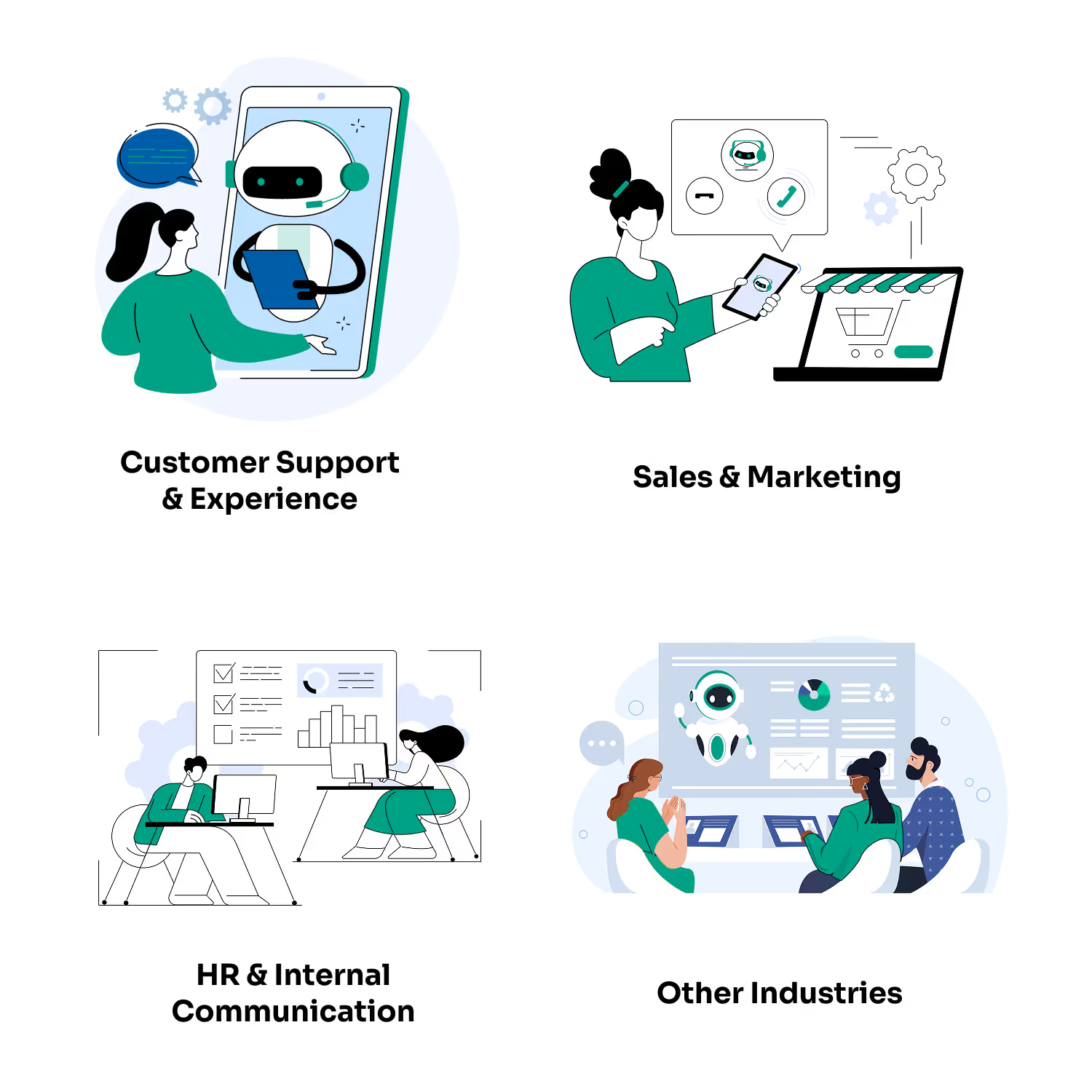
Marketing and personalization
Conversational intelligence is also making waves in marketing. AI chat agents on websites or social media can personalize product recommendations by analyzing what customers have browsed or purchased in previous sessions or visits. They can upsell or cross-sell with a conversational touch (“I see you bought a laptop - do you need a case for it?”).
Furthermore, conversational intelligence can be used for interactive marketing campaigns. For example, a beauty brand might have an AI chatbot that quizzes users and gives personalized skincare advice, creating an engaging experience that also drives product discovery.
These intelligent conversation software solutions blur the line between service and marketing, providing value to the customer while steering them through the marketing funnel.
Beyond marketing, AI-powered agents built on conversational intelligence are also transforming how enterprises approach market research and insights - especially in market research.
We expect to see more and more companies adopting this tech and conversational intelligence becoming a staple in the business communication trends of 2025 and beyond.
Internal communications and HR
Aside from using AI agents for hiring, enterprises are also applying conversational intelligence internally. HR chatbots (a type of conversational AI agent) can answer employees’ questions about benefits, company policy, or IT issues on Slack or other internal channels.
This improves employee experience by giving instant answers and freeing HR staff from repetitive queries. Meeting assistants (like Zoom’s AI assistant or Microsoft Teams’ Copilot) can live-transcribe meetings, highlight action items, and draft follow-up emails.
These AI meeting notes and insights mean employees don’t have to worry about scribbling notes and can focus on the discussion. The AI ensures nothing is lost, and everyone gets a summary after the meeting.
Different industries are customizing conversational intelligence to their needs.
There are countless benefits in adopting this tech, especially for enterprises. In healthcare, AI chatbots handle patient triage (“symptom checkers”) or help schedule appointments, improving accessibility.
Reports show that 58% of telemedicine platforms now use conversational interfaces to facilitate doctor-patient interactions. In finance, AI assistants help with account information and advise on basic financial questions.
In education, AI tutors or campus chatbots guide students. These specialized agents show that conversational intelligence isn’t one-size-fits-all – it can be trained on domain-specific knowledge (medical terms, financial regulations, etc.) to become an expert virtual assistant.
The trend points to more conversational intelligence platforms tailored for specific sectors (e.g., legal AI assistants, real-estate AI chatbots, etc.), which will further drive adoption because they can be deployed faster with industry context built in.
Can you think of a department in your company that could benefit from adopting conversational intelligence? If so, contact us!
Interview anxiety isn't just "all in your head." It’s neuroscience.
You probably know the feeling: sweaty palms, a racing heart, and a blank mind as soon as the camera turns on. Telling yourself to calm down doesn’t help because your body reacts on its own. This isn’t about being unprepared; it’s simply how your body works.
For decades, the only solution was to "fake it till you make it." Today, we have a science-backed way to fix it. Here is the psychology behind why we freeze up, and how interview anxiety help has evolved from breathing exercises to exposure therapy with AI.
Understanding the Neuroscience of Freezing Up
In stressful situations like job interviews, your brain’s amygdala, which detects threats, often sees being judged by strangers as a risk to your social standing.
This sets off your fight-or-flight response. Your body releases cortisol and adrenaline, and blood moves away from the part of your brain that handles logic and language, sending it to your muscles instead.
That’s why it’s so hard to beat interview anxiety. In those moments, your thinking brain takes a back seat to your survival instincts. It doesn’t mean you’re bad at interviews; it just means your stress hormones are in control.
Why Telling Yourself to "Just Relax" Doesn’t Work
Friends might say, "just relax" or "be yourself." But this advice doesn’t work because it tries to fix a physical reaction with a mental solution.
You can’t simply think your way out of an adrenaline rush. If your brain links interviews, the camera, the questions, and the silence with danger, positive thinking won’t stop your body’s reaction. To lower stress, you need to change how your brain sees the situation.
How Systematic Desensitization Works
For decades, psychologists have used a method called Systematic Desensitization to treat phobias. The idea is simple: face your fear in small, safe steps until your brain no longer sees it as a threat.
If public speaking scares you, you wouldn’t start with a TED Talk. You’d begin by talking to a mirror, then to a friend, and eventually to a small group.
If you’re an introvert or feel anxious, the goal is to face interview stressors, like being timed, recorded, or asked tough questions without the risk of losing a job opportunity.
Changing Your Brain with Safe Practice
This is where repetition becomes a superpower. Every time you face an interview question and get through it without negative consequences, your brain lays down a new neural pathway. It begins to reclassify the interview environment from "Threat" to "Safe Challenge."
But practicing with another person has its limits. People get tired and can be judgmental. Sometimes, practicing with a friend can even make you more anxious because you care about what they think.
How AI Provides a Safe Practice Space
That’s why preparing for interviews with AI is a game-changer for building mental resilience. Platforms like SpectraSeek offer a patient, non-judgmental space to practice.
- No Social Cost: If you stumble, freeze, or give a bad answer to an AI, there’s no embarrassment. The pressure is gone.
- Infinite Patience: You can repeat the same interview as many times as you want. The AI never gets bored or frustrated.
- Controlled Exposure: You set the difficulty. Begin with simple behavioral questions and move to harder technical ones as you gain confidence.
When you practice with a machine, you avoid the fear of being judged by others. This lets your brain work as it should, in a stress-free setting. You get more practice and help your brain get used to interviews.
The Practical Protocol: A 3-Phase Approach
To change your anxiety response, use a step-by-step desensitization plan. AI platforms can mimic the unpredictability of real interviews, so you can’t always pick only easy questions. Instead, set different goals for each practice phase.
- Phase 1: Low-Stakes Exposure (Familiarization) The goal is to get used to the environment - the timer, the recording, and the camera. Don’t worry about how good your answers are. Just keep talking until the timer ends. Focus on getting comfortable with being recorded, not on giving perfect answers.
- Phase 2: Structured Challenge (Validation) When you’re comfortable with the setup, start focusing on your answers. Use frameworks like the STAR method. After each session, check your Response Insights and Authenticity Score. Watching your scores improve gives your brain proof that you’re getting better, which helps reduce anxiety.
- Phase 3: Simulation Mode (Stress Inoculation) Act as if this is a real interview. Dress professionally and clear your workspace. Most importantly, don’t restart the recording. If you make a mistake or freeze, keep going and finish your answer. This helps your brain learn to recover from mistakes instead of panicking, which is key to overcoming anxiety.
TL;DR
Anxiety is a natural reaction, but confidence comes with practice. If you treat interview prep like exposure therapy, you can train your brain to handle pressure better.
You don’t need to be an extrovert to do well in interviews. You just need enough practice in a safe setting to show your brain there’s no real threat.
Start your desensitization training today. Visit InterspectAI and turn your anxiety into an advantage.
FAQs
Will practicing with AI help me with face-to-face interviews?
Yes. While the format is different, the core skill of retrieving structured answers under pressure is the same. The confidence you build by mastering your stories in the AI simulator transfers directly to in-person conversations.
What if I freeze up even with the AI?
That is okay. In fact, that is the point. Freeze up, take a breath, and resume answering. Every time you recover from a freeze in the simulator, you are training your brain how to recover in real life.
Does SpectraSeek measure anxiety?
SpectraSeek measures indicators often associated with anxiety, such as Communication Confidence (pacing, filler words). By watching these metrics improve over time, you gain objective proof of your progress, which further reduces stress.
Subscribe to The InterspectAI Blog