%201.svg)

Why the Best Candidates Don’t Finish Your Forms, But Will Talk to AI Agents


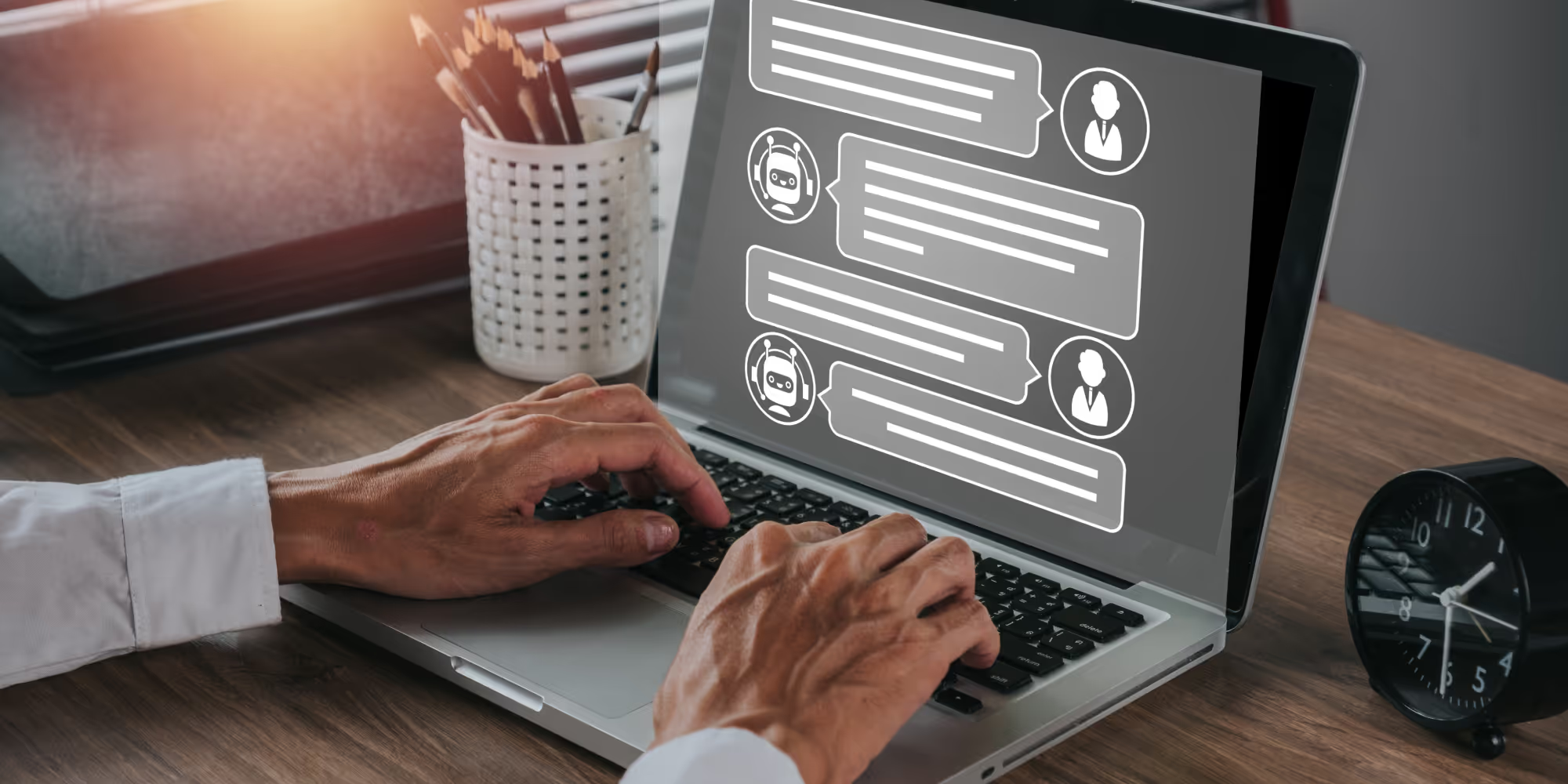
You’ve attracted the right candidate. They clicked on your job ad. Maybe even started your application form. And then… poof. They’re gone.
Sounds familiar?
Application drop-off is one of the most under-discussed challenges in recruiting today. But it’s costing teams top-tier talent - especially those elusive, highly skilled candidates who have options.
And the culprit? It’s often the form.
The “Form Fatigue” problem
Most traditional applications still rely on long, repetitive forms. Pages of checkboxes, essay-style questions, re-typing what’s already on a resume.
The average job application takes 22 minutes to complete, and only 10.6% of candidates finish it on employer career sites.
That’s nearly 9 out of 10 potential hires walking away.
If you’re a high-performing candidate, you’re likely juggling multiple offers. Are you going to fight a clunky interface for 20+ minutes? Or move on to a company that respects your time and engages you differently?
What the best candidates expect
Today’s top talent expects seamless, smart, and conversational hiring experiences.
Think about the rest of their digital life - they’re chatting with Siri, ordering via Alexa, ideating with ChatGPT, texting instead of calling, and expecting 24/7 interaction.
Forms feel static, cold, and somewhat outdated.
So, a recruitment AI agent with conversational interface that feels more like a chat with a helpful guide than a questionnaire will do better.
And this isn’t science fiction. TechCrunch reports that companies using AI agents for the hiring process have seen application completion rates rise by up to 3x.
It’s no surprise that companies looking to improve their recruiting process with AI video interviewing are seeing real traction - not just more applications, but better ones.
Why candidates actually prefer AI conversations
The benefits of agentic AI interviews aren’t just for hiring teams. Candidates, too, get a more natural and engaging experience that respects their time.
Conversational AI agents for hiring teams offer,
- Frictionless interaction - No login. No PDFs. Just a human-like conversation.
- Personalized experience - Questions adjust based on previous answers, location, role, or seniority.
- Anytime access - AI-driven interview agents work 24/7 - perfect for candidates applying after hours or across time zones.
- Low-pressure space - Many candidates feel more comfortable answering questions when there’s no human judging them in real time. It’s still them showing up authentically - just with less stress.
But is it just for screening?
Nope. Agentic AI interviews are revolutionizing hiring and talent assessment by going beyond basic Q&A - they’re adaptive, insightful, and increasingly integral to decision-making.
Platforms built around conversational intelligence for hiring don’t just collect data. They interpret it, flag insights, and help recruiters move faster without losing depth.
A recruitment tool with conversational intelligence doesn’t just improve the candidate journey - it augments your hiring team.
Why it’s not just for high volume
You might think: “Sounds great for entry-level roles or bulk hiring, but what about specialist or leadership roles?”
Surprisingly, these candidates are the most likely to abandon traditional forms - and the most engaged by intelligent hiring assistants.
They value time. They want relevance. They appreciate innovation.
And an AI copilot for recruiters ensures those nuanced, senior-level interviews don’t start with a dull form - they start with a smart conversation that makes people feel heard.
We’re not just seeing efficiency gains. We’re witnessing the rise of agentic AI in hiring - a shift that’s redefining the capabilities and evolution of talent assessment itself
AI recruiting agents are not just a tech upgrade. They are a talent magnet.
With AI recruitment platforms and talent acquisition powered by interview agents, companies are reimagining the application process - and reclaiming great candidates who would’ve otherwise bounced.
Want to do the same? See how SpectraHire can help your organization’s recruitment team.
You might also like

Predicting customer needs is no longer just a nice-to-have capability—it’s becoming essential for businesses to stay competitive. AI agents are now capable of analyzing vast amounts of data, learning from customer behaviors, and forecasting future needs with remarkable accuracy. By anticipating what customers want before they express it, companies gain a critical edge in delivering timely, personalized experiences.
Understanding the Predictive Power of AI Agents
AI agents draw on a variety of data sources like transaction histories, web browsing activity, customer support interactions, and even social media chatter to establish detailed behavioral profiles. Unlike static analysis, these agents learn continuously, adapting to new patterns and context changes. For instance, a sudden drop in engagement or a negative sentiment in customer messages can serve as early warning signs that something needs attention.
Natural language processing (NLP) enables AI agents to interpret the tone and sentiment of conversations, discerning frustration, excitement, or willingness to buy. When combined with predictive analytics, this allows businesses to tailor offerings that not only meet current needs but anticipate future desires.
Practical Applications Driving Business Value
In retail, AI agents forecast demand shifts and optimize inventory, preventing stockouts and overstock while tailoring promotions to individual preferences. Telecommunications companies use predictive AI to identify customers likely to churn and engage them preemptively with personalized retention offers. Financial institutions leverage AI-driven behavior analysis to recommend relevant products or detect fraud early. Even healthcare providers predict patient requirements to schedule timely care and reduce complications.
These real-world applications demonstrate how prediction enhances operational efficiency, drives revenue growth, and strengthens customer satisfaction.
The Role of Spectra in Predictive Customer Needs
InterspectAI’s Spectra platform exemplifies how sophisticated AI agents deliver predictive insights from conversational data. Designed to listen, understand, and reason like humans, Spectra captures rich nuances from customer interactions through natural conversations. It converts this complex data into instant, structured insights that inform predictive models and actionable strategies.
What sets Spectra apart is its commitment to unbiased, secure, and scalable intelligence. Through non-profiling algorithms, it reduces bias, ensuring fair evaluations, while adhering to strict compliance standards such as GDPR and HIPAA. Its plug-and-play architecture allows seamless integration with existing systems, enabling businesses across sectors to harness predictive AI quickly and effectively.
Key Benefits of Predictive AI Agents Using Spectra
- Conversational experience with human-like, personalized interactions during automated video interviews.
- Instant insights with automated interview scores and actionable analytics.
- Bias-mitigated predictions that promote fairness and compliance.
- Seamless integration into existing workflows allowing fast deployment and scaling.
Balancing Automation and Human Expertise
While AI agents handle massive data analysis and early-stage prediction, human judgment remains crucial. The best outcomes occur when AI predictions guide human decisions rather than replace them. Empathy, ethical considerations, and strategic thinking ensure that predicted insights lead to positive experiences rather than automated mistakes.
Looking Ahead: The Future of AI in Customer Prediction
Predictive AI agents are evolving toward greater emotional intelligence and integration with multimodal data—including voice, text, and video. This fusion will enable even more contextual and timely predictions, empowering businesses to anticipate and exceed customer expectations more effectively than ever before.
Take the Next Step with Spectra
Unlock the full potential of your interview data and anticipate needs before they arise with InterspectAI’s Spectra platform. Experience how advanced conversational AI agents, capable of data extraction and instant insights, can transform interview workflows into predictive insights that drive smarter hiring decisions, reduce bias, and enhance overall efficiency.
Request a demo today and discover how Spectra can empower your business to deliver truly proactive, personalized customer experiences that set you apart.
FAQs
1. How do AI agents predict what customers need?
By continuously analyzing diverse data sources and identifying behavioral and emotional patterns that indicate intent or dissatisfaction.
2. How does prediction improve customer relationships?
Proactive, personalized outreach based on AI insights fosters trust, satisfaction, and loyalty.
3. What challenges come with predictive AI agents?
Maintaining data privacy, mitigating algorithmic bias, ensuring data quality, and integrating human oversight are vital.

When a candidate logs in for an AI-led interview, they hope for a fair chance - but is the promise of fairness real, or just a hopeful pitch?
As AI becomes more common in hiring, many wonder: are AI interviews truly fair when evaluating human talent, especially in large hiring funnels with thousands of applicants? Let’s break it down.
What makes people hope AI could be fairer
Standardization reduces some human biases
Traditional interviews can suffer from interviewer bias, unconscious prejudice, mood differences, or simply, variability between different interviewers.
AI-powered candidate interviews bring consistency: each candidate experiences a consistent interview flow designed for that role, evaluated under the same rubric. This standardization can - if done carefully - reduce subjective human bias and improve fairness for large-volume hiring.
Moreover, when AI is used as an initial screening tool (not the final decision maker), it can help sift through many applicants objectively, giving more people a fair shot to show their qualifications.
Potential for transparency and auditability
Unlike informal human interviews, AI systems, when built with transparency and accountability in mind, can log how each answer was scored, what criteria were used, and ensure the same standards are applied across candidates. That traceability can help organizations check for fairness and correct course if needed.
In theory, this can make candidate interviews more data-driven, structured, and less reliant on “who you know” or “who the interviewer likes.”
But AI interviews are not automatically fair
Biases in AI are real - especially across cultures, language and background
A 2025 study analyzed how LLM-based hiring evaluation handled interview transcripts from UK and Indian candidates. Even when anonymized, transcripts from Indian candidates received significantly lower scores than UK ones - highlighting that linguistic features (like sentence structure or lexical diversity) and cultural communication styles can disadvantage certain groups.
That suggests that AI doesn’t magically eliminate bias - instead, it may embed systemic biases present in the data or design.
Also, studies show that AI-driven recruitment tools often favor conventional education paths, resume patterns, and “typical” career trajectories - which disadvantages non-traditional candidates, or those from underrepresented backgrounds.
Why does this happen?
Well, bias often creeps in via training data: if historical hiring or evaluation data reflects stereotypes, societal inequities or particular cultural/communication norms - the AI will likely replicate them.
Further, lack of transparency or explainability (i.e. “black box” scoring) can make it hard for candidates or regulators to understand why someone was rejected. That reduces accountability and trust.
So... fairness isn’t automatic - it depends heavily on how the AI system is designed, trained, used, and overseen.
So, are AI candidate interviews fair?
It depends.
AI candidate interviews can be fair - when implemented thoughtfully. They’re not automatically fair and treating them as infallible “bias-proof machines” is risky. But with good design, oversight, and a hybrid (AI + human) approach, they can improve fairness in many hiring contexts.
What makes an AI interview fair/ Best practices
If you or your company plan to deploy AI in hiring, consider these to maximize fairness:
- Use diverse, representative training data (across languages, cultures, backgrounds).
- Ensure transparency by keeping scoring logic, rubrics, evaluation criteria clear and explainable.
- Use AI for initial screening or assessment, but always include human review for final decisions (culture-fit, soft-skills nuance, empathy).
- Communicate with candidates: be transparent that AI is used, explain how decisions are made. Studies show that when applicants are sensitized to the benefits of consistency and bias mitigation, they view AI interviews more favorably.
- Regularly audit outcomes for bias or disparate impact - and revise models/data as needed.
FAQs
What is meant by “AI interviews” or “automated candidate interviews”?
These refer to interview systems where AI (via NLP, ML, video/audio analysis) conducts part - or all - of the interview process: asking questions, recording responses, scoring answers based on predefined rubrics or models.
Can AI be more fair than human-led interviews?
Yes - AI has the potential to reduce inconsistency, personal bias, and human variability by enforcing standardized processes. But fairness depends heavily on design, data, transparency, and oversight.
Do candidates feel AI interviews are fair?
It varies. Some appreciate the consistency and objectivity; others feel AI lacks empathy, human intuition, and the ability to appreciate individual uniqueness.
What kinds of bias can AI interviews introduce?
Bias can arise from training data (cultural, linguistic, educational background), from design (rubric definitions, scoring logic), or from over-reliance on rigid metrics (ignoring soft-skills nuance, interpersonal chemistry, background context).
Is there a ‘safe’ way to use AI in candidate interviews?
Yes - by using AI as an aid or first filter, not the final decider. Combine AI screening with human review, transparency, regular audits, and sensitivity to cultural and individual differences.
Should companies replace human interviews entirely with AI?
No. While AI helps in scale, consistency, and efficiency - human judgment is still essential for team fit, empathy, cultural alignment, and nuanced soft-skills evaluation.
Interested to see what AI-powered interviews would look like in your hiring process? Check out SpectraHire!
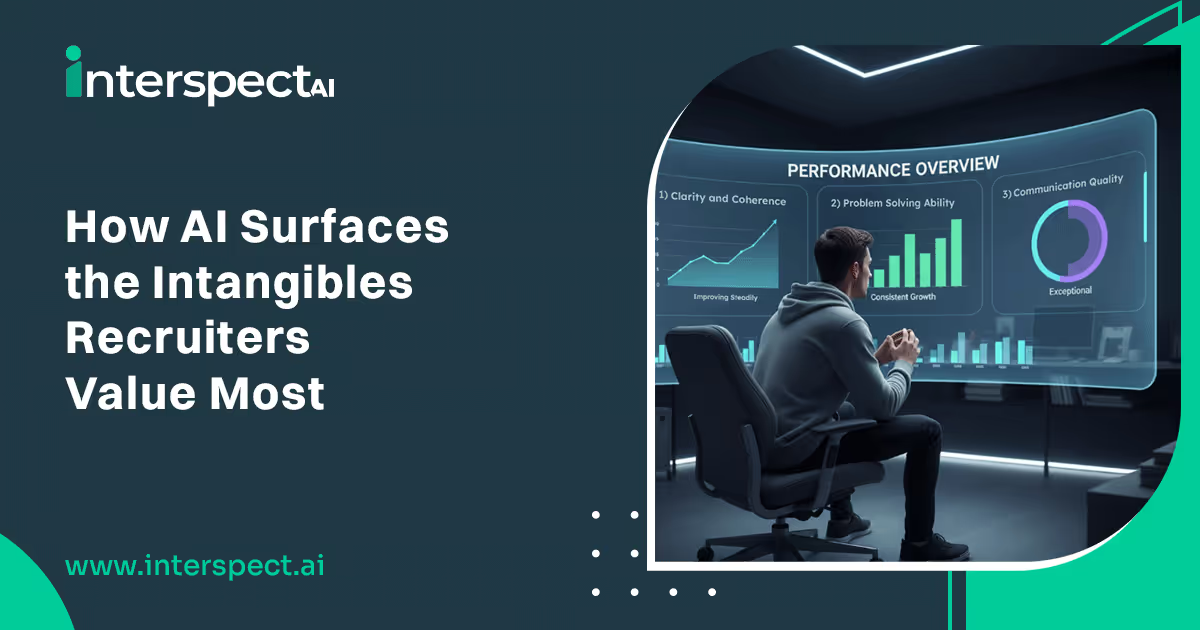
In today's algorithmic job market, technical competence is just the entry fee. Landing the job depends entirely on the intangibles: the unspoken qualities like genuine student confidence, clarity under pressure, and adaptability. These employability insights—the "human" factors are critical, yet they are the hardest traits to teach, measure, and refine using traditional methods.
When two candidates have equally strong résumés, the one who communicates their value with poise and conviction wins. This is why AI soft skills assessment is fundamentally reshaping career preparation. It replaces subjective human observation with objective data, giving students a measurable path toward mastering traits previously considered too elusive to quantify.
I. The Intangibles Gap: Why Soft Skills Elude Metrics
Soft skills like Communication, Adaptability, and Professionalism (core National Association of Colleges and Employers (NACE) ) remain difficult to assess for three main reasons:
- They are Behavioral: Unlike technical knowledge, soft skills are behavioral capacities, measured by observing how a candidate acts and speaks.
- Lack of Standardization: Traditional methods rely heavily on individual interviewer impressions, leading to low consistency and standardization.
- Human Bias: Assessment can be clouded by unconscious bias, potentially misjudging a candidate's competence based on non-relevant factors.
To achieve genuine mastery, students need objective interview performance data that isolates and quantifies these behavioral traits.
II. AI Soft Skills Assessment: The Multimodal Lens
AI achieves this granular analysis through multimodal technology, integrating specialized algorithms to analyze multiple data streams simultaneously (NLP - Natural Language Processing, Machine Learning, and Computer Vision).
SpectraSeek, a pioneer in digital career coaching, is built on proprietary agentic AI. Designed as an LLM-powered decision engine, it delivers verifiable, high-precision assessments. The platform’s ability to reason, analyze, and generate structured feedback enables it to surface critical performance traits directly from a candidate’s responses.
This depth of communication skills analytics provides objective feedback that human staff often cannot standardize across high volumes.
III. Measurable Growth Data and Predictive Validity
For students, the greatest value of AI soft skills assessment is the instant, measurable feedback loop. It transforms vague advice ("be more persuasive") into specific, actionable steps ("reduce your filler word rate").
Students using these AI simulation tools note a demonstrable increase in student confidence and improved articulation of complex concepts. The data shows that focusing on these quantified behaviors delivers tangible career advantages, proving the predictive validity of the metrics:
- Higher Offer Rates: Applicants who engage with AI assessment systems often experience better interview outcomes, as structured AI feedback helps them present clearer, more relevant responses.
- Long-Term Fit: These candidates also tend to show stronger early-stage job stability, suggesting that AI-guided preparation supports more accurate role alignment.
These employability insights establish AI assessment as the new standard for validating career readiness.
IV. Strategic Use for Career Services
For university career services, an AI soft skills assessment is invaluable for moving beyond basic support to a data-driven strategy.
- Curriculum Refinement: Aggregate performance data identifies cohort-wide soft-skill deficiencies (e.g., poor clarity or low confidence scores). This allows institutions to modify curriculum based directly on objective gaps, ensuring training prioritizes skills AI validates as critical for job success.
- Targeted Coaching: By automating the initial assessment, AI frees up human advisors to focus on high-touch coaching: addressing emotional anxiety, complex ethical discussions, and nuanced negotiation strategy.
- Equity and Access: The AI soft skills assessment provides a high-quality baseline of support 24/7. This democratizes access to sophisticated practice, neutralizing the resource scarcity that often causes systemic disparities in career outcomes.
The Future of Readiness is Data-Driven
The traits recruiters value most—confidence, clarity, and adaptability—are no longer intangible guesswork. AI soft skills assessment has provided the measurable framework necessary to quantify and master these core behaviors. By leveraging platforms like SpectraSeek, students gain personalized, objective interview performance data to refine their soft skills, while institutions gain the metrics needed to prove the real-world value of their career programs.
Ready to Quantify Your Soft Skills?
The real proof of career readiness lies in objective performance metrics. SpectraSeek is the platform that delivers this necessary data, quantifying the behavioral skills recruiters prioritize. Ready to move beyond guesswork and start measuring true success?
Whether you're a job seeker aiming for mastery or a university striving to prove graduate success, discover how our agentic AI can transform your metrics.
Frequently Asked Questions
What is the primary focus of AI soft skills assessment?
AI soft skills assessment in SpectraSeek focuses on verbal, behavioral, and response-based traits—such as clarity of explanation, communication quality, logical structure, and relevance of examples. These indicators help determine a candidate’s professionalism, preparedness, and role alignment, offering depth that traditional assessments often miss.
How does SpectraSeek measure confidence and clarity?
SpectraSeek uses advanced linguistic analysis powered by agentic AI to evaluate the clarity, coherence, and structure of a candidate’s responses. By examining factors like answer organization, relevance, filler-word usage, and communication quality, it provides students with objective insights into their verbal performance and overall interview readiness.
Does an AI soft skills assessment help with job placement?
Yes. Candidates assessed using AI are much more likely to receive a job offer and show higher retention rates, confirming that the objective soft-skill data measured by the AI is highly predictive of long-term job success.
How do universities use this performance data?
University career services use aggregated interview performance data to identify cohort-wide skill gaps. This allows them to refine curriculum, moving from generic instruction to targeted training that addresses the specific soft skills lacking in their student body.
Subscribe to The InterspectAI Blog