%201.svg)

Interview Anxiety is Real. Here's How AI Can Help


Interview anxiety isn't just "all in your head." It’s neuroscience.
You probably know the feeling: sweaty palms, a racing heart, and a blank mind as soon as the camera turns on. Telling yourself to calm down doesn’t help because your body reacts on its own. This isn’t about being unprepared; it’s simply how your body works.
For decades, the only solution was to "fake it till you make it." Today, we have a science-backed way to fix it. Here is the psychology behind why we freeze up, and how interview anxiety help has evolved from breathing exercises to exposure therapy with AI.
Understanding the Neuroscience of Freezing Up
In stressful situations like job interviews, your brain’s amygdala, which detects threats, often sees being judged by strangers as a risk to your social standing.
This sets off your fight-or-flight response. Your body releases cortisol and adrenaline, and blood moves away from the part of your brain that handles logic and language, sending it to your muscles instead.
That’s why it’s so hard to beat interview anxiety. In those moments, your thinking brain takes a back seat to your survival instincts. It doesn’t mean you’re bad at interviews; it just means your stress hormones are in control.
Why Telling Yourself to "Just Relax" Doesn’t Work
Friends might say, "just relax" or "be yourself." But this advice doesn’t work because it tries to fix a physical reaction with a mental solution.
You can’t simply think your way out of an adrenaline rush. If your brain links interviews, the camera, the questions, and the silence with danger, positive thinking won’t stop your body’s reaction. To lower stress, you need to change how your brain sees the situation.
How Systematic Desensitization Works
For decades, psychologists have used a method called Systematic Desensitization to treat phobias. The idea is simple: face your fear in small, safe steps until your brain no longer sees it as a threat.
If public speaking scares you, you wouldn’t start with a TED Talk. You’d begin by talking to a mirror, then to a friend, and eventually to a small group.
If you’re an introvert or feel anxious, the goal is to face interview stressors, like being timed, recorded, or asked tough questions without the risk of losing a job opportunity.
Changing Your Brain with Safe Practice
This is where repetition becomes a superpower. Every time you face an interview question and get through it without negative consequences, your brain lays down a new neural pathway. It begins to reclassify the interview environment from "Threat" to "Safe Challenge."
But practicing with another person has its limits. People get tired and can be judgmental. Sometimes, practicing with a friend can even make you more anxious because you care about what they think.
How AI Provides a Safe Practice Space
That’s why preparing for interviews with AI is a game-changer for building mental resilience. Platforms like SpectraSeek offer a patient, non-judgmental space to practice.
- No Social Cost: If you stumble, freeze, or give a bad answer to an AI, there’s no embarrassment. The pressure is gone.
- Infinite Patience: You can repeat the same interview as many times as you want. The AI never gets bored or frustrated.
- Controlled Exposure: You set the difficulty. Begin with simple behavioral questions and move to harder technical ones as you gain confidence.
When you practice with a machine, you avoid the fear of being judged by others. This lets your brain work as it should, in a stress-free setting. You get more practice and help your brain get used to interviews.
The Practical Protocol: A 3-Phase Approach
To change your anxiety response, use a step-by-step desensitization plan. AI platforms can mimic the unpredictability of real interviews, so you can’t always pick only easy questions. Instead, set different goals for each practice phase.
- Phase 1: Low-Stakes Exposure (Familiarization) The goal is to get used to the environment - the timer, the recording, and the camera. Don’t worry about how good your answers are. Just keep talking until the timer ends. Focus on getting comfortable with being recorded, not on giving perfect answers.
- Phase 2: Structured Challenge (Validation) When you’re comfortable with the setup, start focusing on your answers. Use frameworks like the STAR method. After each session, check your Response Insights and Authenticity Score. Watching your scores improve gives your brain proof that you’re getting better, which helps reduce anxiety.
- Phase 3: Simulation Mode (Stress Inoculation) Act as if this is a real interview. Dress professionally and clear your workspace. Most importantly, don’t restart the recording. If you make a mistake or freeze, keep going and finish your answer. This helps your brain learn to recover from mistakes instead of panicking, which is key to overcoming anxiety.
TL;DR
Anxiety is a natural reaction, but confidence comes with practice. If you treat interview prep like exposure therapy, you can train your brain to handle pressure better.
You don’t need to be an extrovert to do well in interviews. You just need enough practice in a safe setting to show your brain there’s no real threat.
Start your desensitization training today. Visit InterspectAI and turn your anxiety into an advantage.
FAQs
Will practicing with AI help me with face-to-face interviews?
Yes. While the format is different, the core skill of retrieving structured answers under pressure is the same. The confidence you build by mastering your stories in the AI simulator transfers directly to in-person conversations.
What if I freeze up even with the AI?
That is okay. In fact, that is the point. Freeze up, take a breath, and resume answering. Every time you recover from a freeze in the simulator, you are training your brain how to recover in real life.
Does SpectraSeek measure anxiety?
SpectraSeek measures indicators often associated with anxiety, such as Communication Confidence (pacing, filler words). By watching these metrics improve over time, you gain objective proof of your progress, which further reduces stress.
You might also like

Every spring, career services offices celebrate their strongest cohorts. Students with stellar GPAs, polished resumes, and impressive internships head into recruiting season with confidence. And every spring, a troubling pattern repeats: some of the most talented graduates stumble at the interview stage, not because they lack knowledge, but because they never learned to perform under the conditions modern employers now use.
The problem is not aptitude. It is preparation misalignment.
In recent years, hiring processes at mid- to large employers have shifted dramatically. According to surveys conducted in 2025, more than 60 percent of companies with more than 500 employees now use some form of AI-assisted interviewing in their first-round screening. These systems evaluate candidates on dimensions that traditional mock interviews rarely address: speech pacing, response structure, filler word frequency, facial engagement, and the coherence of answers under adaptive follow-up questioning.
Students trained through conventional career center workshops—where a counselor conducts a 20-minute behavioral interview once or twice a semester—are practicing for a format that increasingly does not exist. The gap is not one of intelligence. It is one of exposure.
Consider what a typical AI video interview measures. The candidate sits in front of a camera and responds to questions delivered by an automated system. There is no conversational warmth, no encouraging nod from a human interviewer. The system logs speaking pace in words per minute, counts filler words, tracks eye contact as a percentage of total response time, and evaluates answer relevance against a rubric. Students who have never encountered this format often underperform, not because their answers are weak, but because their delivery patterns trigger low scores on metrics they did not know existed.
This creates a paradox for universities. Their strongest students may be the ones most affected, because high-achievers often rely on interpersonal rapport to shine in interviews. When that rapport is removed—replaced by an algorithm—their advantage disappears.
The solution is not to abandon human career advising. It is to augment it.
Universities that have introduced AI-powered interview practice platforms report significant improvements. When students can rehearse against an adaptive AI interviewer that mirrors the systems employers actually use, they learn to calibrate their delivery to algorithmic evaluation. They discover their unconscious habits—the verbal tics, the tendency to ramble, the nervous glance away from the camera—and they correct them before those habits cost them an offer.
The data supports this approach. Institutions that integrated AI practice tools into their career readiness programs in 2024 and 2025 saw measurable gains. Placement rates at pilot universities rose between 20 and 35 percent within a single academic year. Student satisfaction with career services increased because counselors, freed from repetitive mock-interview sessions, could devote more time to high-value activities such as salary negotiation coaching, industry-specific strategy, and networking guidance.
For career services directors weighing this shift, the calculus is straightforward. The cost of an AI interview platform is a fraction of a single counselor’s salary. The return—measured in placement outcomes, student satisfaction, alumni engagement, and institutional reputation—compounds over time.
The question is no longer whether AI interview preparation belongs in higher education. It is whether your institution will adopt it proactively or reactively—and how many graduating classes will pass through underprepared before the change is made.
Career services teams that act now position their universities as leaders in student outcomes. Those that wait will find themselves explaining why their placement rates lag behind peer institutions that moved faster.
The best candidates deserve preparation that matches the reality they face. AI-driven hiring is that reality. It is time career services caught up.
The modern shift to remote and hybrid work demands a new approach to talent acquisition. Traditional methods struggle with time zones, scheduling conflicts, and maintaining consistent evaluation standards across decentralized teams. AI-Powered Recruitment Interviews are the answer, providing the standardization, scalability, and objective data collection needed to hire high-quality talent anywhere in the world.
5 Ways AI Interviews Drive Remote Hiring Success
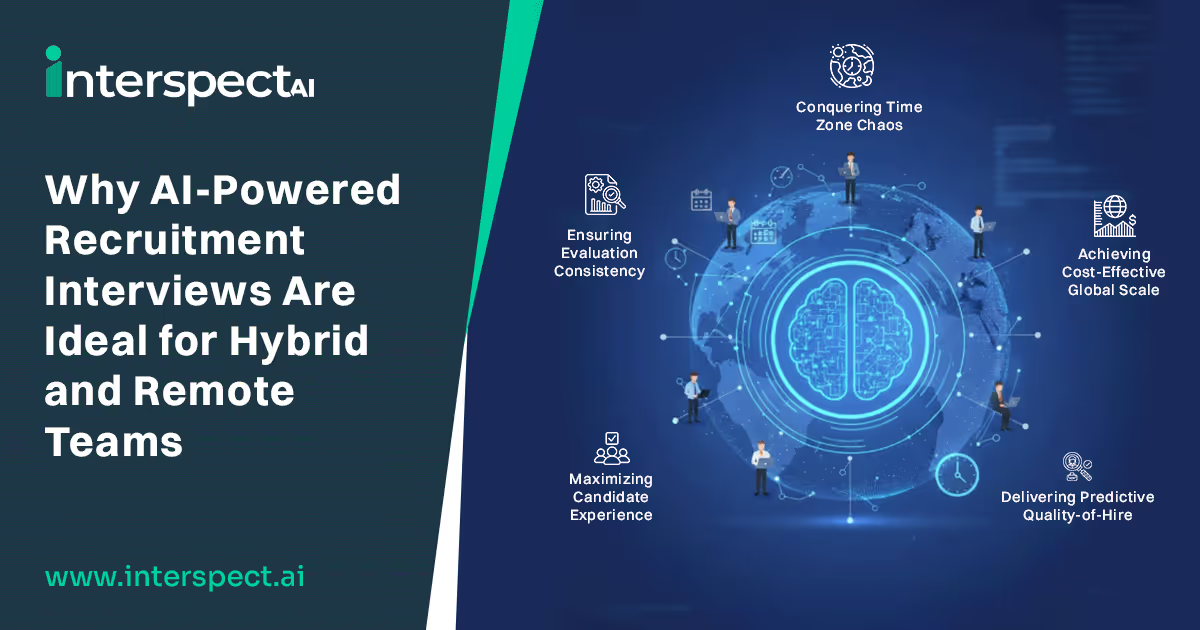
1. Conquering Time Zone Chaos (Boosting Time-to-Hire)
In traditional remote hiring, scheduling involves complex, manual coordination across continents, a bottleneck that significantly increases the Time-to-Hire (TTH). Automated candidate interviews solve this by offering true 24/7 access. This means a candidate in Tokyo can complete their screening at 2 AM their time, and the recruiter in London can review the objectively scored data during their standard workday. This asynchronous efficiency eliminates the delay caused by logistical friction, allowing hiring managers to move qualified candidates forward instantly and to secure global talent faster.
2. Ensuring Evaluation Consistency (Fostering Fairness)
Decentralized teams often struggle to maintain interview standards, where variations in interviewers' questions or biases can lead to unfair or inconsistent hiring decisions, harming the Bias Reduction Index. AI Candidate Evaluation Tools guarantee uniformity. Every candidate, regardless of their location or the time they interview, is subjected to the same standardized questions and scored against the same rubric. This removes the variable of human inconsistency, ensuring a consistently fair process that focuses purely on objective, job-relevant competencies like Role Alignment.
3. Maximizing Candidate Experience (Boosting CSAT)
For candidates, a drawn-out, fragmented remote hiring process is frustrating and can severely lower the Candidate Satisfaction Score (CSAT). AI-Powered Recruitment Interviews provide a seamless, reliable, and fast experience. The ability to complete the first screening immediately is a major convenience benefit. Furthermore, many AI systems provide candidates with personalized, actionable feedback (like a Skills Breakdown), which turns the interview into a valuable growth opportunity, fostering a positive view of the company even for those who are not hired.
4. Delivering Predictive Quality-of-Hire (QoH)
Traditional remote interviews can struggle to assess soft skills and behavioral fit accurately. AI transcends this by providing deep, objective behavioral analysis. By assessing communication patterns and consistency, AI makes data-driven predictions about a candidate's future performance and cultural fit, directly increasing your Quality-of-Hire (QoH). Metrics like the Overall Candidate Fit and Authenticity Score quantify fit with far greater precision than subjective human judgment, ensuring the remote hire is set up for long-term success in a distributed team environment.
5. Achieving Cost-Effective Global Scale (Lowering CPH)
Scaling a global remote recruiting effort using human recruiters is expensive due to increased labor hours for coordination and screening. By automating the most time-intensive tasks like screening, scheduling, and basic evaluation, AI-Powered Recruitment Interviews reduce the number of recruiter hours required per hire. This automation functions as a scalable infrastructure, enabling companies to expand their talent search globally without proportionally increasing their internal recruitment team size, resulting in a dramatic reduction in Cost-per-Hire (CPH).
SpectraHire: Quantifying Fit for Follow-Ups
To master candidate follow-up, recruiters need specific, granular data to make communication meaningful. SpectraHire is an agentic AI platform that provides this exact level of quantification, helping recruiters move beyond subjective impressions to objective, measurable metrics:
- Overall Candidate Fit: Provides a holistic score, evaluating an applicant's strengths, gaps, and next suggested steps. This ensures follow-up is relevant, whether the candidate is being advanced or pipelined.
- Role Alignment Score: Precisely checks how a candidate’s experience directly matches the Job Description requirements (critical for automated decision-making).
- Authenticity Score: Evaluates the genuineness in responses through the use of personal examples, ensuring honest candidate insight.
- Communication Skills/Confidence: Assesses clarity of explanations, including pacing, which are core indicators of effectiveness.
- Technical Proficiency: Assesses competency in technical interview rounds.
By leveraging these quantified insights, recruiters are armed with a much higher signal-to-noise ratio, ensuring automated follow-up is personalized and accurate, and that only the most qualified candidates move forward.
Conclusion
The "black hole" of recruitment is a choice, not a necessity. By deploying AI Agents to manage the entire spectrum of candidate follow-up—from instant acknowledgment to personalized feedback and future nurturing—companies demonstrate respect for every applicant. Recruiters leverage data provided by platforms like SpectraHire to quantify complex metrics such as Overall Candidate Fit and Authenticity Score. This investment proves that modern AI Candidate Evaluation Tools are not just an efficiency play; they are a strategic move to secure the highest quality talent faster, fairer, and cheaper than ever before, ensuring that even rejected applicants become advocates for the company.
Start hiring smarter. Request a SpectraHire demo today.
FAQs
How does AI for recruitment interviews ensure a fairer process?
AI ensures fairness by applying a standardized scoring rubric to every candidate, eliminating human unconscious biases. It focuses purely on objective metrics like Role Alignment to provide a transparent assessment based on required competencies.
Is Quality-of-Hire (QoH) measured solely by the AI tool?
No. AI improves the predictive aspect of QoH by analyzing communication and behavioral fit, providing metrics like the Overall Candidate Fit score, which strongly correlates with post-hire success. QoH is an organizational metric measured after the hire.
What is the main difference between an AI screening interview and an automated candidate interview?
AI screening is focused on early funnel filtering (e.g., basic qualification questions). An automated interview can be a more comprehensive assessment, including scenario-based questions to measure Technical Proficiency or providing a full Skills Breakdown report.
Can small and medium-sized businesses (SMBs) afford to use these AI recruitment tools?
Yes. The efficiency gains in Time-to-Hire and Cost-per-Hire often result in a rapid ROI, making the investment worthwhile for SMBs. Scalable AI for recruitment interview solutions is available for businesses of all sizes.
When you hear “AI interviews,” your brain probably goes straight to recruitment and HR tech. Makes sense - after all, AI interview agents are making waves in recruiting. But recruitment is just the tip of the iceberg.
AI Agent-driven interviews are extending far beyond hiring into sectors such as education, research, compliance, and even mental health. Powered by platforms like Spectra - a modular AI interview agent platform for assessments, hiring, research, and insights - these use cases are proving that intelligent, conversational technology is more than just a hiring hack.
Here are 10 areas where agentic AI-driven interviews are elevating business outcomes.
1. Smart assessments in EdTech
Imagine a classroom without an educator handing out tests, but still full of feedback. That’s where agent-based video interviews step in.
In education, AI agents are being used to assess students’ problem-solving, communication, and domain expertise. It’s not just automated quizzes, it’s real-time conversation with an AI interview agent, simulating oral exams and giving instant, personalized feedback.
This is one of the best things to happen to EdTech platforms, as AI agents offer scale and structure, without sacrificing human nuance.
2. Conversational market research
Traditional surveys can’t always read between the lines, but custom AI agents for qualitative insights can.
Instead of static questions, brands are deploying AI agents to conduct one-on-one interviews with consumers. These conversational AI for interviews tools can pick up emotional cues, ask follow-up questions, and surface trends faster than a research assistant could when dealing with a large set of responders.
The use of agentic AI for human conversations provides brands with a rich, nuanced understanding of customer sentiment, which is ideal for agile product development or messaging pivots.
3. Compliance checks made conversational
No one likes audits. But interview agents powered by AI are making them less painful and a lot more consistent.
These AI agents can automate oversight as they ask standardized questions, record answers, flag anomalies, and generate reports - all while ensuring a stress-free experience for employees. It’s particularly powerful in heavily regulated industries where routine checks are critical.
4. Exit interviews that yield insights
Traditional exit interviews are hit or miss.
People often don’t speak freely to HR… but they can be more candid with an unbiased, non-judgmental virtual interview agent. With custom AI agents for enterprises, companies can collect structured, anonymized data at scale, spotting patterns in attrition before it’s too late.
Additionally, this fosters a rich feedback loop that informs more effective employee retention strategies.
5. Job interview prep at scale
Not everyone has access to a great career coach. But what if they had an AI-powered interview coach available 24/7?
That’s precisely what tools like SpectraSeek offer. Job seekers use this AI mock interview platform to practice real-life interview scenarios, get real-time feedback, and boost their confidence, all without another human in the room. The job prep AI agent also simulates varied roles and difficulty levels.
It’s ideal for first-time applicants, career switchers, or anyone prepping for their next big move.
6. Mental health check-ins without stigma
Burnout is real, but not everyone feels safe opening up at work. That’s where AI agents for human conversations are making a quiet difference.
These conversational agents are now being tested as wellness check-in tools. They can ask questions, assess stress levels through tone and word choice, and guide users toward resources—all confidentially.
For HR teams, it’s a compassionate, scalable approach to emotional well-being.
7. Performance reviews reinvented
Annual reviews often suffer from unconscious bias, inconsistency, and lack of clarity.
With an AI agent with conversational intelligence that “understands” nuance, teams can gather feedback from multiple peers, subordinates, and managers using standardized formats, all handled by autonomous AI interview agents.
The result will be more precise and fairer evaluations that accurately reflect real performance.
8. Customer service roleplay and training
How do you train a support team to handle angry customers, tricky objections, or sensitive escalations?
Enter AI interview simulators, which can roleplay high-pressure customer service situations. Staff can practice, fail, learn, and repeat, without any real-world fallout.
The system functions as a personal AI interview assistant, providing immediate feedback on language, empathy, and resolution quality.
9. Simulation-based learning for frontline teams
Whether it’s a nurse, a cashier, or an airline attendant, some jobs require more than a training manual.
AI interview agents can assist frontline workers in rehearsing scenarios with conversational AI, from greeting guests to handling emergencies. Unlike static training videos, these simulations are interactive and adaptive.
For industries with high turnover or limited training budgets, this is a practical, scalable solution.
10. Academic research interviews, faster and smarter
Qualitative research interviews are time-consuming, but AI agents are turning them into a breeze.
Researchers can deploy custom AI agents to gather qualitative insights, transcribe participant responses, organize themes, and generate reports. Whether it’s sociology, psychology, or UX research, these AI video interview agents are becoming a secret weapon in the academic toolkit.
AI interview agents are just getting started
AI interview agents are proving their worth across every industry imaginable. And these aren’t just chatbots, they’re competent, AI-driven interview agents built for meaningful, scalable conversations.
If your org still thinks of interview agents as just HR tech, it might be time for a mindset shift. Because with conversational intelligence this powerful, the use cases are limited only by imagination.
Want help exploring where Spectra can add value for you? Start by mapping the conversations you wish you had more of and let an AI copilot take it from there!
Subscribe to The InterspectAI Blog