%201.svg)

Are AI Interviews Fair? A Deep Dive into Candidate Interviews and Equity


When a candidate logs in for an AI-led interview, they hope for a fair chance - but is the promise of fairness real, or just a hopeful pitch?
As AI becomes more common in hiring, many wonder: are AI interviews truly fair when evaluating human talent, especially in large hiring funnels with thousands of applicants? Let’s break it down.
What makes people hope AI could be fairer
Standardization reduces some human biases
Traditional interviews can suffer from interviewer bias, unconscious prejudice, mood differences, or simply, variability between different interviewers.
AI-powered candidate interviews bring consistency: each candidate experiences a consistent interview flow designed for that role, evaluated under the same rubric. This standardization can - if done carefully - reduce subjective human bias and improve fairness for large-volume hiring.
Moreover, when AI is used as an initial screening tool (not the final decision maker), it can help sift through many applicants objectively, giving more people a fair shot to show their qualifications.
Potential for transparency and auditability
Unlike informal human interviews, AI systems, when built with transparency and accountability in mind, can log how each answer was scored, what criteria were used, and ensure the same standards are applied across candidates. That traceability can help organizations check for fairness and correct course if needed.
In theory, this can make candidate interviews more data-driven, structured, and less reliant on “who you know” or “who the interviewer likes.”
But AI interviews are not automatically fair
Biases in AI are real - especially across cultures, language and background
A 2025 study analyzed how LLM-based hiring evaluation handled interview transcripts from UK and Indian candidates. Even when anonymized, transcripts from Indian candidates received significantly lower scores than UK ones - highlighting that linguistic features (like sentence structure or lexical diversity) and cultural communication styles can disadvantage certain groups.
That suggests that AI doesn’t magically eliminate bias - instead, it may embed systemic biases present in the data or design.
Also, studies show that AI-driven recruitment tools often favor conventional education paths, resume patterns, and “typical” career trajectories - which disadvantages non-traditional candidates, or those from underrepresented backgrounds.
Why does this happen?
Well, bias often creeps in via training data: if historical hiring or evaluation data reflects stereotypes, societal inequities or particular cultural/communication norms - the AI will likely replicate them.
Further, lack of transparency or explainability (i.e. “black box” scoring) can make it hard for candidates or regulators to understand why someone was rejected. That reduces accountability and trust.
So... fairness isn’t automatic - it depends heavily on how the AI system is designed, trained, used, and overseen.
So, are AI candidate interviews fair?
It depends.
AI candidate interviews can be fair - when implemented thoughtfully. They’re not automatically fair and treating them as infallible “bias-proof machines” is risky. But with good design, oversight, and a hybrid (AI + human) approach, they can improve fairness in many hiring contexts.
What makes an AI interview fair/ Best practices
If you or your company plan to deploy AI in hiring, consider these to maximize fairness:
- Use diverse, representative training data (across languages, cultures, backgrounds).
- Ensure transparency by keeping scoring logic, rubrics, evaluation criteria clear and explainable.
- Use AI for initial screening or assessment, but always include human review for final decisions (culture-fit, soft-skills nuance, empathy).
- Communicate with candidates: be transparent that AI is used, explain how decisions are made. Studies show that when applicants are sensitized to the benefits of consistency and bias mitigation, they view AI interviews more favorably.
- Regularly audit outcomes for bias or disparate impact - and revise models/data as needed.
FAQs
What is meant by “AI interviews” or “automated candidate interviews”?
These refer to interview systems where AI (via NLP, ML, video/audio analysis) conducts part - or all - of the interview process: asking questions, recording responses, scoring answers based on predefined rubrics or models.
Can AI be more fair than human-led interviews?
Yes - AI has the potential to reduce inconsistency, personal bias, and human variability by enforcing standardized processes. But fairness depends heavily on design, data, transparency, and oversight.
Do candidates feel AI interviews are fair?
It varies. Some appreciate the consistency and objectivity; others feel AI lacks empathy, human intuition, and the ability to appreciate individual uniqueness.
What kinds of bias can AI interviews introduce?
Bias can arise from training data (cultural, linguistic, educational background), from design (rubric definitions, scoring logic), or from over-reliance on rigid metrics (ignoring soft-skills nuance, interpersonal chemistry, background context).
Is there a ‘safe’ way to use AI in candidate interviews?
Yes - by using AI as an aid or first filter, not the final decider. Combine AI screening with human review, transparency, regular audits, and sensitivity to cultural and individual differences.
Should companies replace human interviews entirely with AI?
No. While AI helps in scale, consistency, and efficiency - human judgment is still essential for team fit, empathy, cultural alignment, and nuanced soft-skills evaluation.
Interested to see what AI-powered interviews would look like in your hiring process? Check out SpectraHire!
You might also like

Large enterprises seem to operate on a different playing field.
They have a massive advantage in hiring, market research, and strategic planning.
They can afford to have entire teams dedicated to analyzing interview data, running large-scale candidate screening programs, and extracting every last drop of intelligence from every conversation.
Startups and small-to-medium businesses (SMBs) have to compete for the same top talent and the same customers.
Yet, they are often stuck with manual processes, limited resources, and basic hiring technology.
This creates a significant intelligence gap that has traditionally been difficult to overcome.
The Startup's Dilemma: Big Ambitions, Small Teams
If you are leading or working in a small, growing company, you are constantly juggling a dozen different priorities.
You don't have the luxury of a dedicated market research department or a large HR team with specialized analysts.
Every single interview, whether it's with a potential hire, a new customer, or an industry expert, is incredibly valuable.
These conversations are packed with the insights you need to build a better product and a stronger team.
The problem is that you lack the time and the tools to analyze this data systematically.
The insights get trapped in individual notebooks, forgotten in Slack channels after a meeting, or remain locked in the minds of the few people who were on the call.
You know there is valuable information in those conversations, but you have no efficient way to unlock it, connect it, and turn it into a strategic asset.
You are forced to rely on gut feelings and anecdotal evidence instead of hard data, while your larger competitors are making decisions based on deep, analytical insights.
Leveling the Playing Field with AI Agents
This is where AI agents for small businesses can completely change the game.
Technology provides access to the kind of powerful conversational intelligence that was once the exclusive domain of large corporations.
The same sophisticated AI agents used in enterprises are now accessible and affordable for you.
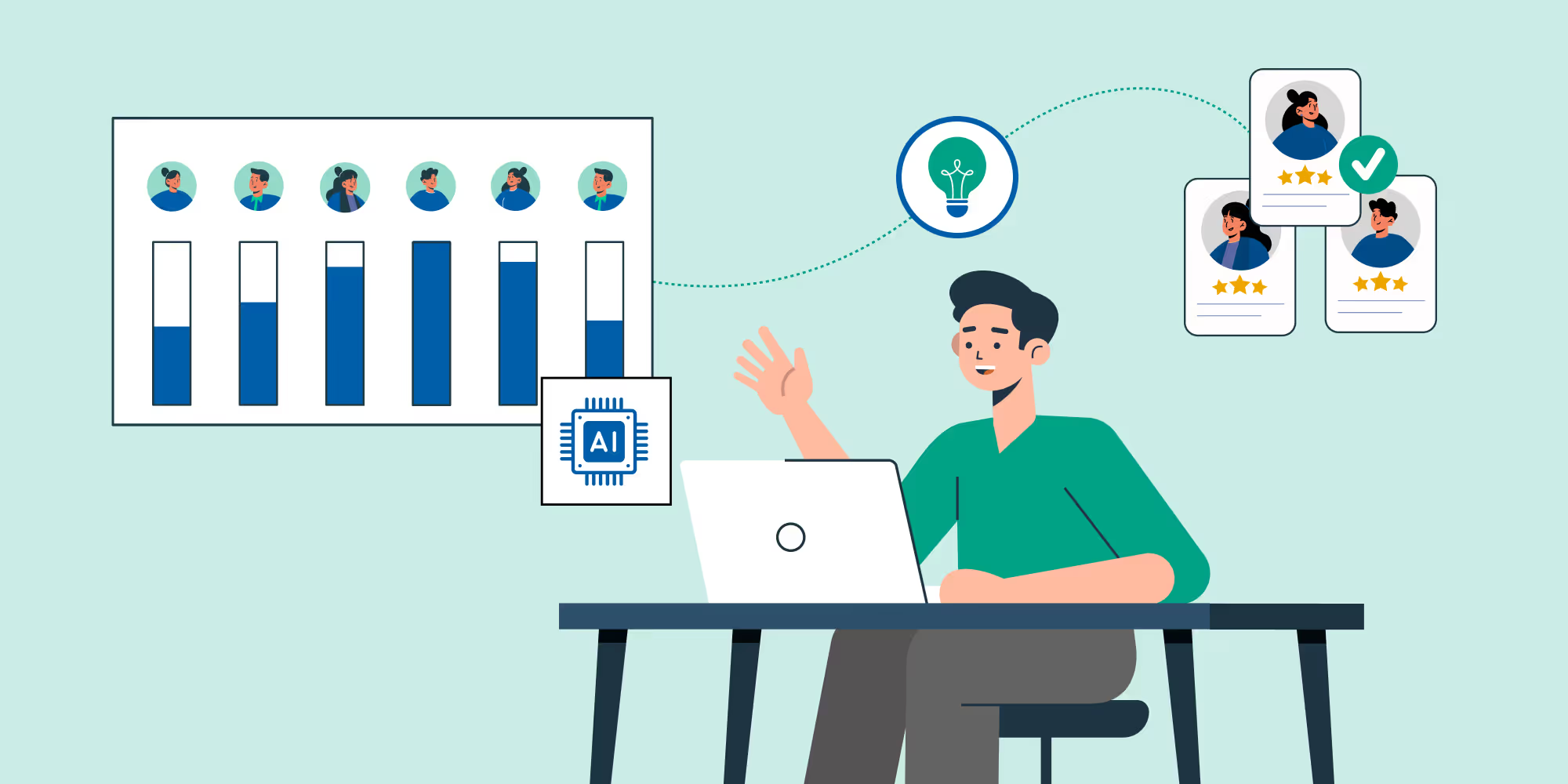
You can deploy an AI agent to conduct your initial interviews, analyze customer feedback, or screen candidates at a scale that would typically require a dedicated team of five.
The AI agent automates the most time-consuming parts of the process: the data capture and the analysis. It doesn't just record the conversation; it structures it. It identifies key topics, extracts important entities like competitor names, and analyzes sentiment.
This process delivers clean, structured insights directly to you and your team, allowing you to bypass the manual work and get straight to the strategic thinking. It gives you the power of an enterprise analytics team without the enterprise-level headcount.
A Case Study in Efficiency: Startup vs. The Old Way
Imagine two startups competing for the same senior software engineer.
Startup A uses the traditional method. Their two co-founders and lead engineer spend a collective of 15 hours over two weeks conducting initial phone screens with a dozen candidates. That's 15 hours of high-value time pulled away from product development.
Startup B uses an AI-powered platform. They send a link to the same dozen candidates for a 20-minute interview with an AI agent. The AI asks targeted technical questions and assesses problem-solving skills.
The entire screening process is complete in a few days, with zero hours spent by the founding team.
They receive a ranked, data-driven report on all twelve candidates.
They spend their valuable time only on final-round interviews with the top three contenders.
Startup B not only saves time and money but also gets to the best candidate faster, giving them a critical edge.
This is the power of modern startup hiring tech.
A Cost-Effective Model for Smart Growth
You do not need a massive, six-figure budget to start making smarter, data-driven decisions. Modern platforms are designed for scalability and affordability.
You can begin by using an AI agent for a single, critical function, such as screening candidates for your most important open role.
This allows you to see an immediate and tangible return on your investment without a huge upfront commitment.
As your company grows, you can easily expand the use of AI agents across other business functions.
You can use them for customer onboarding interviews, user research for a new feature, or even internal employee feedback sessions.
This cost-effective and modular rollout enables you to benefit from enterprise-level technology that scales with your business.
Solutions like Spectra provide this capability, ensuring interview equity and strategic parity.
It allows you to compete on a more level playing field, making decisions based on deep, data-driven insights, just like the Fortune 500 giants.
Want to scale your hiring intelligence without scaling your team?
Try Spectra and unlock AI-powered interviews built for fast-growing startups.
For decades, the human interviewer has been the gold standard of hiring. Relying on instinct, experience, and personal rapport, hiring managers have made countless decisions based on gut feelings and the nuances of face-to-face interaction. However, this human-centric approach is also prone to a wide range of unconscious biases and oversights. In the fast-paced, high-volume world of modern talent acquisition, these seemingly minor missed cues can lead to major hiring mistakes.
This is where AI-powered interview platforms like InterspectAI are not just a tool for efficiency but a crucial partner in objectivity. While a human interviewer might be distracted by a resume detail or a charming anecdote, an AI agent analyzes every element of an interaction with unwavering consistency. It can detect subtle behavioral patterns that a human brain, even the most experienced one, is trained to ignore.
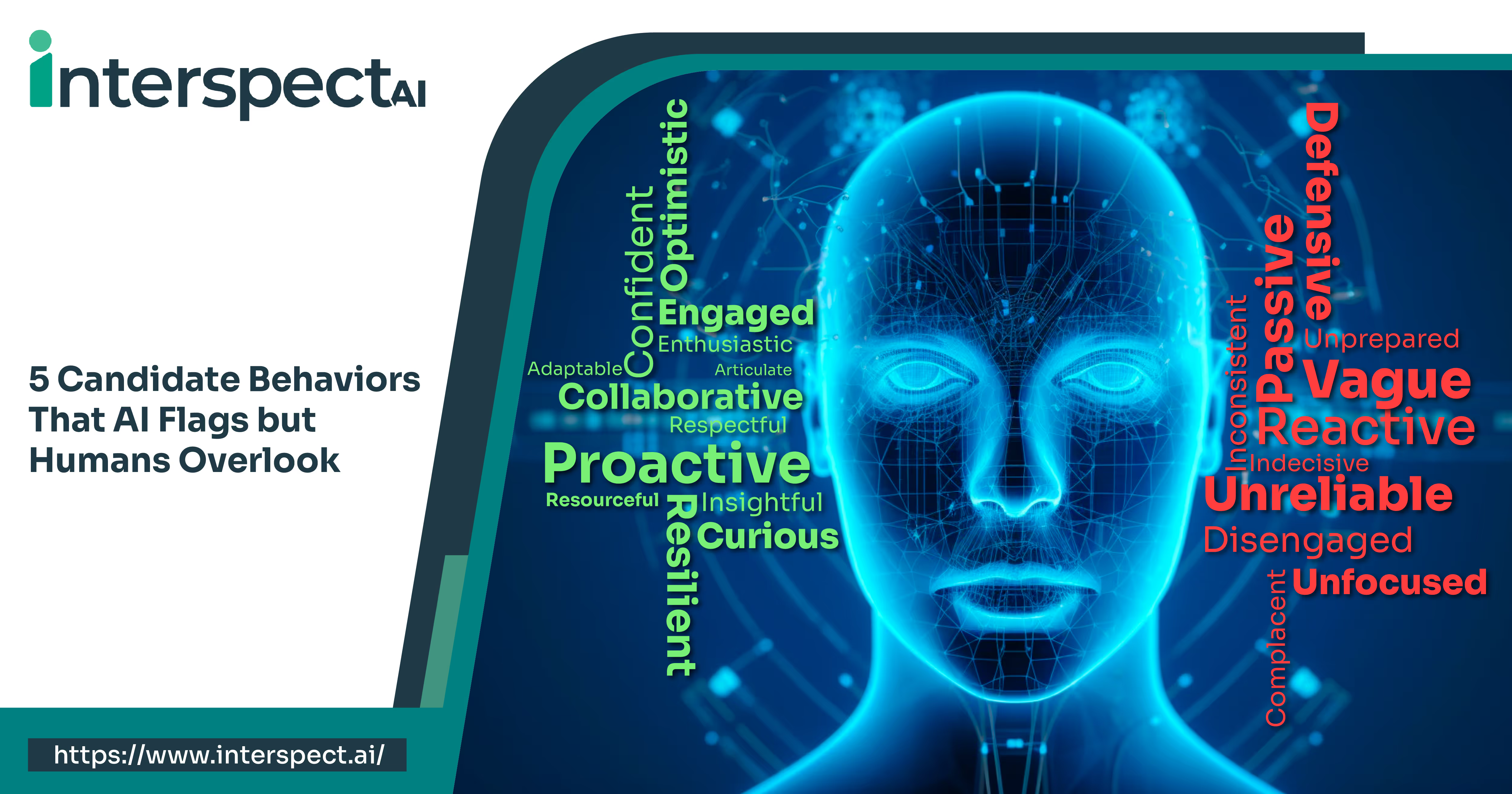
Here are five key candidate behaviors that AI flags but humans often overlook, and why they matter.
1. Inconsistent Behavioral Patterns
A human interviewer relies on a candidate's single, curated performance during a 30-minute meeting. If the candidate is prepared and articulate, they may get a glowing review. But what if their answers are subtly inconsistent across different questions or with information on their resume?
InterspectAI's agentic AI-powered interview platform, including its hiring solution SpectraHire, is designed to track and analyze these patterns. They can detect inconsistencies in a candidate's responses by cross-referencing their answers about past experiences. This level of cross-analysis ensures the candidate's stories are not just well-told, but also logically consistent with their stated skills.
2. Leveraging AI for Contextual Communication Analysis
Video interviews provide a glimpse into a candidate's non-verbal communication, but human analysis is often subjective. A nervous candidate might fidget, a quiet one might be misinterpreted as disengaged, and a soft-spoken one might be seen as lacking authority.
InterspectAI's platform analyzes voice, video, and text inputs to provide richer contextual understanding of candidate responses. Its advanced NLP models evaluate the clarity, depth, completeness, and relevance of answers, helping hiring teams gain an objective and structured view of a candidate’s communication style and problem-solving approach. This ensures assessments remain data-driven and consistent, reducing the influence of subjective interpretation.
3. Unstructured and Unclear Language
We've all been in interviews where a candidate's nervousness manifests as rambling, unclear answers. While a human interviewer might dismiss this as normal jitters, AI goes deeper. InterspectAI's platform can score for "relevance and accuracy". This allows it to evaluate not just what a candidate says, but also how they say it, flagging a potential lack of clarity in communication or a tendency to be vague when put on the spot. This insight is a strong predictor of effective communication and problem-solving skills.
4. The Absence of Curiosity
A candidate who is truly engaged with a role will have questions. They will want to know about the company culture, the team, and the challenges of the job. But in a rushed, half-hour interview, a human can easily overlook a candidate's lack of questions or their reliance on generic, pre-prepared inquiries.
InterspectAI's AI agents facilitate a conversational, two-way interview, providing "real-time responses to candidate questions." The absence of genuine curiosity is a significant flag, signaling low enthusiasm, which is an invaluable insight for identifying candidates who are genuinely invested in a role.
5. Lack of "Overall Fit" Metrics
Humans often rely on a gut feeling for "culture fit," which is a highly subjective and often biased assessment.
InterspectAI's platform provides "automated interview scores and insights instantly post-interviews across technical and behavioral metrics and overall fit." This data-driven approach allows hiring teams to move past subjective impressions and make a more objective assessment of a candidate's compatibility with the role and organization. This metric, combined with other insights, helps create a comprehensive and objective candidate profile, ensuring you're hiring for true alignment, not just personal chemistry.
Conclusion
AI is not here to replace human expertise; it's here to augment it. By providing an objective, data-driven layer of analysis, platforms like InterspectAI give hiring teams the insights they need to make truly informed decisions. AI acts as a safeguard against the biases and distractions that can cloud human judgment, ensuring you never overlook a great candidate again.
Ready to uncover the hidden potential in your candidates?
Learn more about InterspectAI and request a demo today.
FAQs
Q1: Does AI analysis of behaviors introduce new biases?
InterspectAI is built with "non-profiling algorithms" to minimize bias. By standardizing the assessment and focusing on skills and competencies, the platform removes subjective human judgment, which is far more susceptible to unconscious bias. The AI provides an objective report to guide, not replace, human decision-making.
Q2: Can a candidate "trick" the AI by rehearsing their answers?
While a candidate can rehearse, AI is designed to look beyond surface-level answers. It analyzes subtle cues like consistency, language complexity, and emotional tone. A truly honest and prepared candidate will always perform better on a behavioral assessment, as the AI can detect discrepancies that may indicate a fabricated persona.
Q3: How does InterspectAI ensure data privacy and security?InterspectAI adheres to rigorous security and compliance standards. The platform is SOC2 Type 2, GDPR, CCPA, and HIPAA compliant, with end-to-end encryption. This means data is handled with the highest level of security and in accordance with global privacy regulations, providing peace of mind for both companies and candidates.

Gut instinct, paper resumes, and back-to-back interviews... that's what hiring used to be all about.
Today? It’s increasingly about conversations; that too smart, data-rich, and AI-powered ones.
AI agents powered by conversational AI are changing how we screen, engage, and assess talent at scale, and with surprising empathy.
What is conversational AI in hiring?
Conversational AI refers to intelligent systems that can hold two-way conversations with humans - through text, voice, or video. In hiring, these systems aren’t just answering FAQs or scheduling interviews. They’re conducting interviews, screening candidates, and collecting insights in real time.
They are intelligent recruiting agents.
But instead of replacing human recruiters, they free them up to build relationships with the most promising candidates before competitors do, and make informed hiring decisions.
Why it’s gaining serious ground
The hiring process is more complex than ever. Here’s why conversational AI is stepping in.
1. It scales what humans can’t
Recruiters spend an average of 7 seconds scanning each resume.
That’s not a process - it’s a scramble.
Conversational AI can instantly engage 100s of applicants in parallel, screen for role-specific criteria, and score candidates fairly; no bias, no burnout.
2. It saves time (a lot of it)
Pre-screening calls, email coordination, no-shows—it all adds up.
One study found that companies using conversational AI in the early stages of hiring reduced time-to-hire by up to 30%.
That’s not just faster - it’s better candidate experience too.
3. It improves candidate engagement
Old hiring funnels are passive. Apply, wait, hope.
With conversational AI candidates get instant responses, can ask questions, and feel seen early in the process - without waiting on a recruiter’s calendar.
And more engagement = higher quality hires.
What conversational AI is not
Let’s clear up a misconception - It’s not a robot replacing your team.
Conversational AI doesn’t make final decisions. It doesn’t judge nuance like a seasoned recruiter can. And it definitely doesn’t eliminate the human touch.
What it does do is tee up the right conversations by giving hiring teams better signals, faster.
Real-world use cases in hiring
Conversational AI isn't just a concept anymore as it's already powering smarter hiring workflows across industries. Here's how.
AI-driven interviews
Instead of endless phone screens, AI interview agents now conduct structured, role-specific interviews at scale. Intelligent agents adapt their tone and questions, creating a more natural and insightful experience for candidates without needing a human on the other end.
Resume screening + scoring
AI doesn’t just filter resumes based on keywords, it screens applicants through conversation, then scores them based on relevant competencies. This ensures alignment with the role beyond just what’s on paper.
Interview insights + analytics
Beyond recording responses, AI interview agents generate actionable analytics: how clearly a candidate communicates, how confidently they speak, and how relevant their examples are.
AI-powered feedback
Candidates receive automated, structured feedback post-interview. It's clear, constructive, and rooted in actual performance, not vague impressions. This not only boosts candidate experience but encourages future applications.
ATS integration
Conversational AI isn’t another disconnected tool. AI interview agents like SpectraHire integrate smoothly with your ATS, ensuring candidate data, transcripts, and scores flow into your system of record, with zero manual effort.
Interview transcripts + recordings
Every conversation is transcribed and stored with a video recording, giving hiring teams a chance to review responses together, evaluate soft skills, and reduce bias in decision-making.
Customizable interview templates
Whether you're hiring for a developer, a designer, or a customer support role, AI interview agents let teams build templates tailored to competencies that matter. No starting from scratch every time.
One platform doing all of the listed use cases well is SpectraHire, which allows companies to deploy smart AI interview agents that feel surprisingly human.
These agents conduct structured conversations that assess skills, extract insights, and keep the hiring funnel moving without overwhelming recruiters.
Interested in adding conversational AI to your hiring workflow?
SpectraHire makes it easy to scale interviews, reduce time-to-hire, and gain insight without losing the human touch.
It’s not automation for automation’s sake.
It’s better hiring, powered by better conversations.
Subscribe to The InterspectAI Blog